Sunday, 18 September 2016

The WWII Evacuation to Derbyshire


Evacuation of children during the Second World War
by Gillian Mawson – August 2016

In the early hours of 1 September 1939, the British Government's plans for evacuation swung into operation and millions of children, teachers and mothers were moved to safety before war was declared on 3 September. Other waves of evacuation occurred from May 1940 onwards, when fears of the invasion of Britain became very real.  Since 2008 I have interviewed over 600 evacuated children and adults - from England, Northern Ireland, Scotland, Wales, the Channel Islands and Gibraltar – to collect their wartime experiences, documents and photographs. I feel it is important that these stories are preserved for future generations. I have organised evacuee reunions and published two books, 'Guernsey Evacuees:The Forgotten Evacuees of the Second World War' and 'Evacuees: Children's Lives on the WW2 Home Front'. My third book will be published on 1 December 2016 and contains stories and documents from evacuees all over Britain, the Channel Islands and Gibraltar.

Families throughout Derbyshire and the High Peak received large numbers of evacuees from areas such as Manchester, Southend, Lowestoft and the Channel Islands.  Boys from Guernsey's Elizabeth College lived at 'Whitehall' on Long Hill between Buxton and Whaley Bridge whilst the senior boys lived at the Florence Nightingale Home in Great Hucklow.  Alan Boast lived in a Lowestoft children's home and remembers his journey to Derbyshire in great detail:
The sight that met my eyes when we arrived at the station was something I will never forget.There were children everywhere, hundreds of them – and I was one! We were told we were being evacuated for our safety, and would be going school by school, not as Home boys. We were taken to the front of the station where ladies were waiting for us. They had lots of labels and wrote our name, school and age on each one and tied or pinned it to our clothes.
            This must not be taken off, we were told. On to the platform where our train was being reversed
            in.   If needed – go to the toilet, as it would be some time before we could go again! We were
            then  lined up, and more ladies arrived, with a trolley-full of boxes. They gave us two sticks of
            barley sugar each. We were told to wait until we were on our way before sucking them, as they
            were to combat ‘travel sickness’ – whatever that was!  Into the carriages we were shown, 
            teachers and all, and off we went! Major Humphery (the Mayor)  told us that the honour of                    Lowestoft rested on our shoulders, and we had to be well-behaved.

Alan later found himself in the Co-Operative Stores hall in Glossop:
In came these people from the village to select which boy, or boys, they would take in and look after. ‘I’ll have him, I’ll take those two’ etc. I put on my best beaming smile but nobody picked me! Soon the hall was cleared and there were only two of us left, myself and a boy called Peter Harvey. He wasn’t a Home boy but I knew him from school. In came two ladies and after a lot of talking one said ‘I’ll take them as I have room for two.’ So off we went with these two ladies into what turned out to be a different world entirely – believe me! One of the ladies introduced herself as Mrs Townsend and said we would be living with her. We followed them out, under the railway bridge and into Clowne. I, as usual was chattering to Peter about where we were going. Mrs Townsend looked round and said in a broad Derbyshire accent, 'If thou don’t shut thee rattle. I’ll belt thee tabs!' I was taken aback – I will never forget it! 'What did she just say?' I asked Peter. He shrugged his shoulders, saying 'I couldn’t understand it.' It was our first experience of the local dialect, which took some understanding. I have often wondered since, what they thought of our Suffolk twang! For those of you who don’t know it meant, 'Stop talking or you’ll get a thick ear!'

The fate of pupils at Earl Hall School in Southend was decided on Sunday, 20 May 1940 when the BBC announced that East Anglian coastal towns were to be evacuated by 2 June, for fear of German invasion. During a bewildering week, parents had to decide whether to have their children evacuated and that their destination would be Derbyshire.  Doreen Acton (nee Mason) left Southend with Westcliffe High School:
I remember waving good-bye to my mother and was surprised to see her eyes fill with tears. There did not appear to be any immediate danger either to my parents or to us.  We had no idea where we were going and as the long train journey progressed, rumours began to circulate. Finally we were told it was to be Chapel-en-le-frith in Derbyshire. After a short drive in a chauffeur-driven car, my friends and I arrived at an impressive mansion, Bowden Hall, outside Chapel-en-le-Frith. We were greeted by a friendly looking elderly gentleman who shook our hands. Freda and Beryl were directed to bedrooms in the mansion to unpack. Audrey and I were taken to the chauffeur's cottage,  we did not know then that the chauffeur and his wife had hospitably given up their bed to us. We went back to the main house and again met our host, Mr Lauder. It appeared his wife was away visiting their daughter.
            Chrissie, the Scottish maid, was a very good cook and we were served up delicious meals. I had been used to breakfast, dinner, tea and supper - we now switched over to breakfast, lunch, evening dinner and a hot drink before bed. After about a week or two, Mrs Lauder returned home. At first I got the impression that she thought we had been allowed too much liberty. We were consigned to the kitchen for meals. Very soon however she realised we were quite house trained and not a threat to peace and good order. From then on she treated us as kindly and generously as her husband.

Another young girl, evacuated from Southend's Earls Hall school, enclosed some picture postcards in her first letter home:
Dear All, I hope you are all well at home. We arrived at Chinley at 3.30 Sunday afternoon and when we got out of the train some boy scouts gave us all a half pint bottle of milk. After waiting about twenty minutes we got on a bus to Whaley Bridge. We went to a hall and had a cup of tea and a piece of cake. After about one hour they started to put the children to their new homes. First the farmer came and said we could go there but the teacher would not let us. Then the vicar came and asked us to go to the rectory but then something happened. After all we were put with Mrs Bailey. As soon as we got home she got tea and when we had finished, Winifred and Yvonne took us to the post box. These postcards are some of the lovely places here, and my bedroom window looks out on a lovely hill. Please send my shorts and my music book. We are all very well. Give my love to grannie, Love Kathleen

The aim of evacuation was to send children and adults to safety until the war was over. However, many never returned home after the war. Evacuees died whilst being evacuated or within days or weeks of arriving in a 'safe' area. Some suffered accidents whilst exploring their new communities with friends. Others died because of the inherent dangers of wartime such as air raids, unexploded bombs and minefields. In addition to this, some children endured neglect, physical and mental cruelty and sexual abuse at the hands of their foster parents. These stories make very difficult reading but need to be shared in order to provide a full picture of the British evacuation experience.
Beryl Blake-Lawson's friend suffered a fatal accident whilst returning to her billet and Beryl recalls, 'There was one tragedy, one day running down the hill from Bank Hall for lunch at her billet, Christine Markham, tripped and fell against the stone wall and was found by two senior girls. It was a great shock to them as she had broken her neck and was dead.'

Faith and Stella Shoesmith, aged 6 and 9, were evacuated from Lowestoft to Glossop and  Faith remembers the harsh treatment received in their billet:
We were the last to be picked and grudgingly collected by a Mrs Jessie Woods. Our stay was very unhappy as she treated us like slaves. Every Saturday we had to clean all of the bedrooms from top to bottom and we also had to polish the hall floor on our hands and knees. Mrs Woods inspected our work thoroughly afterwards to make sure that we had done a good job. We were not allowed into the dining room, and if we wanted to go upstairs, we had to ask permission. I would say 'Please may I go upstairs?' or 'Can I please go upstairs?' but it was always wrong and Mrs Woods would stand and laugh at us. We had to mind our manners, stand with straight backs and walk a certain way! 
            Our Dad had joined the army. Mum was in Lowestoft and every now and then she would send us parcels of sweets but we never received them. She did visit us when she could, and always brought sweets and toys with her. Our one victory was that we found a large square tin of biscuits hidden behind Mrs Woods' wardrobe. Every week when we cleaned her bedroom we helped ourselves to one biscuit.  After about two years Mum found a place in Sherwood and took us there so we could all be together.

When the war was over, many children were delighted to be returning home. However, for some it was 'evacuation' all over again as they struggled to readjust to life with their own families. Younger children in particular had come to love their wartime foster parents. Their own parents, whom they had rarely or never seen since their evacuation, were a distant memory. One boy remembers that the little girl who had lived with them for five years did not want to return home to her parents, 'She had forgotten them completely and was dragged kicking and screaming out of our house by her father. It was very upsetting for us all.’ Doreen Holden did not enjoy leaving the Matlock countryside to return to Manchester, 'I felt very claustrophobic back home, there were noisy buses and trains and the smell of smoke in the air. Of course I didn't let Mum and Dad know how I felt. Mary and Vi Draper did not want to leave Derbyshire either and Mary recalls: 'When we had to leave Mr and Mrs Bacon to return to our Dad in Lowestoft, it broke our hearts as well as theirs. They had no children of their own and had practically become our Mum and Dad – our own Mum had died. The war really did us a favour because Mr and Mrs Bacon (Auntie Bee and Uncle Bob) were marvellous to us, treating us like little princesses. Luckily many of the children remained in contact with their wartime foster families, through letters and visits, for the rest of their lives. Many have attended evacuee reunions in the areas in which they lived during the war whilst villages and towns have unveiled plaques in memory of the evacuees they welcomed so many years ago.


Gilllian's new book will be published on 1 December by Frontline Books. The chapters include: Plans for Evacuation, The Parents' Decision, Finding Homes for evacuees, Wartime Letters Home, Evacuated adults and teachers, The kindness of strangers, Out of the Frying Pan, The return home and the Aftermath of evacuation.  For more information see Gillian's author page on Amazon:

https://www.amazon.co.uk/Gillian-Mawson/e/B008MWQ0IE


Her Evacuation blog can be viewed at: https://evacueesofworldwartwo.wordpress.com/

Mary and Vi Draper


Evacuee children from Southend arrive at Chapel-en-le-Frith in 1940

Children are met at Whaley Bridge

Saturday, 17 September 2016

The David Frith Memorial Bridge

 A recent update on these proposals has been received and may be read by following the link below.

An imaginative proposal by Graham Aldred envisages a new footbridge at the head of Toddbrook Reservoir. This would give access to a footpath leading to Kishfield Bridge. The bridge will be dedicated to David Frith. A fitting memorial, as  David in his working and leisure time, was greatly concerned with Toddbrook Reservoir and with our local footpaths.

The fully detailed proposal may be found here: http://furnesshistory.blogspot.com.cy/p/blog-page_19.html 

or by clicking the link above 

Monday, 12 September 2016

A Curious Occurrence at Hayfield

from Vivian Preston Dubé
7 September · Glenbrook, NSW, Australia

Hayfield, besides being the chief portal to Kinder, is not without some singular event to keep its
name in remembrance. Indeed, it seems to have had a resurrection on its own account in 1745.
Dr. James Clegg, a Presbyterian minister, who resided at Chapel-en-le-Frith in the middle of
the last century, gave an account of the extraordinary occurrence in a letter to his friend, the Rev.
Ebenezer Latham, then the principal of Findern Academy.
' I know,' he wrote, ' you are pleased with anything curious and uncommon by nature ; and if what
follows shall appear such, I can assure you from eye-witnesses of the truth of every particular. In a
church about three miles from us, the indecent custom still prevails of burying the dead in the place
set apart for the devotions of the living ; yet the parish not being very populous, we could scarce
imagine that the inhabitants of the grave could be straightened for want of room ; yet it should seem
so ; for on the last of August several hundreds of bodies rose out of the grave in the open day in the
church, to the great astonishment and terror of several spectators. They deserted the coffin, and
arising out of the grave, immediately ascended towards heaven, singing in concert all along, as they
mounted through the air. They had no winding-sheets about them, yet did not appear quite naked ;
their vesture seemed streaked with gold, interlaced with sable, skirted with white, yet thought to be
exceedingly light, by the agility of their motions, and the swiftness of their ascent. They left a most
fragrant and delicious odour behind them, but were quickly out of sight ; and what has become of them,
or in what distant regions of this vast system they have since fixed their residence, no mortal can tell.
The church is in Heafield, three miles from Chappelle-en-le-frith, 1745.' (Taken from The History of Derbyshire by John Pendleton 1886)

Sunday, 11 September 2016

Hear John Wesley Preach !

On Sunday 18th September the Rev John Wesley will preach a sermon upon the topic of ‘Awake, thou that sleepest’ in the New Chapel on High Street.  Hymns by Rev Charles Wesley will be sung.
The ‘New Chapel’ on High Street that is the home for Revive Church will be 250 years old this year and is the oldest place of worship in New Mills still in use for its original purpose. John Wesley (the founder of Methodism) preached there regularly and to celebrate the anniversary, history will be re-created. Come and hear Reverend Wesley preach and watch the multimedia story of the building to the present day.  18th Century dress encouraged!
10.00 – 11.00, Admission Free

Monday, 29 August 2016

Furness Vale Station in 1978

Neil Ferguson-Lee has kindly allowed us to publish his photographs of Furness Vale Station. These were taken in black and white in 1978.  We have added a little colour to two of them.

On the level crossing is a Vauxhall Chevette.

Taking The Waters

Raphael Tuck published a number of postcards on the theme of "Taking The Waters" featuring Buxton. Those released in 1909 were illustrated by Lance Thackeray, an artist who produced over 950 cartoons in his career.

A carriage passes The Slopes

Queuing at St Ann's Well
Sheltering from the typical Buxton weather on The Slopes. Devonshire Dome in the background


Also by Thackeray but from a different series is this card "Rivals For The Fare" with The Crescent in the background.
"Keep The Ball Rolling" by Thackeray.

In 1930, Tuck published postcards by Fred Buchanan, also on a theme of "Taking The Waters" and again featuring Buxton.

Add caption

Sunday, 17 July 2016

The Turnpike Roads

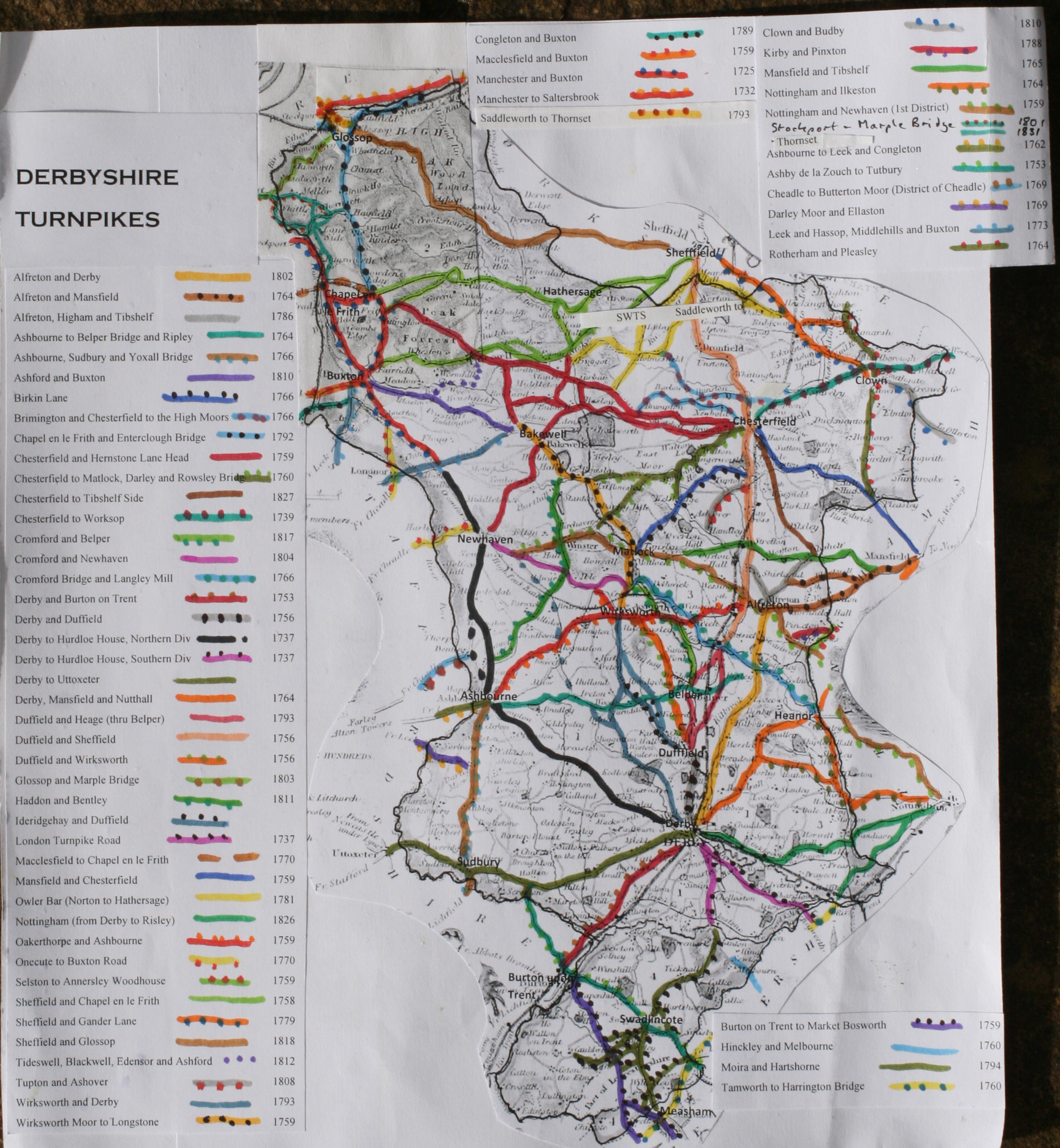
Much of our local road system was developed and improved under the Turnpike Acts. Trusts were set up under individual acts of parliament in order to construct and maintain roads through a system of tolls. The Manchester to Buxton Turnpike dates from 1759 and originally by-passed Furness Vale by following the old Roman road between Disley and Whaley Bridge across Whaley Moor (often known as Whaley Tops). Because this involved steep ascents, a new road was constructed through Newtown and Furness, opening in 1804.  Another system of roads was constructed by the Stockport and Marple Bridge (1801) and Thornsett (1831) Trusts. These linked New Mills with Hayfield, Marple and Mellor, Bugsworth and Furness Vale.

The turnpikes became increasingly unpopular, restricting travel and the movement of farm stock due to the fees  that were charged at the various tollbars. In some parts of the country, riots often broke out and tollhouses were burned down. An act of 1888 gave responsibility for these roads to the county councils and gradually the tollbars were removed, often leading to great local celebrations.

One local toll road which was not part of the system was New Road, between Bridgemont and Bugsworth. This had been built by the Carrington family, owners of the Britannia Wire Works. Tolls continued to be levied here until 1919 when the county took over responsibility for the road.

For more information on turnpike roads visit the turnpikes.org website. Their map of Derbyshire roads shows every turnpike colour coded with dates of opening.
 http://www.turnpikes.org.uk/map%20Derbyshire%20turnpikes.jpg
Explore the site for similar maps of the whole country and the history of these roads. There are also pages listing known tollbars and toll houses for each county.

Fernilee Toll Cottage in 1939.


Bugsworth Toll Bar.

Friday, 20 May 2016

Furness Vale from the Air

Thanks to Jim Oliver for the loan of this aerial view of the village. The date is believed to be in the mid 1970s. The brickyard is still busy judging by the stacks of finished products. The framework can be seen, partly erected for one of the new "Industrial Estate" buildings. The last remaining "beehive" kiln is still to be seen. The Charlesworth Crescent estate looks very new having been completed around this time. Riddick's office and builders yard is still in Charlesworth Crescent so the picture is perhaps just before they took over the former Co-op in about 1974.
There are open fields on Station Road where houses have since been built.
The photograph appears to be one of a series of aerial views taken by Whaley Bridge photographer Frank Armstrong although it is one which we have not seen before

Friday, 15 April 2016

View of the Printworks

 In the background of this photograph are the buildings of Furness Vale Printworks. This view is from the area of Lodge Farm which is just off of Station Road.  Wew can see one of the  mill lodges with asluice to control the flow of water. The man on the right appears to be operating a pump worked by a lever. In the foreground are a number of side tipper trucks and a section of narrow gauge contractors railway.  These were often employed on construction sites and could be quickly laid or re-located. It is not clear what work is being carried out  but it looks as if one of the ponds has been drained.
The photograph is undated.

Our thanks to New Mills Local History Society for allowing us to use this photograph.


Monday, 15 February 2016

A Dangerous Road


William Wood


The murder of William Wood in July 1823 is well recorded. He was killed at a lonely spot on Buxton Old Road at Longside on Whaley Moor. This is the old roman road between Disley and Whaley Bridge and at that time was in Cheshire. The spot is marked by a commemorative "Murder Stone".  


Wood, a cotton weaver from Eyam, was returning home from Manchester where he had sold his cloth and had received about £100 in payment. He travelled on foot and at Disley, called at a pub for refreshment. He got into conversation with three men and later continued on his way. After about ten minutes, the three left the pub and followed in Wood's direction catching up with him after a mile or two. Wood was beaten to death with stones and left at the roadside where his partly concealed body was later discovered. Wood's body was taken to the Cock Inn in Whaley Bridge where the coroners inquest was held a few days later.

The following day, three men appeared in Macclesfield where they bought new sets of clothes and gave away their old outfits. When news of the murder reached the town, suspicions were raised but the three had already left for Manchester by coach. When the old clothes were examined they were found to be stained with blood. The police followed to Manchester where one of the men was arrested in a public house. His companions had already left and there was no further trace of them.  The arrested assailant was Charles Taylor, 17 years of age. He committed suicide at the New Bailey Prison in Salford. His companions, of a similar age were known to the authorities, having only recently been released from a term of imprisonment. 


 The New Bailey Prison
Taylor had left prison just a day before the murder.  On 12th August of 1823 it was reported that Joseph Dale had been arrested in Liverpool whilst trying to enlist on a ship. On 24th April 1824, Dale was sentenced to death and was hanged on the following Wednesday. The third man was named as John Platt but it seems that he was never apprehended.

James (or John) Ellis

Just three years later, at almost the same spot, history was almost repeated. 

John Ellis of Parwich near Ashbourne was on his way  to visit his brother in Gorton to whom he was carrying a bundle of clothes. He spent the night at the White Horse in Horwich End.  


Another man, calling himself Michael Murray had also spent the night at the inn. Murray was described as being about 30 years of age with a thin face, dark hair and whiskers. Setting out the next day, Ellis saw that Murray was sitting on a wall at the roadside.. Murray changed the clogs that he wore for shoes and joined Ellis on the road towards Disley.  On reaching a lonely part of the road Ellis was hit with a blackthorn stick that Murray carried and beaten until defenceless. This assault took place at Longside on Whaley Moor very close to the spot where William Wood had been murdered in similar circumstances just three years before. His pockets were rifled for a silver watch and a few shillings and a bundle containing a waistcoat, shirt and stockings, tied in a plaid handkerchief was taken.

A description of the robber and of the stolen items was sent by Mr Newton, the Whaley Bridge magistrate to police in Liverpool and a notice was given to several pawnbrokers in the City. A few days later, a man answering the description of the robber presented a  silver watch to Mrs Fox, pawnbroker in St Thomas's buildings.  Mr Miller, the Superintendant of Police was immediately informed and Murray taken into custody.

Ellis had been taken to Disley where he lay in a state of imminent danger.  The prisoner was brought before him and unable to speak, he indicated by gestures that Murray was the perpetrator of the crime. Seeing no chance of escape, the prisoner said "Yes I am the man that did it and I am very sorry for it now"  He offered to shake Ellis by the hand but the gesture was declined.

The prisoner was taken to Stockport and later committed for trial at Chester Castle.  He gave his real name as Philip McGoveron, an Irishman

Crime in the High Peak

FIRE

In 1905 William White appeared in court at Chapel-en-le-Frith, facing a charge of arson.  He had set fire to a haystack at Long Hill Farm.  He told Sergeant White that he had thought of going to Buxton to do a spot of housebreaking but had decided to set a haystack on fire instead.  He gave himself up to police at Buxton because he wanted to go to prison for 5 years !  The prisoner was remanded in custody; perhaps his wish came true.


OLD BONES

October 1861.  At the door of Knutsford Jail, Joseph Hales was arrested on release from his last imprisonment.  He was committed for trial at the petty sessions for stealing 2 cwt of bones, the property of John Newton of Whaley Bridge. Now who would be in the market for a bag of stolen bones I wonder ?


COMMON LAW OFFENCE
 A Whaley Bridge butcher was in the habit of delivering meat to Buxton by train but in order to reduce his costs, resorted to rather unusual methods which in 1932 put him on the wrong side of the law.  A railway detective was travelling on a train and on it's arrival at Whaley Bridge was approached by the butcher who asked if he was going to Buxton.   A large piece of meat was placed on the seat opposite with the request that it be delivered to the bookstall at Buxton.  On proferring threepence, the butcher said "it's all right, I often send it like this".   On arrival at the destination, a bookstall assistant came to collect the meat which was soon picked up by a local butcher.

On hearing the case, under the old English Common Law offence of cheating and deceiving, Stockport Magistrates were told that the defendent had been sending parcels in this manner for somne time.   The magistrates agreed with the defence that there had been no intention to defraud.  It was suggested that the practice must occur daily throughout the Kingdom.  Although the practice was improper and irregular, it was not illegal and the case was dismissed.


AN ITALIAN IMMIGRANT

May 1908 saw the appearance of an Italian named Soberti Diego before Stockport Police Court.  He was charged with being on enclosed premises for unlawful purposes and with assaulting a police officer in Whaley Bridge on April 27th.  Diego had been seen climbing from a waggon up into the rafters of the goods warehouse at the station. The prisoner had refused to descend and when the police constable arrived  he jumped onto a van and threw a stone at the officer and hit him in the chest.  Diego jumped over the waggons and  tried to escape but the pursuing policeman fell over him and a desperate struggle ensued.  The prisoner had a razor with which he attacked the officer, cutting his hand.  It was only when support arrived that the Italian was overpowered.  Speaking through an interpreter, Diego explained that he had arrived in England seven months previously and finding himself in Whaley Bridge without food or money, decided to head to London.  He thought he would be safe hiding in the rafters until a train should arrive.  He had only used the razor to prevent the police officer from choking him.   Soberti Diego was sentenced to 28 days in prison and advised to leave the country as soon as he was released.

A QUICK DIVORCE

Perhaps not a crime but even then, irregular behaviour

In 1837 a less conventional method was followed to dispose of a wife.
The wife of John Allen of Turnditch eloped with J Taylor of Shottle.  The injured husband heard that the couple were in lodgings at Whaley Bridge and resolved to settle the matter.  Finding them he demanded 3s for her clothes. Taylor said that he would pay this provided Allen would accompany them to Wirksworth next market day and deliver her according to the law. Arriving at Wirksworth, Allen purchased a halter, placed it around his wife and gave the end of the rope to Taylor saying "I, John  Allen, was bereaved of my wife by James Taylor of Shottle on 11th July last; I have brought her here to sell her for 3s 6d; will you buy her James?" Taylor answered "I will, here is the money, and you are witness Thomas Riley" calling to a potman who was appointed for the purpose.  The ring was delivered to Allen with three sovereigns and 3s 6d, when he shook hands with his wife and her paramour wishing them all the good luck in the world. She had been married to Allen at Kniveton about ten years ago and had lived together until then.


TRADING STANDARDS

Surprisingly there existed a Victorian equivalent of today's trading standards officer.
Esther Ollerenshaw of Whaley Bridge was a milk dealer and sent her produce, presumably by train to Manchester.  In March 1883 a can of milk was intercepted at London Road Station by Inspector Edwards and sent for analysis. The milk was found to contain 41% water.  A fine of 40 shillings was imposed.

Esther Ollerenshaw however, did not learn her lesson.  Twelve months later, almost to the day, Inspector Edwards again took a sample of milk from one of Mrs Ollerenshaw's consignments of milk. The sample was forwarded to the city analyst, Mr C. Estcourt and was found to contain 30% water. Mrs Ollerenshaw, a widow and farmer was summoned but denied watering the milk.  As this was her second offence she was on this occassion fined £3 plus costs.

The Driven Gipsies

I don't know where the German Gipsies started their journey nor where it finished but in 1906 they weren't given a very friendly welcome by either the Derbyshire or Cheshire police.
One Friday night in October the Sheffield police tried to drive them across the border into Derbyshire; the Derbys police sent them back. Eventually the police tired of this game and the gipsies, 60 of them with horses and caravans were allowed to camp in a field a few miles from Sheffield.

Saturday morning and 20 or so Derbyshire police  were ready to drive them over the moors through Hathersage, Hope, Castleton and Chapel-en-le-Frith.  It was late at night by the time they crossed the river at Whaley Bridge and so into Cheshire.  At that time the Cheshire Police didn't know of their progress so they were able to set up camp at the roadside.  The bridge was guarded on the Derbyshire side to prevent their return and it was reported that the encampment looked like  a fair.  The people of Whaley made them welcome and feeling sorry for their treatment even gave them money.  The gipsies even did some trade in cheap jewellery.  They declared that they liked the country and intended to stay for two years.


The Cheshire police however, got wind of their presence and a contingent from the Macclesfield force, 30 officers strong, led them through Bollington and Adlington and so on to the Stockport Road.  There was some disorder here. One of the gipsies threw his hat into a field and was prevented from going after it. The gipsies then threw sticks at the police to show their resentment but were soon persuaded to continue their journey.  The Stockport police joined the Macclesfield contingent on reaching Hazel Grove and the band was kept on the move along Buxton Road. At the Stockport boundary, 2 inspectors and 25 officers took charge.  They were not allowed to go into shops but occassionally dashed in to beg but were quickly brought out again.

The group were disappointed at not being allowed to stop in Stockport. At Heaton Lane, they were turned off of the main road towards Heaton Mersey where the Lancashire police were telephoned and a force of 20 were sent to meet them .  As darkness fell, the gipsy leader pointed to the children and indicated that they were becoming tired and needed sleep. Inspector Moore of Stockport insisted that they continue.  "You bad inspector" shouted the gipsy leader, "we come back when you gone". The inspector replied "if you come back, we shall lock you up" The Stockport men escorted them along the Didsbury Road until a little way beyond Barnes Homes, the body sent out from Old Trafford took charge. They were allowed to turn into a field for the night, very glad to get some rest.

This is the last we hear of them, presumably they were allowed to settle at some stage or they would be wandering still.

Latitudinarians

Latitudinarians

1848

 For several weeks back, the neighbourhoods of New Mills, Chapel-en-le-Frith and Whaley Bridge have been infested with a number of able-bodied individuals, who, under pretence of being destitute, have committed serious outrages upon the shopkeepers and other inhabitants there.  And yet it is remarkable how very indifferently, or rather very inadequately these offences have been entertained by the administrators of the law in that district; as the following cases will illustrate.  On Tuesday evening, three stout looking young men, natives of Manchester, but who had been to Sheffield, applied at the Chapel-en-le-Frith workhouse for shelter for the night and obtained it.  No sooner, however, had they been admitted within the walls of the night asylum, than they began to destroy their clothing by burning them (their own being ragged and wet), calculating that in the morning they would each be supplied with new and better clothng at the Union expense.  In this latter instance, they were mistaken, for the only habitaments provided for them were made from wrappering, and the appearance not being very complimentary, they became very disorderly and refused to put them on.  The Governor insisted; a riot ensued; and the tramps threatened to commit some outrage in the village if they were turned out in the clothing tendered to them.  In this dilemma, a resident magistrate was consulted; but he declined to interfere. The Governoer then on his own responsibility, got assistance; the tramps were clothed by force, and they were turned out of the workhouse early in the afternoon.  About three o'clock,  being on their way from Chapel-en-le-Frith to Stockport, they broke the windows of Mr T C Mosley, and stole several currant cakes thereout, and were apprehended by the constable while they were eating the cakes near to the shop.  The next day they were taken before a resident magistrate; but, after hearing the case, he declined to commit them fot the felony, because the property stolen was so trifling.  On the other hand, he would not discharge them, because they had threatened the constable that if he did not take them into custody, they would commit another outrage before dark.  They were accordingly committed to Derby house of correction for two months, with an intimation to Mr Mosley that the expenses of £1. 4s must be paid by him.  Mr Mosley complained that the defendents had not been committed on his charge; and, therefore he had no right to be called upon, not only to repair the damage to his broken window, the loss of his cakes, but the additional costs of their commitment, for using improper language to the constable. He submitted that as the felony having been proved, the magistrate had no alternative but to commit for felony; and moreover mutated the injured and robbed shopkeeper in the amount of cost of £1. 4s.  This, upon the face of it, appears a very cruel proceeding; and if it be Derbyshire law or Derbyshire equity, we shall much prefer being governed by our system of Cheshire justice.  Our correspondent further complains that the same magistrate seems to have an insuperable objection to committing for trial in trivial cases of felony. A few weeks since, two men went into the shop of Mr Collier near Whaley, and asked for 3lb of bread; and when given to them they began to eat it, but refused to pay for it.  The parties were apprehended, but no committal followed. In consequence of this systematic indisposition to administer the law fully, the shopkeepers and licenses victuallers in that vicinity have determined upon sending a protest with their names attached, to the proper authorities on the subject, intimating that  if any further depredations are committed upon their property by tramps and latitudinarians, they will deal summarily with the case, without troubling the resident magistrate.

A Benighted Parish.

Until recently I was under the impression that all vehicles were obliged by law to  carry lights after nightfall, but it appears that such is not the case. It seems to me that all the grandmotherly care and attention of the various public bodies and authorities has latterly been bestowed upon the cyclists, while other equally dangerous offenders are allowed to go scot free.  I have the misfortune to live in one of the most benighted parishes in the three kingdoms.  We have several churches, chapels and schools and a plethora of public houses but no lamps. 
Our good, easy ,old fashioned parishoners have recently canvassed with the object of getting a few introduced, but in vain.  Drivers of all sorts, trusting to their own knowledge of the tortuous and winding roads and the their horses' instinct, go about at high speeds and in the most reckless manner.  It is the exeption to see one with a light.  Meanwhile, as usual, it is the old and infirm, the women and children, who run the greatest risks.  Only last week a woman was knocked down, and narrow escapes are of frequent occurrence.  If any of your readers love the quaint and antiquated, let them, on the first dark night, take a ticket for Whaley Bridge on the Buxton line; let them grope their way from the main street of the village into the parish of Fernilee.  They will not have bruised themselves above once or twice against stone walls before they will be startled by erratic and mysterious will-o'-the-wisp-like glimmerings in the distance.  On a nearer approach they will discover worthy natives perambulating in true seventeenth century fashion, with horn lanterns, like philosophers seeking for truth.  Hoping these letters may draw the attention of public bodies generally to the matter.

Sunday, 14 February 2016

The Tin Bath

Chris Wilman braved the cold of Eccles Pike this morning to photograph the steam special "The Tin Bath"  Here is her photo of the train hauled by locomotives44871 and 45699 "Galatea" passing Buxworth.

Reckless Motoring and other stories

Reckless Motoring 
 
 Summer has at last arrived and living as I do in Whaley Bridge, within half a mile of Taxal Church, in good air and good company, I ought, you would think, to be as happy as the days just now are long. Not so. Motor cars run through our pretty village to and from Buxton at the rate of from 25 to 40 miles an hour. Some - I do not say all - are careless of everybody and everything but themselves. They think they have the complete right of the road. Everyone must make way for a high powered motor car. Dogs and cats they run over, and occasionally old men. The dust they create in running at the speed they do is most injurious to pedestrians, crops, and dwellings. Should you open your bedroom windows your rooms are soon covered, and make extra work for the already hard worked maids and assistants. Shopkeepers have to shut their doors, or their goods would be spoiled. A butcher told me that on a Saturday afternoon in fine weather, after his shop had been open all day, anything sold after 4 to 5pm wanted washing before being fit to eat.
J.E.Cheetham
July 17th 1907


Poor Fellow

Buxton  September 1927

When one of their guests started to behave a little strangely, the management of a Buxton hotel wasted little time in calling the police.  When questioned, he seemed to be suffering from loss of memory.  He thought that his name was Arden and believed that he worked for a cable company in Buenos Aries. He had no idea of how he came to be in Buxton nor of his friends or relatives. He was described as 35 to 40 years of age, 5ft 10in tall, and clean shaven.  He appeared to be well educated and of good appearance.  The response of the police was to incarcerate him in the Chapel-en-leFrith Union Workhouse !


The Crime of the Whaley Bridge Postmaster

Robert Jackson was postmaster at Whaley Bridge, a position he had held for 16 years. He also held the post of assistant overseer where his responsibilities would include collection of rates and administering the poor law.  He also acted as collector of tithes for the parish of Taxal and as treasurer of the church restoration fund.

Jackson had received £55 from the ladies who managed the Provident Club to be invested in a Post Office savings account. They had little knowledge of the methods of the Savings Bank and did not ask for a receipt, relying instead upon the honestly of the postmaster. Jackson  received £20 from the Senior Overseer, also for investment.  The anticipated interest on these investments was paid regularly.

In July 1889, Jackson suddenly disappeared. On the investigations of the Charity Commissioners and the Paot Office Authorities, it was found that not only these sums were missing but a total of £275 including moneys from the poor rates. A warrant was issued for arrest and he was discovered in Manchester where he was furnishing a house. The prisoner was conveyed to Whaley Bridge where he was handed over to Constable Hunt. He was then remanded at Stockport and in December 1889 was tried for embezzlement. In his defence, it was stated that Jackson and his wife also ran a stationery business, the stock of which amounted in value to more than the missing funds. Had repayment been demanded, Jackson would have had little difficulty in raising the money. The auditor had found that much of the money could be recovered and the Post Office had refunded £20 leaving a deficiency of only £45. Jackson had a wife and young family and in his support the Rev. Sam Evans, vicar of Taxal and Mrs Johnson and Mrs Shalcross, managers of the Provident Club spoke of his excellent character despite his having made off with the money which they had entrusted to him.

The defendent pleaded guilty and was sentenced to 12 months hard labour.
Jackson was clearly popular in Whaley Bridge for he had only been in jail for a month when the Home Secretary received a petition signed by a large number of Whaley Bridge citizens praying for Jackson's early release. The signatories included local magistrates, clergy and ministers and nearly all the ladies of the Provident Society from whom he had embezzled the funds!

Sheep Rustling

In December 1850 Samuel Taylor of Hulme left 9 sheep in a field in Hodge Lane in Salford. He had left them in the charge of a young man named Richard Warren but the following day, neither man nor sheep were to be found. The loss was reported to the police at Chorlton upon Medlock who soon tracked down the culprit. Warren was found to have sold a sheep to a butcher at  Heaton Lane, Stockport, another to a butcher at Hazel Grove and a third in Whaley Bridge.
The police caught up with Warren in a Whaley Bridge pub where he was found with the remaining 6 sheep in his possession.


The Sale of a Wife at Market

In 1837 an unconventional method was followed to dispose of a wife.
The wife of John Allen of Turnditch eloped with J Taylor of Shottle.  The injured husband heard that the couple were in lodgings at Whaley Bridge and resolved to settle the matter.  Finding them he demanded 3s for her clothes. Taylor said that he would pay this provided Allen would accompany them to Wirksworth next market day and deliver her according to the law. Arriving at Wirksworth, Allen purchased a halter, placed it around his wife and gave the end of the rope to Taylor saying "I, John  Allen, was bereaved of my wife by James Taylor of Shottle on 11th July last; I have brought her here to sell her for 3s 6d; will you buy her James?" Taylor answered "I will, here is the money, and you are witness Thomas Riley" calling to a potman who was appointed for the purpose.  The ring was delivered to Allen with three sovereigns and 3s 6d, when he shook hands with his wife and her paramour wishing them all the good luck in the world. She had been married to Allen at Kniveton about ten years ago and had lived together until then. 


An Artful Trick

The other day, as one of the coaches which plies between Buxton and Manchester was ascending the hill near Taxal, the coachman was accosted by an Irish woman with a child in her arms, requesting him to "give her a ride". He replied, "that the proprietors employed him to receive fares, not to give rides." upon which she, pretending to find her pocket among the folds of her ragged dress said, "Sure and have you change for a sovereign?". The coachman, elated with the prospect of receiving his short fare, ordered her to get on and he would furnish the change at Buxton. On arrival at the destination, the woman alighted and was proceeding apace without producing the coloured material, when the coachman, in a stentorian voice exclaimed, "Hallo, you have not paid your fare."  "Fare do you mean, sir, sure and I have only a penny in my pocket." "Then why did you ask me for change?" replied the coachman. "Sure and it was the change that I wanted; the devil of a sovereign had I." The coachman, much chagrined at the loss of his anticipated fare, at the request of a passenger, alloed the woman for her craft, to proceed on her journey.

The Blackburn Standard 3rd December 1845

Saturday, 13 February 2016

What The Papers Said

John Allen sold his wife for 3s 6d; the electric fluid entered a cottage and smashed the furniture; a bear and a deer absconded from a boat and The Bugsworth Nick Club terrified local women. 

One Saturday evening, not long ago, a man who had been making a little too free with "John Barleycorn", had to pass through Taxal churchyard where a deep grave had been dug (for an interment on the morrow), close to the footpath over which the jolly fellow had to pass on his way home; and being rather unsteady in his gait, and not quite able to maintain his true perpendicular, he unfortunately fell into the grave; and being unable to get out again, he quietly resigned himself to his fate and went to sleep. Shortly afterwards, one of his boon companions, in passing the same way, had the misfortune to fall into the same grave and rouse the first occupant from his sleep, who feeling himself offended at the intruders visit, muttered out in an angry growl "It's strange one cannot lie quietly in the grave". 
Read about these and other curious stories in "What The Papers Said" a selection of news reports from the 19th and 20th centuries about the Derbyshire villages of Bugsworth, Furness Vale and Whaley Bridge.price £2.40.  Follow the link below to download your copy.
 http://amzn.to/1myVLJI

A printed version of the book is available from the History Society
I

Sunday, 24 January 2016

THE RAILWAY MYSTERY OF AUGUST 1908


Unknown Lady's Death
An inquest was held last evening at Furness Vale touching the death of a well-dressed unknown woman who was found dead on the Buxton branch of the London and North Western Railway between Furness Vale and New Mills early on Tuesday morning.
Frank Wm. Green son of the Furness Vale station master and a porter at Disley, said he was walking along the line to his work when he found a lady's hat in the sixfootway about 150 yards from Bank End Bridge. Twenty yards lower down he noticed what he took to be a bundle of rags, but which proved to be the dead body of a woman, which he lifted into the six-foot. He did not notice if there was any sign of a struggle. There was no public footpath or crossing near the spot, and he did not see much blood.
Joseph Wood, who went to see the body, said the grass in a meadow between Buxton Road and the railway had been trampled down, and the woman must have climbed a wall four foot high, separating the meadow from the railway. Some coping stones had been thrown off at the end of the track. Witnesses wife found two artificial roses near the wall.
Police sergeant Sandbach said the woman had been dead several hours. There was nothing on the body that would lead to identity. The woman wore a wedding ring and carried a satchel-purse containing 5s 2d, a latch-key and some hair pins. She was about 30 years old. She had wounds on the head, her back was broken, and the toes of the right foot were cut off. No blood had been found on any of the engines that had passed that way. There were blood spots for a distance of about 20 yards along the line. He thought it was impossible for her to have fallen out of a train, she had no ticket on her. A photograph of her had been taken.
The Coroner said if the woman was identified the witnesses could go to his office and make their statements to him. He was of the opinion that she had either deliberately taken her like or come to her death accidentally. He advised an open verdict so that the police could prosecute their inquiries, and the jury returned a verdict of "Found dead on the railway"

 A Strange Funeral
The mystery attending the finding of a dead body of a well-dressed woman on the London and North Western Railway between Furness Vale and New Mills is as great as ever and the prospect of unravelling it is made more and more remote by the burial of the body.
After lying five days, the internment took place on Saturday and as no one came forward to identify the unfortunate lady, the internment had to be taken in hand by the relieving officer of the Hayfield Union, Mr. James Taylor, New Mills, but this could not be done until the body had been brought back from the Furness Vale Station waiting room in another union. It was accordingly taken back and placed in a workman's hut on the line near the spot where it was found, and from this place the funeral took place. The only persons present were the relieving officer, the Union undertaker, the assistant overseer, the sexton and the driver of the dog-cart that had conveyed the coffin, and for a distance of two miles, this little party accompanied the corpse to Disley Church where Canon Slatterthwaite, the vicar, officiated.
The theories of suicide or accident are not shared by everybody. Several policemen who were on Bank End Bridge at four o'clock on Tuesday morning declare there was nothing on the line at that hour, and the body was found shortly after six o'clock. There was no trace of blood or anything else on the wheels of any engines and close to the wall separating the railway from a field near the spotlight where the body was found were two artificial roses - one pink and the other white - from the lady's hat.

Sunday, 3 January 2016

The Unlucky Dresser

From the Glossopdale Chronicle 20th May 1871

  The inhabitants of Shady Grove , Furness Vale, were greatly alarmed early on Sunday morning to hear of a neighbour's child being lost. It appears Mr James Sharples, foreman tailor to Mr. Mosscrop of Whaley Bridge, went to Stockport on Saturday afternoon to buy a dresser, leaving by the quarter to three train, and taking with him his daughter Polly, aged about five years. On arriving at Stockport he purchased his dresser, and a good bed of flocks, as he is about to leave the neighbourhood for a colder region, (Kinder Scout, near Hayfield) he means taking care of James by creeping over head in his bed of flock after snipping hours. How the child came to be lost is a mystery. After paying for his dresser he went to see his brother Jack and stayed gilling rather too long; on arriving at the station the train was gone, so James would go and have another gill wi' Jack, leaving little Polly at the station , in the waiting room, consoling her with a few goodies, and telling her he would be back directly. Bad luck! He stayed rather too long wi' Jack again, giving him a few styles of broad cloth, and now and then a song; on arriving at the station about midnight, he found that his train had gone before ten o'clock, and his daughter too; the child having been found by a Mr. Cook, of Chapel-en-le-Frith, nearly heart-broken, he brought her along with him and took her to his own home, Chapel station, sending her home on Sunday morning to her mother, who was nearly heart-broken with the loss of her child, and to make things more sad for Martha, Jimmy never turned up till Sunday night, after being rambling about nearly all day in Stockport, in search of his child, besides sending the bellman round the town and outskirts, and giving her description to the police, and offering a good reward for her restoration. On arriving at Furness and finding that his lost child had landed safe at home, he took a run jump into the Soldier Dick, and there gave them his horrible journey of buying the dresser. When he wakened out Sunday morning his yed opened and shut, and tears rolled down his cheeks as big as t'quart pot on th' table, he shed a gallon o' tears he wor shure. It wor biggest trouble he ever had in his life, sin he wor wed to their Matt. He said haum sure I'm daft, he said if it had bin anybody else, haw should ha' laft up my sleeve, bur it wines button. So he went home arm in arm wi' their Matt.

Tuesday, 29 December 2015

Lady Pit. A Local Coal Mine


Lady Pit, one of our local collieries closed in 1903. It was operated by the Beard and Bugsworth Colliery Company  and was one of several mines owned by  L & E Hall. This mine, also known as Beard Colliery was opened in 1816 – 1818 and was the largest in the vicinity of Furness Vale.  There were numerous shafts: Air Pit; Chain Pit; Furnace Pit, Lady Pit; Blind Pit, Deans Piece Pit and Bullbower Pit.

A feature of the mine was the Jowhole Tunnel which was dug in 1853. This ran in a straight, almost westerly direction to a yard off of Marsh Lane near Gow Hole Farm. Here was a wharf where coal could be loaded by tipplers on to road vehicles. A horse drawn tramway ran through the tunnel and this opened into a number of sidings at Gow Hole. The site is now Nick Rowleys Yard.

The opening of the railway between Sheffield and Manchester allowed high quality, inexpensive coal to be transported across the Pennines and our local mines could not stand up to the competition.

Lady Pit was sited at the point where Dolly Lane meets Lady Pit Road. The buildings have been demolished and the land restored to farming.  The colliery was served by a short railway line which extended from Gowhole sidings, crossing the field on a low embankment which may still be seen in the photograph below.