Showing posts with label New Mills. Show all posts

Thursday, 2 June 2022

The Beards of Beard Hall


extract from The Old Halls, Manors and Families of Derbyshire Vol 1 by Joseph Tilley, published 1892

Along the north bank of the Goyt, from Kinderscout to Mellor, is the tract of land once designated Bowden Middlecale.  Within this tract there once stood a solitary mill, situated in a romantic glen, which did duty for centuries for all the surrounding townships.  There are several mills now (it is the district of mills), and a railway station, too, from whence it is a comfortable stroll to Beard, or Ollerset, or Thornsett, or Scout, or the Mermaids' Pool, or Hayfield, or Long Lee.  Here we are surrounded by those picturesque spots where some of the oldest of the Peak families were located in such remote times. Here, almost within sight of each other, were the homesteads of the Beards, Bradburys, and Needhams. In our stroll we noticed a shopkeeper (a chemist, druggist, and colourman), named Kinder; we remembered that Hayfield Church was built by the munificence of a Kinder in 1385.  Is it not probable that the colourman may be a descendant of an ancestor whose name is found on several glorious rolls?

The Manor of Beard, says White, was given to John, Earl of Shrewsbury, by Henry VIII. This could not be, for there was no John Talbot who wore the coronet under that monarch; though white is correct in saying it was given to the Talbots, and this brings us face to face with a fact Lysons could have rendered intelligible.  If Henry VIII gave it to the Talbots, how could the Beards, Leghs, and Duncalfs have possessed it and passed it by heiress previous to the Talbots?  The Royal gift would shew it to be Royal demesne, while there is no evidence that the Beards were tenants in Capite.  We have an idea that the tenure of the Beards, and their heirs, was under the Abbey of Basingwerke(a).  These are the kind of facts the compilers will not face.  The senior line of the Beards became extinct about 1400, when the heiress mated with the Leghs (she was the wife of two brothers successively), and the manor was certainly in her dowry.  Beard Hall was assuredly distinct from the manor, for the homestead remained with a junior line of the family until the days of Queen Elizabeth anyway.  The old edifice is delightfully situated about half-a-mile from New Mills, and from its position commands a splendid view of the surrounding country.  The masonry of the remains (for there is only a gable left of the original structure) was evidently the work of William Beard, who was living here in 1570, and whose daughter, Elizabeth (senior co-heiress), married Ralph Ashenhurst.  We do not refer to the foundations, for they are considerably older, nor to a small portion of the interior, which has the appearance of having been former out of a tower with port holes. How an old Peak family gets lost sight of can be instanced by the Beards.  The most careful and accurate of Derbyshire compilers (dear old Lysons) has these sentences:  "The grandfather of the last Beard, of Beard Hall had four sons; the two elder died without male issue, each of them having only a daughter and heir; Alice, daughter of Nicholas, married Blackwell; Alice, daughter of Richard, married Bowden.  William, son of John, the third son, was of Beard Hall, and had three daughters married to Ashenhurst, Holt and Yeaveley.  The Ashenhursts inherited Beard Hall.  Ralph, the fourth son, had four sons, but we know nothing of their posterity."  The descendants of this fourth son are yet among us; yes, living within a short stroll from their ancestral homesteads, but not as lords of a manor, but as vendors of treacle and soap, and other delectable necessities of life.

We had little hope of finding any remains of Beard Hall yet standing, for intelligence had reached us - indeed, we were so told as we were plodding our way from Bugsworth - that it had been entirely rebuilt.  There was more than one pleasure awaiting us, for not only was there the old gable, but a resident within who was a descendant of the historic Staffords, who has been repeatedly asked why he makes no attempt to recover on of the peerages once held by that family, and which is still in abeyance.  The courtesy of Mr. Daniel Stafford and his lady we most gratefully acknowledge, while their willingness to give information makes us their debtor, to which we would add, that if our ideas could have been as readily grasped by some people who are tenants of other old edifices as by this lady and gentleman, we should have gathered more facts by the way than we have. The Legs who held the Manor of Beard were offshoots of the great Cheshire house who had branches at Adlington, Bothomes, Bruche, Lyme and Ridge.  The name they held was not really their own, paternally, for they were descendants of the  Venables, Baron Kinderton, one of whom, in the reign of Henry III, married the heiress of the Leghs, and adopted her name.  Their son espoused Ellen de Corona and acquired Adlington, thus the two quarterings of their shield become intelligible.  The pedigrees of Cheshire families given by Earwaker tells us of many unions with Peak families, of which we gather but little from our own compilers. The wife of the last Beard of Beard Hall was a daughter of the Davenports of Henbury.

The Ashenhursts were a Staffordshire house of remote antiquity. John, the grandson of the Beard heiress, who was born here, became that famous, or infamous Parliamentary Colonel during the Civil War, whose compound treachery is known to historical students. This fact alone would have attracted many an individual to Beard. The father of the Colonel was a J. P., who donned the profession of a clergyman occasionally, for the entry is on record that he married seventeen couples of Chapel-en-le-Frith lads and lasses one morning.  Is it not singular that this old building, after having sheltered the Beards and the Ashenhursts, should now be the dwelling of a gentleman whose ancestor not only fought at Hastings, and whose name if on the Roll of Battle Abbey, but who was cousin to the man to whom the victory gave the throne of England?  Is it not singular, too, that the Halls of Beard, Shalcross, Ollerset and Mellor (all comparatively within a stone's throw of each other), all seeming with historic associations, all within about twenty miles from Bakewell, should be so little known even to the curious.

 (a)  Basingwerke Abbey near Holywell, Flintshire was abandoned in 1536. They formerly held considerable lands in Derbyshire


Wednesday, 13 April 2022

The Great Floods of 1930 and 1931

 June 18th 1930 was a day of tragedy in New Mills when torrential rain accompanied by a thunderstorm brought a great flood to the district resulting in the loss of two lives and much destruction.  

These illustrations are from the pages of The Ashton Reporter.


There were further floods in September 1931 that affected a wider area than New Mills

Windsor Castle Lodging House flooded once again 

Mr J. J.Hadfield makes his escape from Garrison Printworks


A steam lorry makes its way along flooded Buxton Road near the quarry in Furness Vale.

The notice board advertises bungalows for sale.


The newspaper cuttings are courtesy of "Books at the Basin" in Whaley Bridge

Monday, 5 October 2020

Back to School in New Mills

Tony Beswick has supplied a selection of photographs mostly featurning New Mills School. 


Church Lane in the early 20th century, looking towards St.George's Church. In the centre is St.George's Primary School and on the left, Beech House. The empty fields to the right of Church Lane are the site of New Mills Grammar School. The school opened in 1912 and is a Grade II listed building.  St George's is the Anglican parish church and was built in 1829-1830 to the design of  R. D. Chantrell.  The Chancel was rebuilt in 1898.


                               The North East corner is the nearest to Church Lane

Saturday, 8 August 2020

An Overnight Stay


                                           The "Round House" or "Honey Pot" at Curbar 


In 1863, John Warren wrote in his diary: "William WELCH of Whaley Bridge was put in the Buxton Lockups for being Drunk and Disordley the cost was all together £4.2s.6d."
The fine was the equivalent of £450 today, a hefty penalty for being drunk.
The location of the Buxton Lock-up is unknown. It had opened in 1829 and was in use until about 1899. The inspector of prisons described it in his 1850 report. It was a detached building with two cells, but no accommodation for a keeper. The building is very ill adapted for its purposes. It had been built at the cost of the township and was intended chiefly for vagrants in want of a nights lodging, and that was its main use. Only one cell was used, the other used to store coal and other articles. This cell is about 9 feet long, 6 feet wide and 6 feet high. It is dry, with an open fire. It had unglazed window, through which people outside might be hand anything in. There were two poles fixed on each side of the cell for seats, and there was some loose straw for bedding. The constable said that there were formerly proper benches, but that they had been pulled to pieces and burnt.' 
Many towns and villages had their own lock-ups, established mostly in the 19th century as local police forces were established although some were of a much earlier period.

Sunday, 7 June 2020

Off The Rails


On Monday 9th September 1867 the most serious of the local rail incidents took place on the Midland line.  A goods train had entered the tunnel between Chapel and Peak Dale and had stopped to unload gravel for track maintenance.  Against the rules, a following train carrying 1000 sheep and cattle was allowed to enter the tunnel shortly after 5pm, where it crashed into the stationary ballast train.  A little girl had taken some clogs to her father, a blacksmith called Vaines, who was working in the tunnel and together they were in one of the wagons. She was the first fatality of the day.  Several other workmen were injured.  Two engines hauled the cattle train and these left the track causing the 23 cattle trucks to become detached and these started to roll backwards.  On leaving the tunnel, the guard and three drovers jumped and their injuries were not known. The telegraph wires were out of order and it was not until the wagons sped through Bugsworth that the signalman there, was able to warn New Mills and have the signals set to danger.  The train was seen approaching New Mills at 6pm A passenger express had already set off from New Mills and was halted by the signal after some distance.  Driver Cooper set the train in reverse and he, the fireman and guard all jumped off.  There was still a collision in which four cattle drovers were killed and a fifth injured.  Many sheep and cattle lay dead amongst the wreckage. The express in the meantime was still travelling backwards out of control and its speed increased due to the collision. The train was not brought to a halt until directed into a siding at Romiley. None of the passengers were injured although some suffered from shock.

Thursday, 21 May 2020

Bonus Sweatmore

Bonus Sweatmore started work at Knowles Brickyard in 1930, aged 16. 
49 years later, on 1st June 1979, he retired and was presented with a clock by his employers.
Bonus lived first in St George's Road in New Mills before moving to a newly built bungalow on Marsh Lane in the 1970s. He walked to and from work every day, come rain or shine. He was able to enjoy a long retirement before passing away in 2008.

Few  people spend all their working  days with one employer but having left school, Bonus Sweatmore found a "job for life".

 Bonus was born in December 1915 and married in March 1940.

 Bonus, photographed at the wedding of his daughter Ann in 1965

 Bonus and Ann in his garden in 2003

 The inscription on the clock reads: "Presented by Messrs R E Knowles Ltd to Bonus Sweatmore in recognition of his 49 years faithful service with the company 1st June 1979"

Knowles Brickyard, Furness Vale. Bonus Sweatmore's place of work for 49 years.

Sunday, 9 February 2020

Low Leighton Wesleyan Mission

Tony Beswick has sent this 1927 postcard showing the chapel at Low Leighton, New Mills. A pre-fabricated "tin tabernacle", the chapel was opened in February 1911.

New Mills suffered from a German air raid in July 1942 and the mission was destroyed. New Mills Fire Station now occupies the site. "Whitfield Villas", the semi detached houses just beyond the Mission was also hit  by a bomb. A ten year old girl died and five people were wounded at Low Leighton. There were other casualties and further damage in other parts of New Mills and Hayfield. 

The house at the nearest end of the row appears to be much larger than the others. This is deceptive for the entrance is at the side. There are signs in the ground floor windows suggesting that this might have been a commercial or business premises. Nowadays, it is divided into two flats.

Our article of 16th November 2019 "Flat Pack Churches" tells of other local "tin tabernacles"


Monday, 30 September 2019

Murray's Bakers of Newtown

Murray's established a bakers shop at 42 Market Street, New Mills in 1902. Next door at 40 Market Street, was Murray's Draper and Dressmaker. In 1905, a bakery and shop was opened at 52 Buxton Road, Newtown.
42 Market Street is now "Lee's Kitchen" a Chinese Takeaway and No 40 is Sham's Spices. The Newtown shop was at the corner of Redmoor Lane and is now a private house.

The horsedrawn baker's van was used to make local deliveries but we are unable to identify this location.


George Murray, photographed with a motorised van in Diglee Road, Furness Vale in 1937.


A Look Back at Bridge Street,New Mills


Bridge Street in 1902 looking towards Spring Bank. On the right is the Bridge Taver, The wording on the sign reads: Abel Wild Licensed Retailer of Ale and Porter to be taken on the premises. The original photograph was by J. Randles and has been digitally colourised.

A few years later this was the view from the other end of Bridge Street. At the start of Dye House Lane was the White Hart. At the corner of Mellor Road was Isaac Arnfield's grocer's shop.

In 1954, a North Western bus approaches on the route from Birch Vale. Arnfields shop has long since closed but opposite was Fielgel's grocers and farther down was Thompson's bakers.
Photograph by Peter Thompson, digitally colourised.

Thursday, 30 August 2018

Providence Chapel

Providence Chapel in Mellor Road, New Mills was built in 1823. Due to lack of funds, having purchased the land, members of the congregation built the chapel themselves. At first it was too large and a section of the building was used for a time as a barn. It is pictured in this watercolour in the early 20th century


Sunday, 11 September 2016

Hear John Wesley Preach !

On Sunday 18th September the Rev John Wesley will preach a sermon upon the topic of ‘Awake, thou that sleepest’ in the New Chapel on High Street.  Hymns by Rev Charles Wesley will be sung.
The ‘New Chapel’ on High Street that is the home for Revive Church will be 250 years old this year and is the oldest place of worship in New Mills still in use for its original purpose. John Wesley (the founder of Methodism) preached there regularly and to celebrate the anniversary, history will be re-created. Come and hear Reverend Wesley preach and watch the multimedia story of the building to the present day.  18th Century dress encouraged!
10.00 – 11.00, Admission Free

Sunday, 17 July 2016

The Turnpike Roads

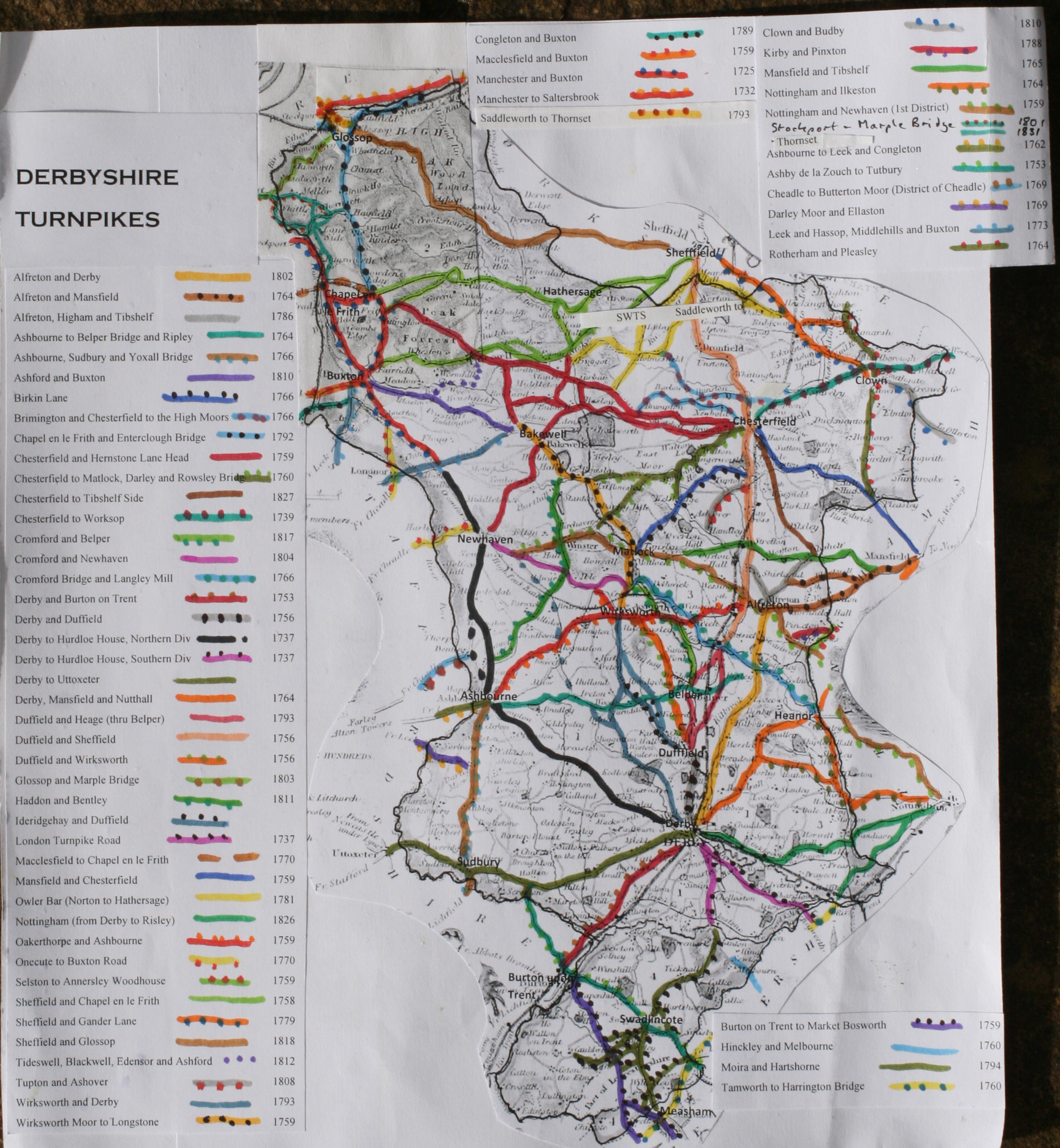
Much of our local road system was developed and improved under the Turnpike Acts. Trusts were set up under individual acts of parliament in order to construct and maintain roads through a system of tolls. The Manchester to Buxton Turnpike dates from 1759 and originally by-passed Furness Vale by following the old Roman road between Disley and Whaley Bridge across Whaley Moor (often known as Whaley Tops). Because this involved steep ascents, a new road was constructed through Newtown and Furness, opening in 1804.  Another system of roads was constructed by the Stockport and Marple Bridge (1801) and Thornsett (1831) Trusts. These linked New Mills with Hayfield, Marple and Mellor, Bugsworth and Furness Vale.

The turnpikes became increasingly unpopular, restricting travel and the movement of farm stock due to the fees  that were charged at the various tollbars. In some parts of the country, riots often broke out and tollhouses were burned down. An act of 1888 gave responsibility for these roads to the county councils and gradually the tollbars were removed, often leading to great local celebrations.

One local toll road which was not part of the system was New Road, between Bridgemont and Bugsworth. This had been built by the Carrington family, owners of the Britannia Wire Works. Tolls continued to be levied here until 1919 when the county took over responsibility for the road.

For more information on turnpike roads visit the turnpikes.org website. Their map of Derbyshire roads shows every turnpike colour coded with dates of opening.
 http://www.turnpikes.org.uk/map%20Derbyshire%20turnpikes.jpg
Explore the site for similar maps of the whole country and the history of these roads. There are also pages listing known tollbars and toll houses for each county.

Fernilee Toll Cottage in 1939.


Bugsworth Toll Bar.

Monday, 15 February 2016

Latitudinarians

Latitudinarians

1848

 For several weeks back, the neighbourhoods of New Mills, Chapel-en-le-Frith and Whaley Bridge have been infested with a number of able-bodied individuals, who, under pretence of being destitute, have committed serious outrages upon the shopkeepers and other inhabitants there.  And yet it is remarkable how very indifferently, or rather very inadequately these offences have been entertained by the administrators of the law in that district; as the following cases will illustrate.  On Tuesday evening, three stout looking young men, natives of Manchester, but who had been to Sheffield, applied at the Chapel-en-le-Frith workhouse for shelter for the night and obtained it.  No sooner, however, had they been admitted within the walls of the night asylum, than they began to destroy their clothing by burning them (their own being ragged and wet), calculating that in the morning they would each be supplied with new and better clothng at the Union expense.  In this latter instance, they were mistaken, for the only habitaments provided for them were made from wrappering, and the appearance not being very complimentary, they became very disorderly and refused to put them on.  The Governor insisted; a riot ensued; and the tramps threatened to commit some outrage in the village if they were turned out in the clothing tendered to them.  In this dilemma, a resident magistrate was consulted; but he declined to interfere. The Governoer then on his own responsibility, got assistance; the tramps were clothed by force, and they were turned out of the workhouse early in the afternoon.  About three o'clock,  being on their way from Chapel-en-le-Frith to Stockport, they broke the windows of Mr T C Mosley, and stole several currant cakes thereout, and were apprehended by the constable while they were eating the cakes near to the shop.  The next day they were taken before a resident magistrate; but, after hearing the case, he declined to commit them fot the felony, because the property stolen was so trifling.  On the other hand, he would not discharge them, because they had threatened the constable that if he did not take them into custody, they would commit another outrage before dark.  They were accordingly committed to Derby house of correction for two months, with an intimation to Mr Mosley that the expenses of £1. 4s must be paid by him.  Mr Mosley complained that the defendents had not been committed on his charge; and, therefore he had no right to be called upon, not only to repair the damage to his broken window, the loss of his cakes, but the additional costs of their commitment, for using improper language to the constable. He submitted that as the felony having been proved, the magistrate had no alternative but to commit for felony; and moreover mutated the injured and robbed shopkeeper in the amount of cost of £1. 4s.  This, upon the face of it, appears a very cruel proceeding; and if it be Derbyshire law or Derbyshire equity, we shall much prefer being governed by our system of Cheshire justice.  Our correspondent further complains that the same magistrate seems to have an insuperable objection to committing for trial in trivial cases of felony. A few weeks since, two men went into the shop of Mr Collier near Whaley, and asked for 3lb of bread; and when given to them they began to eat it, but refused to pay for it.  The parties were apprehended, but no committal followed. In consequence of this systematic indisposition to administer the law fully, the shopkeepers and licenses victuallers in that vicinity have determined upon sending a protest with their names attached, to the proper authorities on the subject, intimating that  if any further depredations are committed upon their property by tramps and latitudinarians, they will deal summarily with the case, without troubling the resident magistrate.

Friday, 4 December 2015

The Things They Made.


We often associate local industry of the past with the textile trade or perhaps coal mining. A much wider and sometimes unusual range of products was also made in this locality. Here are just a few:

Bed Springs.
              The Britannia Mill at Bugsworth was built as a cotton spinning mill.  In 1903 the Britannia Wire Works Company took over the business manufacturing springs for upholstery and mattresses as well as fro the railway and aviation industries.  It closed in 1969.

Soap and Leather
                In the early 1860’s a hatters leather manufacturer was established in Ringstones Clough by John Scholes and John Handford. The business continued for more than 20 years and at one time employed 21 people. The site was
Friday, 30 April 2010

The Fox At The Paragon Garage

A LETTER FROM PETER THOMPSON REGARDING THE PARAGON GARAGE

Not sure about the spelling but the owner was Joel Bold followed later by his son Edwin, the fox was his pet and I saw it often. In fairly recent years Edwin still lived in one of those quite nice houses on the right heading toward Furness just after Bank End.  He had a couple of dogs with him last time I saw him out walking.  Used to be very much an outdoor type ,shooting etc. seriously dressed for it.  Probably shot the fox cub's mother.

Joel had a plaque on the garage, which read something like –

“You are now in Derbyshire;  Strong in the Arm Weak in The Head”

 For a short time the Paragon was owned by Jim Riddick Senior's brother, I think his name was Jack.