Showing posts with label roads. Show all posts

Monday, 25 November 2019

The Blind Man's Road

Two of our local routes were built as turnpike roads in the 18th century by a blind man !


John Metcalf was born in Knaresborough in 1717. Six years later he contracted smallpox which left him totally blind. Known locally as "Blind Jack", he was a man of great accomplishments, especially his expertise as a road builder.
Within a few months of losing his sight, John had gained the confidence to leave his home unaided and within a few years could find his way throughout the town. Making the acquaintance  of boys of his own age, he soon learned to climb trees, joining them in regular forays into local orchards. He learned to ride his father's horses and eventually took up hunting. At the age of 13 he was taught to play the violin, a skill which was to prove a ready means to earn a living.
The deep pools of the River Nidd were popular bathing places and aged 14, Metcalf became a strong swimmer and it was he who was called upon to rescue a drowning soldier who accidentally fell in the river. 
There are numerous anecdotes telling of Metcalf's adventurous life and a popular story relates to a wager with Colonel Liddell, MP for Berwick. Jack won  10 guineas when he walked from London to Harrogate in five and a half days, arriving before the colonel whose journey by coach was slowed by the state of the roads.
Obtaining a four wheeled chaise, he entered the trade of a carrier, initially on local journeys but later transporting fish from the Yorkshire coast to Leeds and Manchester.
Joining the army, he was sent to Scotland during the Jacobite rising of 1745. His duties involved moving guns and entertaining the troops with his music.
On leaving the army, he obtained a stagecoach and driving it himself made a twice weekly journey between Knaresborough and York. 


The Turnpike acts of the 18th century empowered trusts to build and maintain new roads financed by tolls. An act of 1752 authorised a road between Harrogate and Boroughbridge and Metcalf with his experience of the bad state of the roads tendered to construct this three mile section. Despite having no knowledge of roadbuilding, he was awarded the contract and completed the work ahead of schedule. He now embarked on a long career during which he built 180 miles of new roads, often employing innovative methods. He earned more than £40,000 in this enterprise continuing to work until the age of 75. He died at Spofforth near Harrogate in 1810 at the age of 92.
This extraordinary man is commemorated in his home town where a sculpted figure sitting on a bench, holding a surveyors wheel, graces the Market Place.

Fernilee Toll Bar


The road from Macclesfield to Chapel-en-le-Frith was built by Metcalf in 1770. One feature of the road "Blind Jack's Bridge" in Rainow is Grade 2 listed. This is met by another Metcalf road at Horwich End for he constructed the Long Hill route between Whaley Bridge and Buxton. 

Thursday, 31 October 2019

On The Road In Furness Vale


Part 6 - The Thornsett Turnpike

A number of roads in and around New Mills were constructed and maintained by the Thornsett Turnpike Trust. These incuded Union Road - Spring Bank - Bridge Street; Albion Road - Church Road - Hayfield Road and Marsh Lane - Station Road, Furness Vale; a total of eight miles. There were six toll bars in New Mills; one in Furness Vale and another at BirchVale. The Thornsett Trust was established by an act of 1831 for "making and maintaining a Road from Thornset in the County of Derby to Furnace Colliery within Disley in the County of Chester, and for making and maintaining several Additions thereto." 
Income from tolls amounted to £474 by 1850  but in 1838, the trust had a total debt of £11093.
The turnpike was a considerable improvement on previous roads. In Furness Vale, Station Road, now crossed the canal by a bridge and took the present alignment replacing Old Road as the main route to New Mills. There were toll bars at Marsh Lane Head at at Joule Bridge over the River Goyt. It was from this bridge, where in 1851,  William Southern, son of the tollkeeper, fell to his death whilst playing on the parapet.

Sunday, 17 July 2016

The Turnpike Roads

Much of our local road system was developed and improved under the Turnpike Acts. Trusts were set up under individual acts of parliament in order to construct and maintain roads through a system of tolls. The Manchester to Buxton Turnpike dates from 1759 and originally by-passed Furness Vale by following the old Roman road between Disley and Whaley Bridge across Whaley Moor (often known as Whaley Tops). Because this involved steep ascents, a new road was constructed through Newtown and Furness, opening in 1804.  Another system of roads was constructed by the Stockport and Marple Bridge (1801) and Thornsett (1831) Trusts. These linked New Mills with Hayfield, Marple and Mellor, Bugsworth and Furness Vale.

The turnpikes became increasingly unpopular, restricting travel and the movement of farm stock due to the fees  that were charged at the various tollbars. In some parts of the country, riots often broke out and tollhouses were burned down. An act of 1888 gave responsibility for these roads to the county councils and gradually the tollbars were removed, often leading to great local celebrations.

One local toll road which was not part of the system was New Road, between Bridgemont and Bugsworth. This had been built by the Carrington family, owners of the Britannia Wire Works. Tolls continued to be levied here until 1919 when the county took over responsibility for the road.

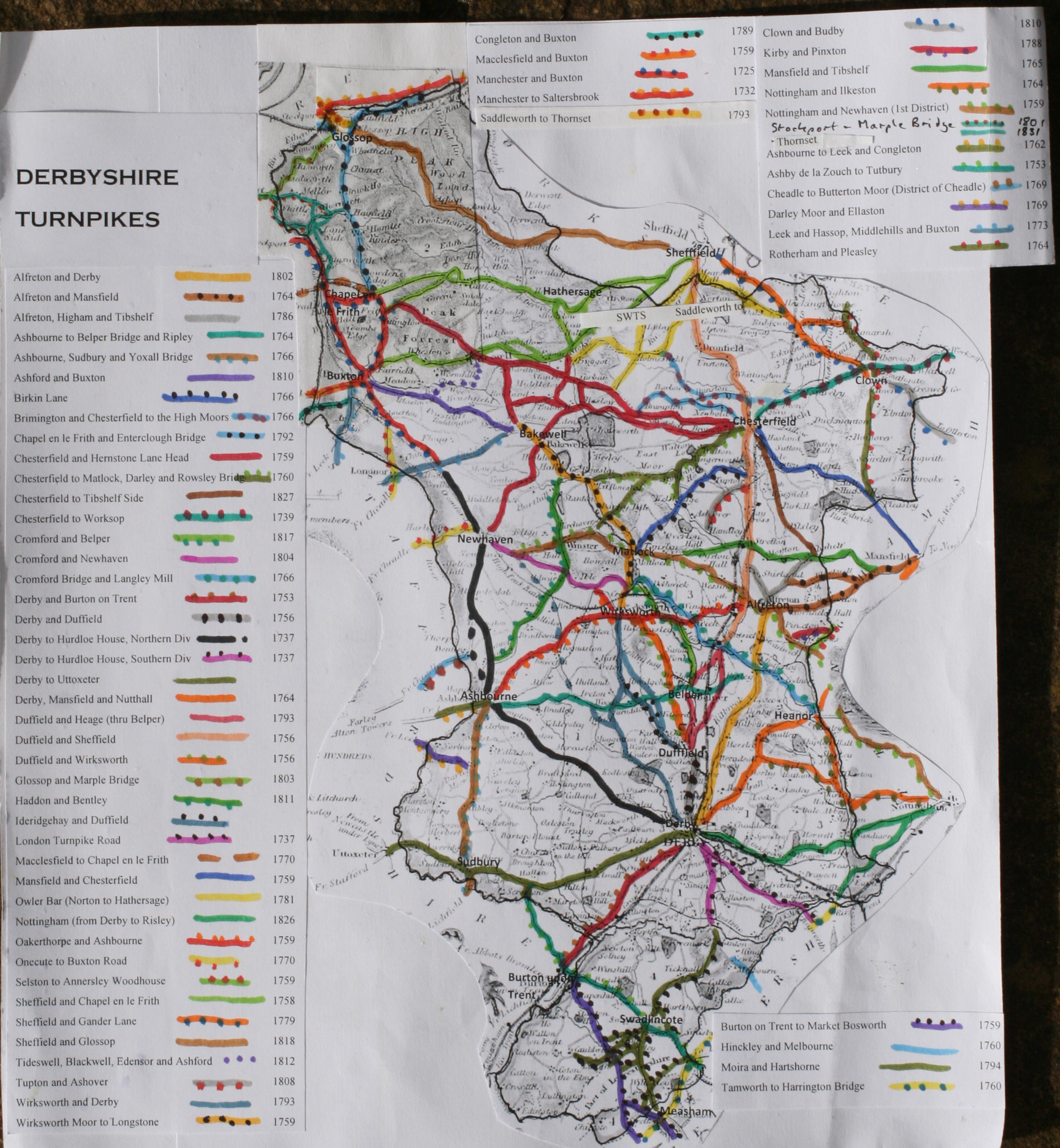
For more information on turnpike roads visit the turnpikes.org website. Their map of Derbyshire roads shows every turnpike colour coded with dates of opening.
 http://www.turnpikes.org.uk/map%20Derbyshire%20turnpikes.jpg
Explore the site for similar maps of the whole country and the history of these roads. There are also pages listing known tollbars and toll houses for each county.

Fernilee Toll Cottage in 1939.


Bugsworth Toll Bar.