

Tuesday, 7 July 2020
Yeardsley Cum Whaley
Yeardsley-cum-Whaley is a name that is often seen on old documents. This was the name of a township within the ancient parish of Taxal. In 1866, Taxal became a civil parish but was abolished in the 1936 boundary changes when it transferred from Cheshire to Derbyshire. The map below shows the township boundaries as well as adjacent townships. As can be seen from the map, the northern half of Furness Vale fell within the Disley township and parish.


Thursday, 18 June 2020
Reuben Wharmby of Furness Vale
Reuben Wharmby was born in 1914 and lived in Canal Row where
his mother ran a small general store. The shop was probably at number 7, in the middle of the row and had a good trade amongst passing boatmen. In the 1920s the business re-located to the house by the canal bridge, formerly the beerhouse The Jolly Sailor/Traveller's Call. On leaving Furness Vale school, he bought a small lorry and established a fruit and vegetable round in the village and neighbourhood.
Listen to this 1999 recording by the Imperial War Museum where Rubin tells of his life in pre-war Furness Vale and New Mills and of his wartime experiences: https://www.iwm.org.uk/collections/item/object/80018207
Listen to this 1999 recording by the Imperial War Museum where Rubin tells of his life in pre-war Furness Vale and New Mills and of his wartime experiences: https://www.iwm.org.uk/collections/item/object/80018207
A full transcript of Reuben's story may be read here: https://furnesshistory.blogspot.com/p/reuben-wharmby-of-furness-vale.html


Saturday, 13 June 2020
Crowning The Whaley Bridge Rose Queen
Every
year a lucky young lady was voted as Rose Queen for the year and as
always she was crowned on the front lawn of Taxal Rectory by a notable
personality.
This would be usually a local councillor or some
equally obscure nobody. But things changed in 1950 when Miss Clarke won
the award. And who was announced to crown her? Well when the door opened
the Minister welcomed in Mr. Albert Pierrpoint the infamous hangman.
Until then a hangman kept his job secret, even from his wife.
But
Pierrepoint had become famous after executing many German war criminals. After the ceremony he spent the rest of the afternoon in the
Royal Oak in Taxal.
He was also seen on occasions in the Board Inn and The Shepherd's Arms.
Tony Beswick
Albert Pierrepoint was himself a publican, first at Hollinwood and later at Much Hoole near Preston. In 1950 he hanged James Corbitt at Strangeways, one of his own customers.
| |||

Monday, 8 June 2020
A Wayward Italian
May 1908 saw the appearance of an Italian named Soberti
Diego before Stockport Police Court. He
was charged with being on enclosed premises for unlawful purposes and with
assaulting a police officer in Whaley Bridge on April 27th. Diego had been seen climbing from a wagon up
into the rafters of the goods warehouse at the station. The prisoner had
refused to descend and when the police constable arrived he jumped onto a van
and threw a stone at the officer, which hit him in the chest. Diego jumped over the wagons and tried to
escape but the pursuing policeman fell over him and a desperate struggle
ensued. The prisoner had a razor with
which he attacked the officer, cutting his hand. It was only when support arrived that the Italian was
overpowered. Speaking through an
interpreter, Diego explained that he had arrived in England seven months
previously and finding himself in Whaley Bridge without food or money, decided
to head to London. He thought he would
be safe hiding in the rafters until a train should arrive. He had only used the razor to prevent the
police officer from choking him.
Soberti Diego was sentenced to 28 days in prison and advised to leave
the country as soon as he was released.

Sunday, 7 June 2020
Off The Rails

On Monday 9th September 1867 the most serious of the local rail incidents took place
on the Midland line. A goods train had
entered the tunnel between Chapel and Peak Dale and had stopped to unload
gravel for track maintenance. Against
the rules, a following train carrying 1000 sheep and cattle was allowed to
enter the tunnel shortly after 5pm, where it crashed into the stationary ballast train. A little girl had taken some clogs to her
father, a blacksmith called Vaines, who was working in the tunnel and together they were in one of the
wagons. She was the first fatality of the day.
Several other workmen were injured.
Two engines hauled the cattle train and these left the track causing the
23 cattle trucks to become detached and these started to roll backwards. On leaving the tunnel, the guard and three
drovers jumped and their injuries were not known. The telegraph wires were out of order and it was not until the wagons sped through Bugsworth that the signalman there, was
able to warn New Mills and have the signals set to danger. The train was seen approaching New Mills at 6pm A passenger express had already set off
from New Mills and was halted by the signal after some distance. Driver Cooper set the train in reverse and he,
the fireman and guard all jumped off.
There was still a collision in which four cattle drovers were killed and
a fifth injured. Many sheep and cattle
lay dead amongst the wreckage. The express in the meantime was still travelling
backwards out of control and its speed increased due to the collision. The train was not brought to a halt until directed into a
siding at Romiley. None of the passengers were injured although some suffered
from shock.
Saturday, 6 June 2020
Bridgemont
A postcard from Tony Beswick featuring Bridgemont
The picture is undated and there is not a vehicle in sight. The street is lit by gas lamps which continued in use until 1955. The Dog and Partridge has a car park sign so they are already catering for motor trade. In the distance is the phone box in front of the Bridgemont Mission. It is the K1 style introduced in 1921 and made from cast concrete. Opposite the pub is the Post Office with a sign advertising Star Cigarettes.

The picture is undated and there is not a vehicle in sight. The street is lit by gas lamps which continued in use until 1955. The Dog and Partridge has a car park sign so they are already catering for motor trade. In the distance is the phone box in front of the Bridgemont Mission. It is the K1 style introduced in 1921 and made from cast concrete. Opposite the pub is the Post Office with a sign advertising Star Cigarettes.

Historical Interactive Map of Whaley Bridge
Use the mouse wheel to zoom in and out of the map. Left click and drag to pan. Click on the icons for further information on each location.
Thursday, 21 May 2020
Bonus Sweatmore
Bonus Sweatmore started work at Knowles Brickyard in 1930, aged 16.
49 years later, on 1st June 1979, he retired and was presented with a clock by his employers.
Bonus lived first in St George's Road in New Mills before moving to a newly built bungalow on Marsh Lane in the 1970s. He walked to and from work every day, come rain or shine. He was able to enjoy a long retirement before passing away in 2008.
Few people spend all their working days with one employer but having left school, Bonus Sweatmore found a "job for life".
Bonus was born in December 1915 and married in March 1940.


49 years later, on 1st June 1979, he retired and was presented with a clock by his employers.
Bonus lived first in St George's Road in New Mills before moving to a newly built bungalow on Marsh Lane in the 1970s. He walked to and from work every day, come rain or shine. He was able to enjoy a long retirement before passing away in 2008.
Few people spend all their working days with one employer but having left school, Bonus Sweatmore found a "job for life".
Bonus was born in December 1915 and married in March 1940.

Bonus, photographed at the wedding of his daughter Ann in 1965

Bonus and Ann in his garden in 2003

The inscription on the clock reads: "Presented by Messrs R E Knowles Ltd to Bonus Sweatmore in recognition of his 49 years faithful service with the company 1st June 1979"

Knowles Brickyard, Furness Vale. Bonus Sweatmore's place of work for 49 years.
Death by Poisoning
 |
Brookfield House, Reservoir Road
She was somehow ‘involved’ with a local police officer, Police Constable Gage from Bridgemont. She told other servants that she and Gage used to meet on Reservoir Road and go to the hen house for a drink.
One Saturday night she got off the Buxton train at Whaley Bridge and started to walk up Reservoir Road to Brookfield House where she was ‘in service’. She was followed by PC Gage from Bridgemont as witnessed by Frank Collier who was employed at Botany Bleach Works. PC Gage did not see Frank Collier.
It was rumoured locally that the girl was pregnant but if it was true it never came out officially.
The next day the young lady was found dead in William Eyre’s hen run and, not intended as a pun, foul play was immediately suspected. The hen run was in the field opposite Brookfield House. The field is now owned by Grant Ford and the hen house is still there after all these years.
A post mortem revealed that the girl had been poisoned with a very rare poison. The police made enquiries at all the local chemists and the only person who had acquired this type of poison was Police Constable Gage. Gage was suspected of murdering the girl and was summoned as a witness/suspect to the inquest held at the Mechanics Institute on Market Street in Whaley Bridge.
The number of people who wanted to attend the inquest was far too many than the building could cater for so seats were fixed on the pavement outside and loudspeakers were erected so that those people could at least hear the proceedings. Gage was very evasive with his answers to the Coroner. When asked why he had bought the very same poison that killed the girl he said he knew nothing about it and he had simply bought the poison to end his dog’s life as it was suffering from a medical condition. The Coroner asked Gage where he had buried the dog so that checks could be made on its body. Gage said he had thrown it in the fire-box at Blandola Riddle Works in Bridgemont close to where he lived. Asked where he had kept the remains of the poison so that could be also checked he said he had also thrown that in the fire-box.
The jury was ordered to return an open verdict and Gage was free to go. He was transferred the next day to take up duties in Northwich and nobody was ever charged with the poor girl’s murder.
Below is a photo of Grant Ford’s field before his house was built and the hen house is in the corner. You can see the Masonic Hall in the background at the entrance to the Park.
Tony Beswick

Saturday, 9 May 2020
Gerald Hallworth
We are sad to hear that Gerald Hallworth of Ringstones Farm passed away last week.
Born in Stockport, in February 1928, Gerald was 92 years of age.
He had lived at Ringstones since 1953, mostly farming dairy cattle, with a herd of 50 at its largest. At times, he also kept pigs and poultry.
Gerald was a good friend to the History Society and was often seen at our meetings and events. He will be very much missed in Furness Vale.
Born in Stockport, in February 1928, Gerald was 92 years of age.
He had lived at Ringstones since 1953, mostly farming dairy cattle, with a herd of 50 at its largest. At times, he also kept pigs and poultry.
Gerald was a good friend to the History Society and was often seen at our meetings and events. He will be very much missed in Furness Vale.
Thursday, 7 May 2020
An Anniversary Tale
On this day in 2001, Great Train robber, Ronnie Biggs was finally captured on arrival home from exile in Brasil.
Tony Beswick writes about his colleagues:

Tony Beswick writes about his colleagues:
Another brief tale and this time about Bennetstone Hall.
After
the Great Train Robbery some of the gang escaped from prison and
obviously had quite a bit of money. One such person was Charles Wilson.
He was rumoured very strongly to have stayed at the Hall. He would be
right up Gerry Adshead's street. Gerry liked money and characters. It
was said that Wilson used to sit quietly at one end of the bar drinking.
Apparently even the police knew he was living there and spent some time
drinking with him.
Don't forget there was a lot of sympathy
for the robbers after their excessive sentences and they became sort of
heroes. Wilson did get caught and I think he was the last man to be
released. He was asassinated in Spain years later. Others got away
scott free.
Bruce Reynolds, the mastermind, after he was finally
released did one last job: he broke into a mansion in Macclesfield,
opened the safe and stole £50,000.00 He thought he would have to go on
the run again but the crime was never reported.

Charles Wilson
Wednesday, 6 May 2020
Historic Furness Vale in pictures
A selection of photographs of the village from the collection of Tony Beswick. He will be adding to this album in the coming days.

A group photograph of Bugsworth School from Tony Beswick. The picture is undated but the style of dress suggests the Edwardian period.
 Carr Farm and the view across to New Mills. The spire of St. George's Church is prominent on the horizon. The white cottage between the railway line and Marsh Lane was known as Nob Hall.

A group photograph of Bugsworth School from Tony Beswick. The picture is undated but the style of dress suggests the Edwardian period.

Thursday, 30 April 2020
Shudehill
Shudehill was for long, the home to many of Manchester's markets: The Hen Market, The Apple Market, The Potato Market. As the city grew, so the markets expanded and stalls were to found selling every nature of produce. In 1822 it was given the name Smithfield. In the mid 19th century glazed, iron framed halls were built covering an area of four and a half acres.
Next to the Hen Market was Ye Olde Rover's Return, built in 1306. Not always a public house, it had originally been a manor house for the Wythin Grave family.

Shudehill was an ancient highway which until the 1820's was still on the edge of the countryside. 16th century Bradshaw Hall had extensive grounds and even a large orchard. Very soon however, the rapidly expanding city absorbed all of this open country.
Furness Vale Shops, Pubs and Businesses
Try our new interactive map. Zoom in and out, then click on each marker for more details and photographs
Wednesday, 29 April 2020
The Libraries Of Manchester

Chetham's Library
The oldest library is Chetham's which has been a free public library since 1653, the oldest in Britain. The collection contains over 100,000 books, the majority published before the mid 19th century
The Chethams complex includes one of Manchester's oldest buildings dating from 1422. Built as a manor house, this became a priest's hostel, being alongside the Collegiate Church, now Manchester Cathedral. During the Civil War, it served first as a gunpowder factory and later a prison.
Sir Humphrey Chetham 1580 - 1653 was a successful cotton merchant. He had been educated at Manchester Free Grammar School which was then sited between the later Chetham's Hospital and the Church. He was offered a knighthood in 1631 due to his great wealth and was fined for refusing the honour. He was not able to refuse the post of High Sheriff of Lancashire in 1635 nor of General Treasurer in 1643. He feared that on his death, his wealth might be taken by the Crown and for this reason he bequested money for the establishment of Chetham's Hospital which was to support 40 poor boys and Chetham's Library together with funds for the purchase of books. 24 feoffees or trustees were appointed to manage and stock the library and their aim was to rival the university libraries of Oxford and Cambridge. The building was extended during the Victorian era as was the Grammar School, the latter moving to it's present site in Fallowfield in the 1930's. The books were originally chained although that practice ended in the mid 18th century.
Karl Marx and Friedrich Engels were frequent visitors to Chetham's and a reference book and bench seat mark the spot where they used to meet.
Chetham's Library is open Monday to Friday and visitors are welcome. An appointment must be made in order to read any of the collection.
Further information : http://www.chethams.org.uk/index.html

-------------------------------------------------------------------------------------------------------------------
Sunday, 26 April 2020
A Secret Tunnel Under Deansgate
When workmen demolished old houses in Cumberland Street in 1911, they came across an underground passage. The Manchester City News reported that they found a tunnel with an arched roof, built of brick, wide and high enough to allow a horse and cart to travel along it. The men found that it extended for about 70 yards before being blocked by a brick wall. A pedestrian route through the Spinningfields development now follows the line of Cumberland Street, close to John Ryland's Library.
 The Cumberland Street site.
The Deansgate Tunnel has never been fully documented or surveyed and evidence of its existance and extent is based upon rare glimpses and hearsay. Its age is unknown but it is assumed to be between 200 and 300 years old. Its purpose is unknown. There are even suggestions that it might be Roman in origin.
The tunnel is believed to start near the northern end of Deansgate, close to the Cathedral and to follow the line of the road southwards as far as Knott Mill. Here the tunnel turns westwards towards Old Trafford.

The Deansgate Tunnel has never been fully documented or surveyed and evidence of its existance and extent is based upon rare glimpses and hearsay. Its age is unknown but it is assumed to be between 200 and 300 years old. Its purpose is unknown. There are even suggestions that it might be Roman in origin.
The tunnel is believed to start near the northern end of Deansgate, close to the Cathedral and to follow the line of the road southwards as far as Knott Mill. Here the tunnel turns westwards towards Old Trafford.
Tuesday, 21 April 2020
Shopping in Furness Vale
We will take an imaginary shopping expedition to Furness Vale.
We have had plenty of shopkeepers in the village. There are over 30 addresses, although not all of these traded at the same time and some closed many years ago. How many can you remember?
At one time, there were two fish and chip shops as well as a fishmonger. We had a tailor, a milliners, dress shops and a candle maker. There was even a clockmaker at Ringstones.
Who can remember the undertaker with his stock of coffins lining the wall and the hearse waiting to perform its duties?
Do you remember the wool shop with its colourful window displays. Many women knitted in the past and this craft is again becoming popular. I’m told that even men are learning so it’s a shame that it closed. There were always drapers and haberdashers because so many clothes were hand made.
Every shop had it’s own distinctive aroma, whether that of freshly sliced bacon or newly baked bread, paraffin at the ironmongers or earthy potatoes at the greengrocers. Many of these businesses would have mahogany counters and fittings, always well polished. Colourful sweets arranged in gleaming jars to tempt the eyes of youngsters and weighed out a quarter at a time. Some of us will remember when flour and sugar and sometimes butter was weighed out to order and packed in a blue or white bag.

We’ll hear of Reuben our travelling yeast dealer, of two ghosts, a pub with two names, closed because of disorderly conduct and finally we’ll take a boat trip to the tea rooms.
We are going on a tour of the shops and pubs of Furness Vale.
We will start at the southern end of the village at a house called Hollins View, which stands in front of the old quarry. There was never a shop here but if you needed your shoes soled and heeled in the 1940’s, a cobbler worked from a shed in his back garden.
Sunday, 19 April 2020
A Dangerous Road
William Wood
The murder of William Wood in July 1823 is well recorded. He was killed at a lonely spot on Buxton Old Road at Longside on Whaley Moor. This is the old roman road between Disley and Whaley Bridge and at that time was in Cheshire. The spot is marked by a commemorative "Murder Stone".

Wood, a cotton weaver from Eyam, was returning home from Manchester where he had sold his cloth and had received about £100 in payment. He travelled on foot and at Disley, called at a pub for refreshment. He got into conversation with three men and later continued on his way. After about ten minutes, the three left the pub and followed in Wood's direction catching up with him after a mile or two. Wood was beaten to death with stones and left at the roadside where his partly concealed body was later discovered. Wood's body was taken to the Cock Inn in Whaley Bridge where the coroners inquest was held a few days later.
The murder of William Wood in July 1823 is well recorded. He was killed at a lonely spot on Buxton Old Road at Longside on Whaley Moor. This is the old roman road between Disley and Whaley Bridge and at that time was in Cheshire. The spot is marked by a commemorative "Murder Stone".

Wood, a cotton weaver from Eyam, was returning home from Manchester where he had sold his cloth and had received about £100 in payment. He travelled on foot and at Disley, called at a pub for refreshment. He got into conversation with three men and later continued on his way. After about ten minutes, the three left the pub and followed in Wood's direction catching up with him after a mile or two. Wood was beaten to death with stones and left at the roadside where his partly concealed body was later discovered. Wood's body was taken to the Cock Inn in Whaley Bridge where the coroners inquest was held a few days later.
Friday, 17 April 2020
Some Derbyshire Customs.
In 1817, John Farey's book ,"General View of the Agriculture and Minerals of Derbyshire" was published. One of the later chapters of Volume 3, reviewed some of the customs prevalent in the county.
An ancient custom still prevails in Chapel-en-le-Frith, Glossop, Hayfield, Mellor, Peak Forest and other places in the north of the county, I believe, of keeping the floor of the Church, and pews therein, constantly strewed or littered, with dried rushes: the process of renewing which annually, is called the rush bearing, and is usually accompanied by much ceremony. The rush bearing in Peak Forest,is held on Midsummer Eve, in each year.
In Chapel-en-le-Frith, I was informed, that their Rush-bearing usually takes place in the latter end of August, on public notice from the Churchwardens, of the rushes being mown and properly dried, in some marshy part of the Parish, where the young people assemble; and having loaded the rushes of carts, decorate the same with flowers and ribbons, and attend them in procession to the church; many of them buzzing and cracking whips by the side of the rush carts, on their way thither; and where every one present lends a hand, in carrying in and spreading the rushes.
 Rush-bearing procession in Glossop
Instead of the harvest home feasts of most districts, what is called (I don't know why) "Hare-getting" or "Hare-supper", is given by the corn farmers in some parts of Derbyshire, to their reapers, or shearers as they are here called, and their wives, on finishing the cutting of their corn; and it is usual for such shearers, "to give three cheers on first setting to", to shear or mow, and "three wheeps and a hallow", on finishing the cutting.
An ancient custom still prevails in Chapel-en-le-Frith, Glossop, Hayfield, Mellor, Peak Forest and other places in the north of the county, I believe, of keeping the floor of the Church, and pews therein, constantly strewed or littered, with dried rushes: the process of renewing which annually, is called the rush bearing, and is usually accompanied by much ceremony. The rush bearing in Peak Forest,is held on Midsummer Eve, in each year.
In Chapel-en-le-Frith, I was informed, that their Rush-bearing usually takes place in the latter end of August, on public notice from the Churchwardens, of the rushes being mown and properly dried, in some marshy part of the Parish, where the young people assemble; and having loaded the rushes of carts, decorate the same with flowers and ribbons, and attend them in procession to the church; many of them buzzing and cracking whips by the side of the rush carts, on their way thither; and where every one present lends a hand, in carrying in and spreading the rushes.

Instead of the harvest home feasts of most districts, what is called (I don't know why) "Hare-getting" or "Hare-supper", is given by the corn farmers in some parts of Derbyshire, to their reapers, or shearers as they are here called, and their wives, on finishing the cutting of their corn; and it is usual for such shearers, "to give three cheers on first setting to", to shear or mow, and "three wheeps and a hallow", on finishing the cutting.
Thursday, 16 April 2020
Back In The Seventies


Wednesday, 15 April 2020
Industrial Tracks
Some people still remember the tramway that ran from Furness Colliery
down to the canal and railway siding. It passed under Buxton Road and
beneath the building that is now the (closed) Fish and Chip shop. It was
recorded by John Farey in his 1817 books about the agriculture and
minerals of Derbyshire. The railway was still in use until the early
1960s.
Less known is the railway, also mentioned by Farey, that linked Furness Vale Quarry with the canal. It ran through the tunnel, which of course still exists, to the two canal wharves owned by the quarry company. Building stone was shipped to Manchester and Stockport. It does not appear on any maps. The quarry was in operation until at least the 1960s but the railway must have been removed long ago.

Ringstones Colliery which closed in 1896 was linked to the canal at Bridgemont. Rather than a railway or tramway, the mine employed an overhead ropeway which carried coal in suspended tubs. One stone tower remains in Ringstones Clough, all other remnants have long disappeared. Again, this was never mapped.

Less known is the railway, also mentioned by Farey, that linked Furness Vale Quarry with the canal. It ran through the tunnel, which of course still exists, to the two canal wharves owned by the quarry company. Building stone was shipped to Manchester and Stockport. It does not appear on any maps. The quarry was in operation until at least the 1960s but the railway must have been removed long ago.

Ringstones Colliery which closed in 1896 was linked to the canal at Bridgemont. Rather than a railway or tramway, the mine employed an overhead ropeway which carried coal in suspended tubs. One stone tower remains in Ringstones Clough, all other remnants have long disappeared. Again, this was never mapped.

Tuesday, 14 April 2020
St.John's A.F.C.
A photograph of St.John's Church football team. The picture is undated but appears to be c1920s. Any information would be appreciated
photograph courtesy of Bernard Rogers

photograph courtesy of Bernard Rogers

Mevril Bleach Works
Another picture from Mevril Bleach Works. This group photograph is from the 1950s. Does anybody know what the occasion was or who these people are? The works, at Horwich End, closed in the early 1960s.
photograph courtesy of Bernard Rogers

photograph courtesy of Bernard Rogers

Peace Day
Although hostilites ended in 1918 and November 11th is each year marked by the Festival of Remembrance, the First World War did not officially come to an end until the signing of the Treaty of Versailles on 28th June 1919. The event was celebrated on 19th July when Peace Day saw processions throughout Britain. In Whaley Bridge, a float is photographed outside Mevril Bleach Works at Horwich End.
photograph courtesy of Tony Beswick

photograph courtesy of Tony Beswick

Tuesday, 7 April 2020
OLD AMUSEMENTS AT BUXTON
In a curious black letter book entitled "The benefit of the auncient Bathes of Buckstones, which cureth most greeuous Sicknesses, neuer before published; compiled by John Jones Phisition at the Kings mede nigh Darby, anno salutis 1572," is the following description of exercises and amusements adapted to the invalid.
To the sickly (says the author) small exercyse will serue, by reason of feeblenesse, not able too suffer pantynge, neyther verily so violent for them shalbee requysite. But if their strength will sustayne it, an exercyse conuenient for thyr callinge shalbee vsed
Trol in Madam. The Ladyes, Gentlewomen, Wyues, and Maydes maye in " one of the galleries walke ; and if the weather bee not agreeable to their expectacion they may haue in the end of a Benche, eleuen holes made, intoo the which to trowle pummetes or bowles of leade, bigge, little or meane or also of copper, tynne, woode, eyther vyolent or softe, after their owne discretion. The pastyme Trowle in Madame is termed.
Lykewise, men feeble the same may also practise, in another gallery of the newe buyldinges, and this dooth not only strengthen the stomack, and vpper parts aboue the mydryfe, or wast,but also the middle partesbeneath the sharp gristle and the extreme partes as the handes and legges, according to the wayght of the thing trouled fast, soft or meane.
Bowling. In lyke mannerbowling in allayes, the weather conuenient and the bowles fitte to suche game, as eyther in playne or longe allayes, or in suche as haue cranckes with halfe bowles, which is the fyner and gentler exercise.
Shoting the noblest exercyse.
Shootinge at garden buttes, too them whom it agreeeth and pleaseth, in place of noblest exercyse standeth, and that rather wyth longe bowe, than wyth tyller, stone bowe, or Ccrosse bowe.Albeit to them that otherwyse cannot, by reason of greefe, feeblenesse, or lacke of vse, they may be allowed.
This practise of all other manlyest, leaueth no part of the body vnexercised, the brest, backe, reynes, was, and armes, with drawing the thyghes, and legges, with running or going.
Wind ball, or yarne ball. The wind baule, or yarne ball, betwene three or foure, shall not be invtile to be vsed, in a place conuenient, eache keeping theirlimite for tossing, wherin may bee a very profitable exercise, by cause at all tymes they keepe not the lyke force in stryking, so that they shalbee constrayned too vse more violent stretching, with swifter mouing at one tyme than another, which will make the exercise more nymble and deliuerr, both of hand and whole body, therefore encreasing of heat, through swift moouing, in all partes the sooner.
Plumbes, or weightes. Plumbetes, of Galene termed alteres, one borne in eche hand, vp and downe the stayers, galeries, or chambers, according to your strength, maye bee a goode and profitable exercise: so may you vse wayghtes in lyke maner.
Bow lyne. A fyne hallyer, or bowe lyne, a foote or twoo hyer then a man may reache, fastened in length, some way, shall not bee vnprofitable, holden by the handes, thereby to streche them; very excellent, as well for stretching of the mydrife, interne panicles and wast, with all the rest of the partes, as also to preserue and defend them from apostemes, obstructions, and paynes thereto incident.
These exercyse of your owne power, I thinke, for thys place sufficient. Nowe we will shewe how they may bee profitable vnto you thorow others mouing; as well by waggon, charriet, horselitter, and ryding, as by cradle and chayor hanged, in sorte as to that vse may be best framedd, all very profitable, as they may bee exercised: much, little, or meane, close, or open in the ayre, as to the parties shall bee requisite: taking time likewyse in rocking by vice or engyne; or on the floure, which is more shaking, and therefore to them that may suffer it more profitable.
The other good to weaker persons, as that in frame, conueyed by pendent, from one to another, standing asunder according to the length of the engyne, three or iij fedome drawen from them to the other, swift, slow, or meane, long, short, or mean, as to the party shalbe conuenient. Omitting other deuises to opportunity, &c.
Eu. Hood
published in The Gentleman's Magazine 1824

Sunday, 5 April 2020
Iron Age Furness Vale
The name of our village is a corruption of its original name "The Furnace" which died out of use in the early 19th century.
The Journal of the Historical Society of Lancashire and Cheshire reported in 1957, on the existance of the original "furnace" as recorded in the Jodrell family archives at John Ryland's Library.
Disley furnace was situated on land of the Jodrell family, on the boundary of Yeardsley Whaley. It is first noticed in the 1690s when small quantities of "Jodrell pig" were being received at the south Yorkshire forges, but in 1702 some of its produce found its way as far as Carburton forge in Nottinghamshire. An estimate of the estate for 1737 shows it to have been worth a rent of £50 and then in the hands of Samuel Bagshaw, whilst in 1770 the tenant was Joseph Lowe.
(The locations, Disley and Yeardsley Whaley refer to the relative parishes. The boundary between these being the Furness Brook)
Burdett's Map of Cheshire, published in 1777 shows the furnace which was apparently still in operation at that time.
The Journal of the Historical Society of Lancashire and Cheshire reported in 1957, on the existance of the original "furnace" as recorded in the Jodrell family archives at John Ryland's Library.
Disley furnace was situated on land of the Jodrell family, on the boundary of Yeardsley Whaley. It is first noticed in the 1690s when small quantities of "Jodrell pig" were being received at the south Yorkshire forges, but in 1702 some of its produce found its way as far as Carburton forge in Nottinghamshire. An estimate of the estate for 1737 shows it to have been worth a rent of £50 and then in the hands of Samuel Bagshaw, whilst in 1770 the tenant was Joseph Lowe.
(The locations, Disley and Yeardsley Whaley refer to the relative parishes. The boundary between these being the Furness Brook)
Burdett's Map of Cheshire, published in 1777 shows the furnace which was apparently still in operation at that time.
John Farey, writing in his 1811 book "General View of the Agriculture and Minerals of Derbyshire", claims that he observed slag and remains of old bloomeries and charcoal furnaces at Jow Hole. A bloomer was a type of furnace once commonly used for smelting iron and was fired with charcoal. These were once common in England until most of the available woodland had been denuded. By 1806, just eleven remained in use. The illustration below is a cut-away diagram of a typical bloomer. These were quite small, perhaps no more than 1.5 metres high and made from stone or clay.

This next illustration is of a Roman Bloomery. The principle remained the same.

We must assume that there was a ready supply of iron ore close by. John Farey desribes the methods of obtaining ironstone. "In the early periods, the method of obtaining ore was by removing the soil layer and exposing the mineral beds. These open cast workings were known as Rakes. After these had been worked out, a method of working called Bell-work,was adopted. A roundpit, of the usual size of a shaft, is sunk, until the ironstone is reached, from 3 to 10 tards deep, the first two or three yards being made cylindrical, and the part below it, conical, in order to reach a larger surface of the stone, which being got below the shaft,and a drain laid across it for connecting with the next pit, the workment, or ironstone-men, begin to hollow out the measures all around the shaft into the form of a bell (whence the name), throwing the refuse into the centre, and getting the ironstone as far under as possible on all sides: which done, the pit is abandoned, and another began at a proper distance, the soil from which is tumbled into the last pit, as fast as it is drawn, until the stone is reached and got as before, when another pit is begun and so on."
The location of the furnace is uncertain. Farey states that it was at Jow Hole ( Gow Hole ), later historians believe it to have been close to where Rotational Mouldings is now sited.
Iron ore was to be found locally, between the coal seams.
Beware the Ides of March
Is the black dog to be feared or is it a good omen? This apparition has frequently been reported throughout Britain and according to legend has huge red eyes like glowing coals that can see right into ones soul. Other stories tell of black dogs that help farmers to round up sheep.

The dog at Cockyard appears from nowhere at dusk and follows one down the hill towards Combs where it vanishes just as mysteriously.
On the opposite hillside above Tunstead, along Eccles Road, The Black Dog of Ollerenshaw makes his appearance at the Ides of March. Not far away, at Barmoor Clough a black dog has been seen emerging from a culvert. In the long tradition of ghostly apparitions, this one carries his head tucked under his arm. Whilst here we must mention the curious "ebbing and flowing" well. This natural spring would flow and then cease without any regular pattern but has dried up since work was carried out on the railway tunnel. Near Horwich End is Hob Croft, a name centuries old which refers to the presence of a hob or hobgoblin. These are benevolent yet supernatural creatures which usually make their appearance when the household is asleep. In return for a little food they will tidy up, do the dusting and sweeping and sometimes even the ironing. Take care not to upset a hob for then it will take great delight in mischief and practical jokes. They resemble small hairy men and are notoriously difficult to get rid of.
High Peak News
10 December 1910
strange stories of a “ghost”
seen by several persons
Whaley Bridge and the district is excited over the strange stories which are circulating about a ghost having been seen by several people at Elnor Lane, a lonely road which leads to Buxton. The story goes that the “ghost” is in the shape of a large dog of the greyhound type, and that the dog walks on in front or sometimes by the side of the person, but when anyone has stooped down to stroke it, it has vanished into thin air ! Those who have witnessed this peculiar phenomenon declare that it causes a most creepy sensation.
Only recently two men were going from Fernilee, when they espied a large dog in front of them, which was described as having a luminous appearance. One of the men was so startled that he commenced to run to Fernilee, but the other stayed behind and tried to stroke the animal, but it vanished. It is stated that the “dog ghost” has been seen frequently in the neighbourhood of Elnor House, which is situated in this lonely locality.
The dog at Cockyard appears from nowhere at dusk and follows one down the hill towards Combs where it vanishes just as mysteriously.
On the opposite hillside above Tunstead, along Eccles Road, The Black Dog of Ollerenshaw makes his appearance at the Ides of March. Not far away, at Barmoor Clough a black dog has been seen emerging from a culvert. In the long tradition of ghostly apparitions, this one carries his head tucked under his arm. Whilst here we must mention the curious "ebbing and flowing" well. This natural spring would flow and then cease without any regular pattern but has dried up since work was carried out on the railway tunnel. Near Horwich End is Hob Croft, a name centuries old which refers to the presence of a hob or hobgoblin. These are benevolent yet supernatural creatures which usually make their appearance when the household is asleep. In return for a little food they will tidy up, do the dusting and sweeping and sometimes even the ironing. Take care not to upset a hob for then it will take great delight in mischief and practical jokes. They resemble small hairy men and are notoriously difficult to get rid of.
High Peak News
10 December 1910
strange stories of a “ghost”
seen by several persons
Whaley Bridge and the district is excited over the strange stories which are circulating about a ghost having been seen by several people at Elnor Lane, a lonely road which leads to Buxton. The story goes that the “ghost” is in the shape of a large dog of the greyhound type, and that the dog walks on in front or sometimes by the side of the person, but when anyone has stooped down to stroke it, it has vanished into thin air ! Those who have witnessed this peculiar phenomenon declare that it causes a most creepy sensation.
Only recently two men were going from Fernilee, when they espied a large dog in front of them, which was described as having a luminous appearance. One of the men was so startled that he commenced to run to Fernilee, but the other stayed behind and tried to stroke the animal, but it vanished. It is stated that the “dog ghost” has been seen frequently in the neighbourhood of Elnor House, which is situated in this lonely locality.
Wednesday, 1 April 2020
Three Spinsters and a Fortune in Coal
 |
| Stonehouse Farm, Hayfield |
Stonehouse Farm on Edale Road in Hayfield, was in the
eighteenth century, the home of the Hall family. There are records of this
family in Hayfield from at least the 1600s.
Joseph, born on 14th December 1777, was their second son. He
would not inherit the property nor did
he have any interest in the family sheep farm. On reaching adulthood, he rented
a home in Birch Vale and found employment in the small coal pits then being
worked on Ollerset Moor. The building of the Peak Forest Canal and the Peak Forest
Tramway, saw the establishment at Bugsworth of a number of lime kilns. Here was
a ready market for the locally mined coal, despite its poor quality. Much of
Ollerset Moor was owned by the Duchy of Lancaster and Joseph was able to obtain
his own leases from them and other landowners, to mine coal in his own right.
He married Hannah Lowe and they moved into Moor Lodge, high on Ollerset Moor
and close to the coalfield. Joseph Hall
died there on 8th August 1843 after falling ill with hepatitis.
Tuesday, 31 March 2020
Shirt's Bridge
There had long been a track or footpath leading from Big Tree Farm on Dolly Lane, towards Waterside. The 1885 Ordnance Survey map shows this crossing the Midland Railway over a bridge which had been buit in 1865. When Gowhole Sidings were constructed, the footbridge was extended in 1903 to span the numerous tracks. This was named and numbered by the railway as Bridge 121 but was sometimes known locally as Shirt's Bridge.

Both the original span and the extension are seen in this photograph taken in the 1940s. The locomotive is No 3271 heading south with a train of empty wagons. A group of three train spotters sit at the trackside. Big Tree Farm is on the hillside

Les Footitt recalls the bridge from the late 1960s:
"It brings back the memory of being with my brothers and friends in the late 1960s. We would always be out exploring up at the disused sidings. As you approached the bridge from Waterside , you would walk through the tunnel to the bridge and the then turn left to go up about 10 stone steps, then turn right up another flight of stone steps until you were on the wooden walkway across to Big Tree. Well, it was at the bottom of the steps that we found that the earth had fallen away revealing a small hole and we could see that it was hollow inside. We returned at a later date with torches and scraped a bit more soil out until we could squeeze through on our bellies into what was to us a secret cave. We went there on numerous occasions to play in the “cave” until we eventually got too big to squeeze through the gap. I think the bridge was demolished in the mid 1970s".
Les also describes the far end of the bridge:
You actually came down a flight of about 10 stone steps from Big tree on to the wooden walkway. so if you were to walk along the bridge from Waterside end towards the Big Tree end all you saw were the stone steps as if it was a dead end and no exit until you were at the bottom of the steps.
The bridge has long been demolished but following the path from Big Tree Farm still leads to a descending flight of steps. The path crosses the site of the sidings at ground level and then passes under the remaining railway tracks through the original tunnel.
Neil Ferguson-Lee's photographs show the view along the bridge with the rising flight of steps at the far end.

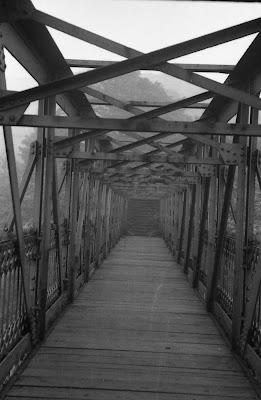
Below is the tunnel under the main railway line. This is the view towards Waterside.


Both the original span and the extension are seen in this photograph taken in the 1940s. The locomotive is No 3271 heading south with a train of empty wagons. A group of three train spotters sit at the trackside. Big Tree Farm is on the hillside

Les Footitt recalls the bridge from the late 1960s:
"It brings back the memory of being with my brothers and friends in the late 1960s. We would always be out exploring up at the disused sidings. As you approached the bridge from Waterside , you would walk through the tunnel to the bridge and the then turn left to go up about 10 stone steps, then turn right up another flight of stone steps until you were on the wooden walkway across to Big Tree. Well, it was at the bottom of the steps that we found that the earth had fallen away revealing a small hole and we could see that it was hollow inside. We returned at a later date with torches and scraped a bit more soil out until we could squeeze through on our bellies into what was to us a secret cave. We went there on numerous occasions to play in the “cave” until we eventually got too big to squeeze through the gap. I think the bridge was demolished in the mid 1970s".
Les also describes the far end of the bridge:
You actually came down a flight of about 10 stone steps from Big tree on to the wooden walkway. so if you were to walk along the bridge from Waterside end towards the Big Tree end all you saw were the stone steps as if it was a dead end and no exit until you were at the bottom of the steps.
The bridge has long been demolished but following the path from Big Tree Farm still leads to a descending flight of steps. The path crosses the site of the sidings at ground level and then passes under the remaining railway tracks through the original tunnel.
Neil Ferguson-Lee's photographs show the view along the bridge with the rising flight of steps at the far end.


Below is the tunnel under the main railway line. This is the view towards Waterside.

Saturday, 28 March 2020
Derelict Dorma
Originally a 19th century paper mill, built by John Sykes, the Forge Bleach Works was for many years occupied by Dorma, manufacturing bedlinen, towels etc. The factory closed in 2005 and stood derelict for some years before the site was redeveloped for housing. Like so many sites that stand empty, Dorma was visited on several occasions by Urban explorers. Here are a few of their photographs:


Sunday, 22 March 2020
Manchester's First Airport

A DeHavilland Moth is pictured at Wythenshaw Airport in 1929.
This aeroplane, a DH 60x model, registered G-EBZU was built in 1928. It was operated by Northern Air Lines until crashing at Irlam in October 1932. Northern Air Lines operated a number of aircraft from this field. These 2 seater Moths could be chartered for a shilling per mile.
This photograph appears to be an advertising opportunity for both BP and Northern Air Lines.
The Moth and its many vairiants were built in the 1920s and 30s. They were operated mostly by flying clubs although many were sold as military trainers and large numbers were exported. The Moth was the most popular aircraft of its day and was produced in large numbers. The Gipsy Moth sold almost 9000 aircraft. When introduced in 1925, the Moth sold for a price of £650.
Mr Tatton, squire of Wythenshaw Hall had in 1926 sold much of his estate to Manchester Corporation for future housing. This was farming country which had been owned by the Tatton family since the 14th centruy. Realising that Manchester would need an airport, the Corporation reserved four fields for that purpose, removed trees and hedges and levelled the ground. Wythenshawe was Manchester’s first municipal airport and opened in April 1929. It was also known locally as Rackheath Aerodrome for it occupied the site of Rackheath Farm. A barn became an aircraft hangar capable of housing just one small aeroplane. and the farmhouse served as the administrative building. As an aid to navigation, a large white circle enclosing the letters M/C was painted on the grass. There was neither lighting nor radio equipment. The airfield was only a temporary arrangement until Barton Airport opened in January 1930 and served only general aviation. Wythenshawe saw its last flight in June of that year. The site was eventually absorbed into the new housing estate which was intended to be a "garden city" and grew to house 100,000 people, the largest public housing development in Europe.
Saturday, 21 March 2020
Sparrowpit and the Wanted Inn
This post concerns the watering hole known as The Wanted Inn.


It
was originally a farmhouse built in 1618 but in 1700 it became a public
house for the first time and was known as The Three Tuns.
But by 1839 the name had changed to The Devonshire Arms.
But
as coaches and taxis dropped people off there who thought they were at
the place holding a function or a party or whatever people soon realised
they were in the wrong pub. They should have traveled a bit further to
Peak Forest to the Devonshire Arms situated there and was a much better
pub.
So it was then renamed The Unwanted Inn.
Eventually
it closed for many years and was then bought by the Buswell family
whose son played the part of Ray Langton in Coronation Street who failed
to turn up for filming one day and was eventually spotted as a Bank
Manager in Las Vegas after firstly working in a casino.
The Buswells called it The Wanted Inn as it is known today.
Below are a couple of photos of the place during a Sparrowpit winter.
I
am not forgetting Bennestone Hall which is alarge topic in its own
right but shortly we must return to Dove Holes village itself.
Tony Beswick


Remembering The Old Clubhouse
When I went to school at Buxton I went from WB to Buxton on the train
and passed it every week day. It was a members’ only club called The
Union Club. It looked very posh and exclusive from the outside.
It was converted in the 70’s to The Old Clubhouse by Chris Brindley, landlord of The Eagle Hotel and Jimmy Milburn, managing director of the building firm Milburn and Mills.
Milburn and Mills had their offices on Lightwood Road on the site of the old outdoor swimming pool. I went there a couple of times as a young lad and it was absolutely freezing. But when M & M took occupation of the site they filled in the pool to make a ‘yard’ and used the changing rooms as their office. I worked there for a year as company quantity surveyor until I could stand it no longer. Everyday somebody would stagger into the office blind drunk and more often than not it would be Jimmy himself. He used to drive a large Mercedes car and took no notice at all of the drink driving laws.
Some mornings he would ring me from his home and ask me to take his kids to school. They were pests and were always trying to make me crash.
Then I would have to go back for Jim as his car wasn’t there. He couldn’t remember how he had got home but we needed to pick his car up from outside The Gaslight Club. It wasn’t there. Ah it must be outside The Queens; not there either. Ashwood Park Hotel then. Wrong. Prince of Wales perhaps.
No chance. Nineteenth Hole. Yes that’s where it will be. But it wasn’t.
Then I spotted it on the grass opposite the Golf Club. Right Jim, there it is, have you got your keys? Er, no.
Well I drove him to the side of the Mercedes and the window was right down and the keys were in the ignition. Ah, I knew I wouldn’t have mislaid them he said. What time is it? Look the Golf Club’s door is open let’s nip in for a few scoops.
Loads more on Jimmy one day
Tony Beswick.
It was converted in the 70’s to The Old Clubhouse by Chris Brindley, landlord of The Eagle Hotel and Jimmy Milburn, managing director of the building firm Milburn and Mills.
Milburn and Mills had their offices on Lightwood Road on the site of the old outdoor swimming pool. I went there a couple of times as a young lad and it was absolutely freezing. But when M & M took occupation of the site they filled in the pool to make a ‘yard’ and used the changing rooms as their office. I worked there for a year as company quantity surveyor until I could stand it no longer. Everyday somebody would stagger into the office blind drunk and more often than not it would be Jimmy himself. He used to drive a large Mercedes car and took no notice at all of the drink driving laws.
Some mornings he would ring me from his home and ask me to take his kids to school. They were pests and were always trying to make me crash.
Then I would have to go back for Jim as his car wasn’t there. He couldn’t remember how he had got home but we needed to pick his car up from outside The Gaslight Club. It wasn’t there. Ah it must be outside The Queens; not there either. Ashwood Park Hotel then. Wrong. Prince of Wales perhaps.
No chance. Nineteenth Hole. Yes that’s where it will be. But it wasn’t.
Then I spotted it on the grass opposite the Golf Club. Right Jim, there it is, have you got your keys? Er, no.
Well I drove him to the side of the Mercedes and the window was right down and the keys were in the ignition. Ah, I knew I wouldn’t have mislaid them he said. What time is it? Look the Golf Club’s door is open let’s nip in for a few scoops.
Loads more on Jimmy one day
Tony Beswick.
 |
| The Old Clubhouse Roof. A watercolour by David Easton
Once Jim decided to splash the cash and he bought a reasonable plot of
land and got Planning Permission to build 3 bungalows and 2 houses. The
design was good and from a distance the properties looked very good. I
won’t mention the location because hopefully they are till standing and
are occupied.
The bungalows were completed first mainly because Jim was going to live in one and his partner Mills in another one. They were virtually complete apart from kitchens, decoration and carpets when there was an unexpected visit from the Structural Engineer who had spotted a mistake on the drawings. There was a point where the roof had inadequate support and needed to be reinforced somehow. He did a quick on site sketch whereby a pillar needed to be built in the hallway and indeed it could be made into a feature if built from stone. Jim agreed immediately. But then the Structural Engineer dropped a bombshell: a foundation would be needed and this meant the concrete floor would need to sawn out and a concrete foundation would have to be put in and he reminded Jim that the hardcore under the slab must not exceed 600mm and that would be where he should find the original clay which he could concrete on. Now I knew full well that the hardcore was at least 1200mm in depth due to the original ground levels and I wondered how Jim would get out of yet another mess. As soon as the Engineer had gone Jim turned to me and said: “Right you. How are you going to get me out of this?” “Well just what do you expect me to do Jim. It is what it is.” As it was Friday I went home and hardly gave it another thought. When I went into the office on the Monday morning Jim arrived at about 11.00am after shaking off yet another severe hang over and he phoned the Engineer and told him the job was done and could he come out after lunch to do a final inspection as Jim was in a hurry to finish the bungalows. The Engineer said that was fine and he would be on site at 2.00pm Intrigued, I went round to the site and we all gathered around the hole which now had a firm clay foundation just below the floor slab level. The Engineer prodded it and declared it suitable to concrete on and gave Jim the go ahead. Jim went to the pub and I went back to the office and shortly Jim’s partner Mills rocked up. And I asked him how such a thing could have happened and he told me Jim had sent Salty the apprentice bricklayer round the back of the 2 houses and dig out some clay and he told him to tip it into the hole and tread it down and then tamp it down to make it look like virgin clay which it did. So as Jim said: “Bob’s your uncle get it concreted in and get on with your work. I’m off to a business meeting.” Which everyone knew meant he was off to The Golf Club or somewhere like that. Tony. |
Subscribe to:
Posts (Atom)