

Monday, 9 January 2017
A view of the Printworks.
This photograph has been digitally colourised from a black and white
postcard titled "Bank View". This is the track leading from the Canal at
Furness Vale down to the Printworks.


Thursday, 24 November 2016
The Cope Family Ventures in Buxworth.
Introduction
Over a three
day weekend in June 1992 the “Friends of Buxworth / Bugsworth School
inaugurated the first “Bygone Buxworth”. It was to be held in Buxworth School.
The turnout was something to write home about. The school was packed to the
gunnel's with past and present villagers jostling to see both the historical
displays and to meet up with long lost friends. The outcome at a post mortem
meeting was that with the numerous offerings of more historical material and
the interest generated, that a further 10 day exhibition would be staged when
the school was not operational during the summer. This occurred in the summer
of 1994.

A taste of what
was on offer in 1992 follows. The Navigation Inn staged a “Canal Themed Weekend”
Richard Hall, the then Chinley milkman brought his shire horses to the
Bugsworth Basin. Opposite Buxworth School a slide show and lecture entitled
“The Peak Forest Canal and the Bugsworth Basin” was held in the former
Primitive Methodist Tabernacle Chapel A
display of old photographs and documents was mounted in the main schoolroom.
Morris Dancers, Clog Dancers, Live Theatre and a Jazz and Blues Band filled in
the gaps. I produced a 28 page booklet plainly entitled “Bugsworth” for the
occasion. An amalgam of local residents recounted businesses and ventures that
I edited into an article entitled “Shop-keeping in Bugsworth over 60 years.”
Other villagers contributed various Bugsworth / Buxworth related articles. The booklet sold well and feedback came back
fast and furious, mostly landing into my possession as the historical editor.
One of the families mentioned was the Cope family who had over many years ran
three separate businesses in Bugsworth / Buxworth, ending in 1944. Derek Cope
their son, unsolicited, furnished me with a 20 page account of their business
dealings, plus a chronological list denoting the names of previous landlords
who had kept either the Bull's Head or the Navigation Inn. The list of
landlords spanned the years 1842—1941.
Keith Holford.
November 2016
Running a business in Buxworth 1932- 1944
Derek's edited
article reads --- My parents first commercial venture was the chip shop, which
stood at the foot of “ The Dungeon ” the footpath that runs from the former
Post Office on New Road, diagonally to the Navigation Inn, adjacent to the
Bugsworth Basin. It was a dark wooden shack with a steeply sloping roof and a
brick chimney at the side facing the Black Brook. There was a serving counter
on the left with the frying fittings behind, a long table with a bench seat
faced the counter. At the back, steps led down to the dank and dismal storage
area for the fish, potatoes, oil and mineral waters, with a small extension at
the rear for the empties.
 |
| The village Chip Shop is pictured left of centre |
Now this
occupation was the before the latter days of the redoubtable “Maude Stiles ” --
Chip Shopper Keeper Extraordinaire. In fact my earliest memories in life are
connected with the “fip fop”. The chip cutter was on the serving
counter. A long handled lever with a heavy metal block below forced down the
potatoes into a mesh of blades, the square chips then fell into a basin below.
No bags of ready made chips, you made your own. The fish was delivered to the
Buxworth Station in wooden tubs packed with ice. One memory is going with my
mother to collect the tub on a cold winter-day, the ground being covered in
snow. The fish tub was lowered onto a small porter's trolley and I can still
hear the crackle of the frozen snow under the iron wheels of the trolley as we
left the station. After a year or two with the chip shop, my parents moved into
the realms of higher commerce and took on the Navigation Inn, always known as
“The Navvy”. Life was broadening and memories are now more plentiful.
Wednesday, 2 November 2016
Sketches By Artist Paul Gent
Paul Gent is a prolific artist from New Mills. Whilst many of his sketches are of local scenes, his portfolio also includes work from many parts of the world. Originally from St.Albans, Paul studied art at Loughborough University.
We are presenting a small selection of Paul's sketches from High Peak and the North West of England. We are sure that these scenes will all be recognised. To view a much wider collection, take a look at the album page of Paul's Facebook account: https://www.facebook.com/paul.gent.5648/photos_albums


We are presenting a small selection of Paul's sketches from High Peak and the North West of England. We are sure that these scenes will all be recognised. To view a much wider collection, take a look at the album page of Paul's Facebook account: https://www.facebook.com/paul.gent.5648/photos_albums


Thursday, 27 October 2016
Pear Tree Cottage and the Middleton Family
Me and Mrs Middleton: A sidelight on my Family History
Written by Charlie Hulme
This fascinating history tells a story of the Middleton Family of Furness Vale and Whaley Bridge, Pear Tree Cottage and Joshua Rhodes Mineral Water Works.
The full story may be read on Charlie Hulme's web site:
http://home.nwrail.org.uk/family/middleton.html
Here are just a few extracts:
Not a member of my family, but someone who played a large part in my early life and deserves to be remembered, was Mrs Rachel Middleton of Whaley Bridge, our neighbour and long-time landlord.
Behind our houses was a yard, formerly part of the mineral water factory which was my personal playground, a place to hang washing, and in our early days a place where the 'dolly tub' and mangle were brought into use on washing day. The yard had, I believe, been roofed over at some time, and part of the roofed area remained with its wooden doors.
After Mrs Middleton died, Pear Tree Cottage was for a while the home of Fred Branson, retired landlord of the nearby Goyt Inn, and his wife Jessie, before eventually becoming a café as it remains in 2016. The shop front on the Canal Street side of the building, has had various uses; I believe that before my time it was run as a haberdashery by a former resident of No.11. All I recall from the 50s and 60s is a 'showroom' for Drinkwater's builders whose yard was nearby, with an uninspiring window display of plumbing fittings.

Street numbering in Canal Street is confusing for historians. Houses were numbered in the traditional way with 'evens' on one side and 'odds' on the other, but in both cases it was only physically possible to build on the 'odd' side, and at some time (1920s?) this was recognised and the houses were renumbered in a consecutive series. The situation in Canal Street is further complicated because the present No. 11 was at some time part of the adjacent white house, Pear Tree Cottage.
John Goodwin Downs described his house in 1911 as no. 16 Canal Street, but oddly the Enumerator on his 1911 summary sheet called it no.21. It was a small house with just four rooms, possibly the one now know as No.13.
In 1915 Rachel Downs married Henry Fawcett Middleton, who in 1911 was working as a printworks labourer living with his father William Middleton in Grove House, Furness Vale, a village between Whaley Bridge and New Mills. William Middleton was described as 'Gentleman living on own means' - in earlier years he had been the farmer at Diglee Farm, and before that a grocer.
Pear Tree Cottage, the large white house - now no. 10 Canal Street - was for many years the home of Joshua Rhodes, whose mineral water manufactory occupied buildings behind the house, and obtained its water from a well in the cellar of the house.
Thursday, 13 October 2016
Furness Vale School Photograph
Here is a photograph of pupils of our village school, early in the 20th century. The picture is not dated.
Most of the pupils have been identified. There is a hand written, accompanying note with the original image. The missing name from the back row looks like either Arnold Hill or Clifford Hill.
Thanks to Francis Footitt for the loan of the photo.

Most of the pupils have been identified. There is a hand written, accompanying note with the original image. The missing name from the back row looks like either Arnold Hill or Clifford Hill.
Thanks to Francis Footitt for the loan of the photo.

Saturday, 8 October 2016
1920s Buxton in Colour
Buxton in the 1920s

In the foreground is the Samuel Turner Memorial Drinking fountain erected in 1878 in memory of a local benefactor.
On
the left are The Slopes, public gardens laid out in 1818 by Jeffry
Wyatville for the 6th Duke of Devonshire. Joseph Paxton made a number of
alterations in the 1850s. In front of the Slopes can be seen some bath
chairs, at one time a popular conveyance in the town.
Behind the
glass collonade on the right is the Thermal Baths, designed by Henry
Currey architect to the Duke of Devonshire and opened in 1854. Since
1987, this has been the Cavendish Arcade, a shopping centre housing an
array of independent retailers.
The bus is a Tilling Stevens of
the North Western Road Car Company. This operator was formed in 1923 and
took delivery of the first vehicles from that manufacturer the
following year.
Prominent in the picture is The Crescent,
finished in 1789 to the design of John Carr for the 5th Duke. The
Crescent is currently undergoing a major renovation and on completion
will re-open as an hotel. Opposite is the Pump Room where visitors to
Buxton “Took The Waters”. In the background is the Old Hall Hotel.
Originally a four storey tower, the Hall was built in 1573 by Bess of
Hardwick. Mary, Queen of Scots was housed there on several occasions
in the 1570s on order of Elizabeth 1st. Rebuilt in 1670 by the first
Duke, it became an hotel in 1727 and still serves that purpose.
Buxton Opera House in 1923.

Built in 1903, it was designed by
Britain’s most prolific theatre architect, Frank Matcham. It was
converted in 1927 for cinema use and extensively refurbished in 1979.
In
the left foreground is the entrance to The Conservatory, part of the
complex of buildings that face the Pavillion Gardens. This structure was
built in 1870 to the design of Edward Milner.
On the right hand
side is The Old Clubhouse, a pub and restaurant. It was built in 1886
as a gentlemen’s club and continued in that role until the mid 1980s.
The
tower in the background is that of St. John The Baptist Parish Church.
Built in 1811 to the design of John White it was the final project of
the 5th Duke of Devonshire who died just after its completion.
The Pump Room, Buxton c1920.

This elegant building was opened in 188,9 a gift to the town from the Duke of Devonshire. Here, one could sample the mineral waters for a penny a glass. The Pump Room is currently being restored and will re-open as a tea room where once again visitors will be able to “take the waters”.
These three photographs have all been digitally colourised from black and white originals.
Thursday, 6 October 2016
A few memories of a boy who grew up in Furness Vale
A life long friend, Bill Jackson, who is connected with your Local History Society, just
sent me a copy of Edwin Bold's book entitled "Instigator of Mischief". It brought back so
many memories of people and places that I felt that perhaps I could also add a few comments
concerning the history of Furness Vale.
I was born in 1936 and lived at No.6, which became 140 Buxton Road, until I left in 1964
to work in Switzerland. This is the house on the corner of Yeardsley Lane opposite the Co-op.
It had a small barred window set into its thick sidewall through which the wages had been paid to
the workers at the nearby coal mine. A large polished stone stood at the corner, which was said to
have served as an aid for people climbing onto their horses.
Edwin, in his book, gave many details concerning the pit and brick works but he forgot to
mention the tip situated in the hollow behind the Co-op. The dumping of hot waste from the
pit/brick works would often cause the tip to catch fire. This would smolder for days on end
before being brought under control. At night, one could see glowing red areas with flickering
flames and the smell was quite appalling. Down the dirt road at the side of the Co-op, beneath the
War Memorial, was a wooden shack which served as a blacksmith's smithy where machinery was
repaired, and horses shod.
I can remember 18 to 20 shops in the village as well as the Post Office. Percy Pearson, the
postman, delivered the mail, going on his rounds twice a day. He went on foot and in all
weathers, carrying a big leather bag hanging from his shoulder. How the village has changed!
Does anyone remember the little shop which sold knitting wool and reels of cotton and silks, that
belonged to two old spinsters called the Wilds, who lived up Yeardsley Lane?
The village school with its four teachers, Miss Turner, Hobson and Jeffries as well as
Mr Morris, was always well attended. Friday afternoon was reserved to tidy ones desk and to
wash out the inkwells, cleaning pen nibs at the same time. This was followed by an inspection.
Space in the school playground was rather limited, as a couple of air raid shelters had been
dug into the surface. Speaking of digging, we would be taken to the school allotment by the garage, to plant, hoe, water, and eventually,harvest our labours.
Furness Vale had a Boy Scout troop and we used to meet in a room on the first floor of a
wooden hut situated in the passage between the Station Inn and the railway station. On
Armistice Day, we would put on our uniforms and proudly march in the procession, either in
Whaley Bridge or Furness Vale, along with the Ambulance Brigade,war veterans and of course,
a brass band. Camping out and cooking was always fun, but lying in your tent wide-awake at
2 o'clock in the morning listening to an owl hooting and rustling sounds nearby, rather
took the edge off things. I guess that I and other Scout friends like Peter Jennison and
Edward Evans still had something to learn about being brave.
My father was born in 1899 and served in the First World War. As an 18-year-old soldier he
was wounded in France and taken a prisoner of war by the Germans. With the outbreak of the
Second World War he was considered too old, so he became one of "Dad's Army". As a member of
the Home Guard he had his uniform, and in a corner of the kitchen, stood his Lee-Enfield rifle
- not to be touched! Manoeuvres would be organised under the watchful eye of their officer
Mr. Finch and once a month shooting practise would take place in the quarry at Bank End.
Memories of the Institute go back a long time for as a boy, I was allowed inside without
having to be 18 years old since it never had a alcohol licence. On entering, the library was
on your left and the reading room on your right. Here people came to read the days papers and
often to play a game of dominoes. Ahead, down the steps, you entered the games room where the
two green baize covered tables would be brilliantly lit in the dim interior. To light up a
table you put coins into a slot machine on the wall. Both billiards and snooker were played
and the village snooker team took part in the Buxton league. We had some good players such as
the brothers Jack and Norman Ashton and, not quite as good, myself. Our best player was
undoubtedly Eric Morton who was a Whaley Bridge farmer. He would arrive by tractor delivering
fresh eggs on the way. I also played for the village football team in the High Peak league before joining Mellor and playing in a Manchester league.
I would like to mention two unusual events in 1951 and which occurred some ten days apart.
Both concerned "Lightning balls", glowing "balls" of pure energy sometimes generated during
severe electric storms. Although we often see lightning, it is very rare that we get to see
this other phenomena. It was a very hot, sultry, late afternoon in summer when my father,
Adam, was walking home from his work at Gowhole railway sidings. A violent storm developed
and he took shelter under the railway bridge near the old and long disused Lady Pit. The tall
brick chimney and some derelict buildings were still standing. He saw a glowing ball
travelling slowly through the air and heading towards the chimney. It seemed to disappear
down the interior where, at the bottom, it disintigrated with a very loud explosion totally
demolishing the chimney. Bricks were thrown in all directions as far as 100 yards away and
the wall of the old barn on the opposite side of the road turned red from the dust as bricks
shattered against its side.
The second event concerned myself. Again, a sudden violent electric summer storm developed
forcing me to take shelter under the awning outside Mr Jackson's butchers shop. A bluish-white
glow, smaller than a football, was coming from the direction of the Soldier Dick, travelling
past the cottages towards the Co-op at roof height. It turned the corner and headed off up
Yeardsley Lane when it seemed to speed up and struck the upper part of Mr and Mrs Ashton's
house. This is the first house of a row of cottages on the left hand side of the road. The
explosion was huge and a large hole was blasted through the wall into a bedroom. It arrived
in he back of a fireplace which finished up against the opposite wall totally demolished. It
was quite an impressive sight.
It is at least twenty-five years since I was last in the village and it is hard to imagine
the changes that have taken place. Maybe one day I will have the pleasure of attending one
of your meetings and catching up on past events.
In the meantime, I wish your society every success.
Denis E. Hill
Switzerland
April 2016
Denis Hill was uncertain of the precise year of the lightning strikes. The newspaper records
show this to have been 1949.(editor)
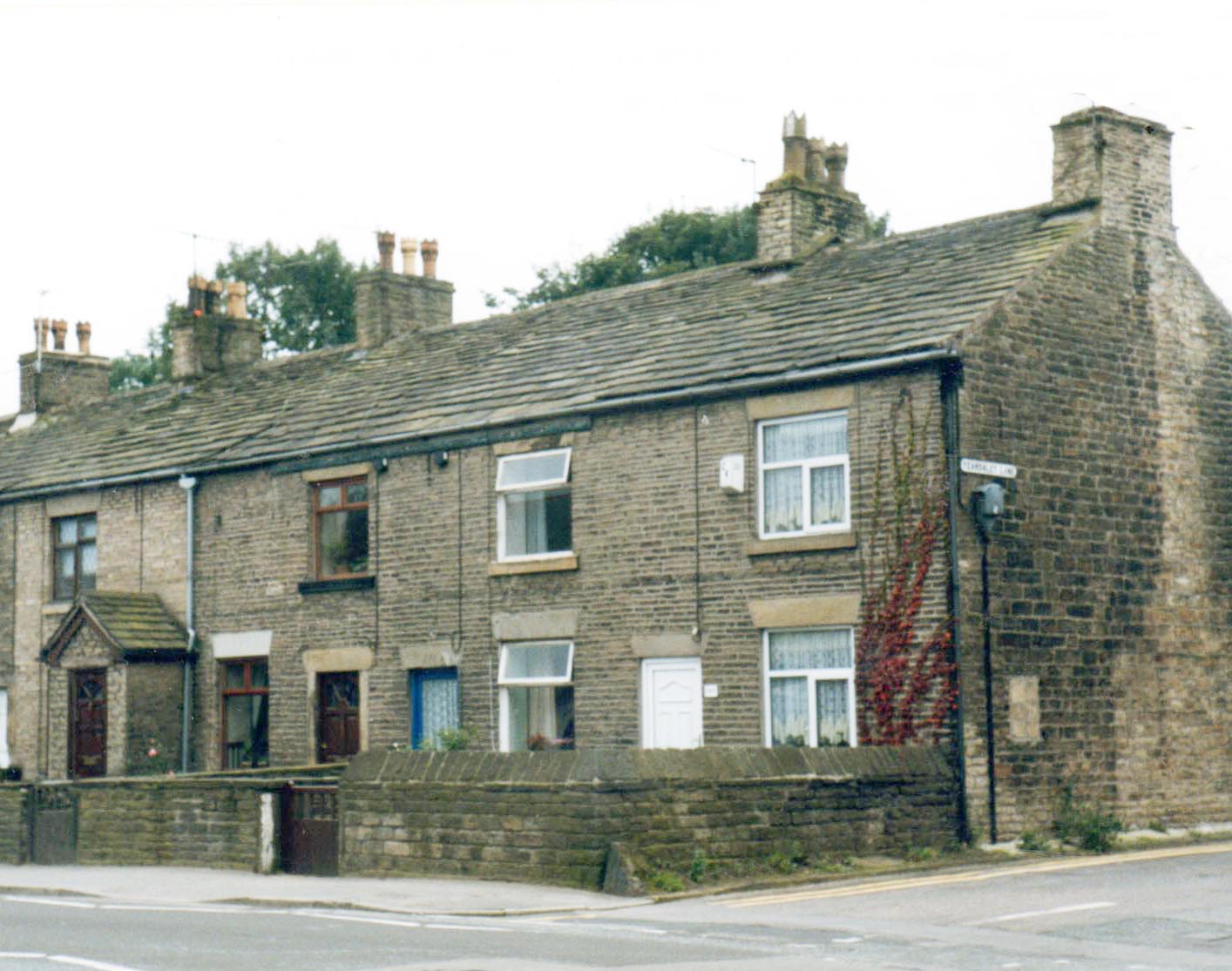 |
| This photograph shows 140 Buxton Road, Denis Hill's former home. The light coloured rectangle of stone in the gable end was the small window where miner's wages were once paid out. |
Saturday, 1 October 2016
The Wild Sisters.
We have received the following comment on a recent post:
Does anyone remember the Wild sisters, Nelly and Edith who had a ladies outfitters on Buxton Road in the 1940's? Their father owned a house on Marsh Lane opposite the signal box which we rented during the war. My mother used to buy silk stockings from their shop and they let me play behind the counter. We had no water, gas or electric. We had a well behind the house and used paraffin lamps and candles. Gow Hole Farm was where we got our milk from the Howards. Mr. Howard used to walk past our house on Sundays wearing a top hat on his way to church in New Mills. Just below the station next to the canal on Marsh Lane there was a lovely mansion type house and I always wondered who lived there and what the history of it was. I discovered recently that it was demolished long ago. One time I saw an elephant walking down Marsh Lane, it turned out to be a circus walking to their next showplace.
I am sure that many people will remember the Wild sisters who ran the wool shop at the corner of Buxton Road and Old Road. Here is a photograph of them.

The "Mansion House" which our correspondent refers to, is of course, Furness Lodge. This large house, just off of Station Road was built as the home of Mr Saxby, an early owner of Furness Vale Printworks. It subsequently came into the ownership of the CPA when they took over the mill and was rented out to a number of different people. It was finally demolished in the early 1970s

We have had a further reply which adds to the story of the Wild family and Marsh Lane:
Lovely photo of the Wild sisters, especially little Edith and the sterner Nellie. We paid 7/6d a week for the house on Marsh Lane opposite the signal both to Mr.Wild, their father and our landlord, who was always smoking a pipe. At last I know who lived in the big posh house! Thank you for the information. Now does anyone remember the Howards at Gow Hole Farm? When I was around 9 I lost my hat and I later saw Mr. Howard wearing it as he was making hay. Such happy days.
Here is a photograph from our archives of Carr View on Marsh Lane, the house referred to, with Mr and Mrs Wild in the doorway. The picture is not dated.


Now does anyone have a photo of Mr. and Mrs. Richard Howard and his brother Frank Howard of Gow Hole Farm? Frank was a regular at the Soldier Dick and evacuees from London lived in the front part of the farmhouse.
Sunday, 18 September 2016
The WWII Evacuation to Derbyshire
Evacuation of children during the Second World War
by Gillian Mawson –
August 2016
In the early hours of 1 September 1939, the
British Government's plans for evacuation swung into operation and millions of
children, teachers and mothers were moved to safety before war was declared on
3 September. Other
waves of evacuation occurred from May 1940 onwards, when fears of the invasion
of Britain became very real. Since 2008
I have interviewed over 600 evacuated children and adults - from England,
Northern Ireland, Scotland, Wales, the Channel Islands and Gibraltar – to
collect their wartime experiences, documents and photographs. I feel it is
important that these stories are preserved for future generations. I have
organised evacuee reunions and published two books, 'Guernsey Evacuees:The
Forgotten Evacuees of the Second World War' and 'Evacuees: Children's Lives on
the WW2 Home Front'. My third book will be published on 1 December 2016 and
contains stories and documents from evacuees all over Britain, the Channel
Islands and Gibraltar.
Families throughout Derbyshire and the High Peak received
large numbers of evacuees from areas such as Manchester, Southend, Lowestoft
and the Channel Islands. Boys from
Guernsey's Elizabeth College lived at 'Whitehall' on Long Hill between Buxton
and Whaley Bridge whilst the senior boys lived at the Florence Nightingale Home
in Great Hucklow. Alan Boast
lived in a Lowestoft children's home and remembers his journey to Derbyshire in
great detail:
The
sight that met my eyes when we arrived at the station was something I will
never forget.There were children everywhere, hundreds of them – and I was one!
We were told we were being evacuated for our safety, and would be going school
by school, not as Home boys. We were taken to the front of the station where
ladies were waiting for us. They had lots of labels and wrote our name, school
and age on each one and tied or pinned it to our clothes.
This must not be
taken off, we were told. On to the platform where our train was being reversedin. If needed – go to the toilet, as it would be some time before we could go again! We were
then lined up, and more ladies arrived, with a trolley-full of boxes. They gave us two sticks of
barley sugar each. We were told to wait until we were on our way before sucking them, as they
were to combat ‘travel sickness’ – whatever that was! Into the carriages we were shown,
teachers and all, and off we went! Major Humphery (the Mayor) told us that the honour of Lowestoft rested on our shoulders, and we had to be well-behaved.
Alan later found himself
in the Co-Operative Stores hall in Glossop:
In came these people from the
village to select which boy, or boys, they would take in and look after. ‘I’ll
have him, I’ll take those two’ etc. I put on my best beaming smile but nobody
picked me! Soon the hall was cleared and there were only two of us left, myself
and a boy called Peter Harvey. He wasn’t a Home boy but I knew him from school.
In came two ladies and after a lot of talking one said ‘I’ll take them as I
have room for two.’ So off we went with these two ladies into what turned out
to be a different world entirely – believe me! One of the ladies introduced
herself as Mrs Townsend and said we would be living with her. We followed them
out, under the railway bridge and into Clowne. I, as usual was chattering to
Peter about where we were going. Mrs Townsend looked round and said in a broad
Derbyshire accent, 'If thou don’t shut thee rattle. I’ll belt thee tabs!' I was
taken aback – I will never forget it! 'What did she just say?' I asked Peter.
He shrugged his shoulders, saying 'I couldn’t understand it.' It was our first
experience of the local dialect, which took some understanding. I have often
wondered since, what they thought of our Suffolk twang! For those of you who
don’t know it meant, 'Stop talking or you’ll get a thick ear!'
The fate of pupils at Earl Hall School in Southend was
decided on Sunday, 20 May 1940 when the BBC announced that East Anglian coastal
towns were to be evacuated by 2 June, for fear of German invasion.
During a bewildering week, parents had to decide whether to have their children
evacuated and that their destination would be Derbyshire. Doreen Acton (nee Mason) left Southend
with Westcliffe High School:
I remember waving good-bye to my mother and was
surprised to see her eyes fill with tears. There did not appear to be any
immediate danger either to my parents or to us. We had no idea where we were going and as the long train journey
progressed, rumours began to circulate. Finally we were told it was to be
Chapel-en-le-frith in Derbyshire. After a short drive in a chauffeur-driven
car, my friends and I arrived at an impressive mansion, Bowden Hall, outside
Chapel-en-le-Frith. We were greeted by a friendly looking elderly gentleman who
shook our hands. Freda and Beryl were directed to bedrooms in the mansion to
unpack. Audrey and I were taken to the chauffeur's cottage, we did not know then that the chauffeur and
his wife had hospitably given up their bed to us. We went back to the main
house and again met our host, Mr Lauder. It appeared his wife was away visiting
their daughter.
Chrissie,
the Scottish maid, was a very good cook and we were served up delicious meals.
I had been used to breakfast, dinner, tea and supper - we now switched over to
breakfast, lunch, evening dinner and a hot drink before bed. After about a week
or two, Mrs Lauder returned home. At first I got the impression that she
thought we had been allowed too much liberty. We were consigned to the kitchen
for meals. Very soon however she realised we were quite house trained and not a
threat to peace and good order. From then on she treated us as kindly and
generously as her husband.
Another young girl,
evacuated from Southend's Earls Hall school, enclosed some picture postcards in
her first letter home:
Dear
All, I hope you are all well at home. We arrived at Chinley at 3.30 Sunday
afternoon and when we got out of the train some boy scouts gave us all a half
pint bottle of milk. After waiting about twenty minutes we got on a bus to
Whaley Bridge. We went to a hall and had a cup of tea and a piece of cake.
After about one hour they started to put the children to their new homes. First
the farmer came and said we could go there but the teacher would not let us.
Then the vicar came and asked us to go to the rectory but then something
happened. After all we were put with Mrs Bailey. As soon as we got home she got
tea and when we had finished, Winifred and Yvonne took us to the post box.
These postcards are some of the lovely places here, and my bedroom window looks
out on a lovely hill. Please send my shorts and my music book. We are all very
well. Give my love to grannie, Love Kathleen
The aim of evacuation was to send children and adults to
safety until the war was over. However, many never returned home after the war.
Evacuees died whilst being evacuated or within days or weeks of arriving in a
'safe' area. Some suffered accidents whilst exploring their new communities
with friends. Others died because of the inherent dangers of wartime such as
air raids, unexploded bombs and minefields. In addition to this, some children
endured neglect, physical and mental cruelty and sexual abuse at the hands of
their foster parents. These stories make very difficult reading but need to be
shared in order to provide a full picture of the British evacuation experience.
Beryl Blake-Lawson's friend suffered a fatal accident whilst
returning to her billet and Beryl recalls, 'There was one tragedy, one day
running down the hill from Bank Hall for lunch at her billet, Christine
Markham, tripped and fell against the stone wall and was found by two senior
girls. It was a great shock to them as she had broken her neck and was dead.'
Faith
and Stella Shoesmith, aged 6 and 9, were evacuated from Lowestoft to Glossop
and Faith remembers the harsh treatment
received in their billet:
We
were the last to be picked and grudgingly collected by a Mrs Jessie Woods. Our
stay was very unhappy as she treated us like slaves. Every Saturday we had to
clean all of the bedrooms from top to bottom and we also had to polish the hall
floor on our hands and knees. Mrs Woods inspected our work thoroughly
afterwards to make sure that we had done a good job. We were not allowed into
the dining room, and if we wanted to go upstairs, we had to ask permission. I
would say 'Please may I go upstairs?' or 'Can I please go upstairs?' but it was
always wrong and Mrs Woods would stand and laugh at us. We had to mind our
manners, stand with straight backs and walk a certain way!
Our Dad had joined the army. Mum was
in Lowestoft and every now and then she would send us parcels of sweets but we
never received them. She did visit us when she could, and always brought sweets
and toys with her. Our one victory was that we found a large square tin of
biscuits hidden behind Mrs Woods' wardrobe. Every week when we cleaned her
bedroom we helped ourselves to one biscuit.
After about two years Mum found a place in Sherwood and took us there so
we could all be together.
When the war was over, many children were delighted to be
returning home. However, for some it was 'evacuation' all
over again as they struggled to readjust to life with their own families. Younger children in particular
had come to love their wartime foster parents. Their own parents, whom they had
rarely or never seen since their evacuation, were a distant memory. One boy remembers that the little girl who had lived with them for
five years did not want to return home to her parents, 'She had forgotten
them completely and was dragged kicking and screaming out of our house by her
father. It was very upsetting for us all.’ Doreen Holden did not enjoy
leaving the Matlock countryside to return to Manchester, 'I felt very
claustrophobic back home, there were noisy buses and trains and the smell of
smoke in the air. Of course I didn't let Mum and Dad know how I felt. Mary and Vi Draper did not want to leave Derbyshire either
and Mary recalls: 'When we had to leave Mr and Mrs Bacon to return to our Dad
in Lowestoft, it broke our hearts as well as theirs. They had no children of
their own and had practically become our Mum and Dad – our own Mum had died.
The war really did us a favour because Mr and Mrs Bacon (Auntie Bee and Uncle
Bob) were marvellous to us, treating us like little princesses. Luckily many of the children remained
in contact with their wartime foster families, through letters and visits, for
the rest of their lives. Many have attended evacuee reunions in the areas in
which they lived during the war whilst villages and towns have unveiled plaques
in memory of the evacuees they welcomed so many years ago.
Gilllian's new book will be published on 1 December by
Frontline Books. The chapters include: Plans for
Evacuation, The Parents' Decision, Finding Homes for evacuees, Wartime Letters
Home, Evacuated adults and teachers, The kindness of strangers, Out of the
Frying Pan, The return home and the Aftermath of evacuation. For more information see Gillian's author
page on Amazon:
https://www.amazon.co.uk/Gillian-Mawson/e/B008MWQ0IE
Her Evacuation blog can be viewed at:
https://evacueesofworldwartwo.wordpress.com/
 |
| Mary and Vi Draper |

 |
| Evacuee children from Southend arrive at Chapel-en-le-Frith in 1940 |
 | ||||
| Children are met at Whaley Bridge |
Saturday, 17 September 2016
The David Frith Memorial Bridge
A recent update on these proposals has been received and may be read by following the link below.
An imaginative proposal by Graham Aldred envisages a new footbridge at the head of Toddbrook Reservoir. This would give access to a footpath leading to Kishfield Bridge. The bridge will be dedicated to David Frith. A fitting memorial, as David in his working and leisure time, was greatly concerned with Toddbrook Reservoir and with our local footpaths.
The fully detailed proposal may be found here: http://furnesshistory.blogspot.com.cy/p/blog-page_19.html
or by clicking the link above
An imaginative proposal by Graham Aldred envisages a new footbridge at the head of Toddbrook Reservoir. This would give access to a footpath leading to Kishfield Bridge. The bridge will be dedicated to David Frith. A fitting memorial, as David in his working and leisure time, was greatly concerned with Toddbrook Reservoir and with our local footpaths.
The fully detailed proposal may be found here: http://furnesshistory.blogspot.com.cy/p/blog-page_19.html
or by clicking the link above
Monday, 12 September 2016
A Curious Occurrence at Hayfield
from Vivian Preston Dubé
7 September · Glenbrook, NSW, Australia
Hayfield, besides being the chief portal to Kinder, is not without some singular event to keep its
name in remembrance. Indeed, it seems to have had a resurrection on its own account in 1745.
Dr. James Clegg, a Presbyterian minister, who resided at Chapel-en-le-Frith in the middle of
the last century, gave an account of the extraordinary occurrence in a letter to his friend, the Rev.
Ebenezer Latham, then the principal of Findern Academy.
' I know,' he wrote, ' you are pleased with anything curious and uncommon by nature ; and if what
follows shall appear such, I can assure you from eye-witnesses of the truth of every particular. In a
church about three miles from us, the indecent custom still prevails of burying the dead in the place
set apart for the devotions of the living ; yet the parish not being very populous, we could scarce
imagine that the inhabitants of the grave could be straightened for want of room ; yet it should seem
so ; for on the last of August several hundreds of bodies rose out of the grave in the open day in the
church, to the great astonishment and terror of several spectators. They deserted the coffin, and
arising out of the grave, immediately ascended towards heaven, singing in concert all along, as they
mounted through the air. They had no winding-sheets about them, yet did not appear quite naked ;
their vesture seemed streaked with gold, interlaced with sable, skirted with white, yet thought to be
exceedingly light, by the agility of their motions, and the swiftness of their ascent. They left a most
fragrant and delicious odour behind them, but were quickly out of sight ; and what has become of them,
or in what distant regions of this vast system they have since fixed their residence, no mortal can tell.
The church is in Heafield, three miles from Chappelle-en-le-frith, 1745.' (Taken from The History of Derbyshire by John Pendleton 1886)

7 September · Glenbrook, NSW, Australia
Hayfield, besides being the chief portal to Kinder, is not without some singular event to keep its
name in remembrance. Indeed, it seems to have had a resurrection on its own account in 1745.
Dr. James Clegg, a Presbyterian minister, who resided at Chapel-en-le-Frith in the middle of
the last century, gave an account of the extraordinary occurrence in a letter to his friend, the Rev.
Ebenezer Latham, then the principal of Findern Academy.
' I know,' he wrote, ' you are pleased with anything curious and uncommon by nature ; and if what
follows shall appear such, I can assure you from eye-witnesses of the truth of every particular. In a
church about three miles from us, the indecent custom still prevails of burying the dead in the place
set apart for the devotions of the living ; yet the parish not being very populous, we could scarce
imagine that the inhabitants of the grave could be straightened for want of room ; yet it should seem
so ; for on the last of August several hundreds of bodies rose out of the grave in the open day in the
church, to the great astonishment and terror of several spectators. They deserted the coffin, and
arising out of the grave, immediately ascended towards heaven, singing in concert all along, as they
mounted through the air. They had no winding-sheets about them, yet did not appear quite naked ;
their vesture seemed streaked with gold, interlaced with sable, skirted with white, yet thought to be
exceedingly light, by the agility of their motions, and the swiftness of their ascent. They left a most
fragrant and delicious odour behind them, but were quickly out of sight ; and what has become of them,
or in what distant regions of this vast system they have since fixed their residence, no mortal can tell.
The church is in Heafield, three miles from Chappelle-en-le-frith, 1745.' (Taken from The History of Derbyshire by John Pendleton 1886)

Sunday, 11 September 2016
Hear John Wesley Preach !
On Sunday 18th September the Rev John Wesley will preach a sermon
upon the topic of ‘Awake, thou that sleepest’ in the New Chapel on High
Street. Hymns by Rev Charles Wesley will be sung.
The ‘New Chapel’ on High Street that is the home for Revive Church will be 250 years old this year and is the oldest place of worship in New Mills still in use for its original purpose. John Wesley (the founder of Methodism) preached there regularly and to celebrate the anniversary, history will be re-created. Come and hear Reverend Wesley preach and watch the multimedia story of the building to the present day. 18th Century dress encouraged!
10.00 – 11.00, Admission Free

The ‘New Chapel’ on High Street that is the home for Revive Church will be 250 years old this year and is the oldest place of worship in New Mills still in use for its original purpose. John Wesley (the founder of Methodism) preached there regularly and to celebrate the anniversary, history will be re-created. Come and hear Reverend Wesley preach and watch the multimedia story of the building to the present day. 18th Century dress encouraged!
10.00 – 11.00, Admission Free

Monday, 29 August 2016
Furness Vale Station in 1978
Neil Ferguson-Lee has kindly allowed us to publish his photographs of Furness Vale Station. These were taken in black and white in 1978. We have added a little colour to two of them.


 |
| On the level crossing is a Vauxhall Chevette. |
Taking The Waters
Raphael Tuck published a number of postcards on the theme of "Taking The Waters" featuring Buxton. Those released in 1909 were illustrated by Lance Thackeray, an artist who produced over 950 cartoons in his career.
In 1930, Tuck published postcards by Fred Buchanan, also on a theme of "Taking The Waters" and again featuring Buxton.

 |
| A carriage passes The Slopes |
 | |
| Queuing at St Ann's Well |
 | |||
| Sheltering from the typical Buxton weather on The Slopes. Devonshire Dome in the background |
 |
| Also by Thackeray but from a different series is this card "Rivals For The Fare" with The Crescent in the background. |
 | |
| "Keep The Ball Rolling" by Thackeray. |
In 1930, Tuck published postcards by Fred Buchanan, also on a theme of "Taking The Waters" and again featuring Buxton.
 |
| Add caption |

Sunday, 17 July 2016
The Turnpike Roads
Much of our local road system was developed and improved under the Turnpike Acts. Trusts were set up under individual acts of parliament in order to construct and maintain roads through a system of tolls. The Manchester to Buxton Turnpike dates from 1759 and originally by-passed Furness Vale by following the old Roman road between Disley and Whaley Bridge across Whaley Moor (often known as Whaley Tops). Because this involved steep ascents, a new road was constructed through Newtown and Furness, opening in 1804. Another system of roads was constructed by the Stockport and Marple Bridge (1801) and Thornsett (1831) Trusts. These linked New Mills with Hayfield, Marple and Mellor, Bugsworth and Furness Vale.
The turnpikes became increasingly unpopular, restricting travel and the movement of farm stock due to the fees that were charged at the various tollbars. In some parts of the country, riots often broke out and tollhouses were burned down. An act of 1888 gave responsibility for these roads to the county councils and gradually the tollbars were removed, often leading to great local celebrations.
One local toll road which was not part of the system was New Road, between Bridgemont and Bugsworth. This had been built by the Carrington family, owners of the Britannia Wire Works. Tolls continued to be levied here until 1919 when the county took over responsibility for the road.
For more information on turnpike roads visit the turnpikes.org website. Their map of Derbyshire roads shows every turnpike colour coded with dates of opening.
http://www.turnpikes.org.uk/map%20Derbyshire%20turnpikes.jpg
Explore the site for similar maps of the whole country and the history of these roads. There are also pages listing known tollbars and toll houses for each county.
The turnpikes became increasingly unpopular, restricting travel and the movement of farm stock due to the fees that were charged at the various tollbars. In some parts of the country, riots often broke out and tollhouses were burned down. An act of 1888 gave responsibility for these roads to the county councils and gradually the tollbars were removed, often leading to great local celebrations.
One local toll road which was not part of the system was New Road, between Bridgemont and Bugsworth. This had been built by the Carrington family, owners of the Britannia Wire Works. Tolls continued to be levied here until 1919 when the county took over responsibility for the road.
For more information on turnpike roads visit the turnpikes.org website. Their map of Derbyshire roads shows every turnpike colour coded with dates of opening.
http://www.turnpikes.org.uk/map%20Derbyshire%20turnpikes.jpg
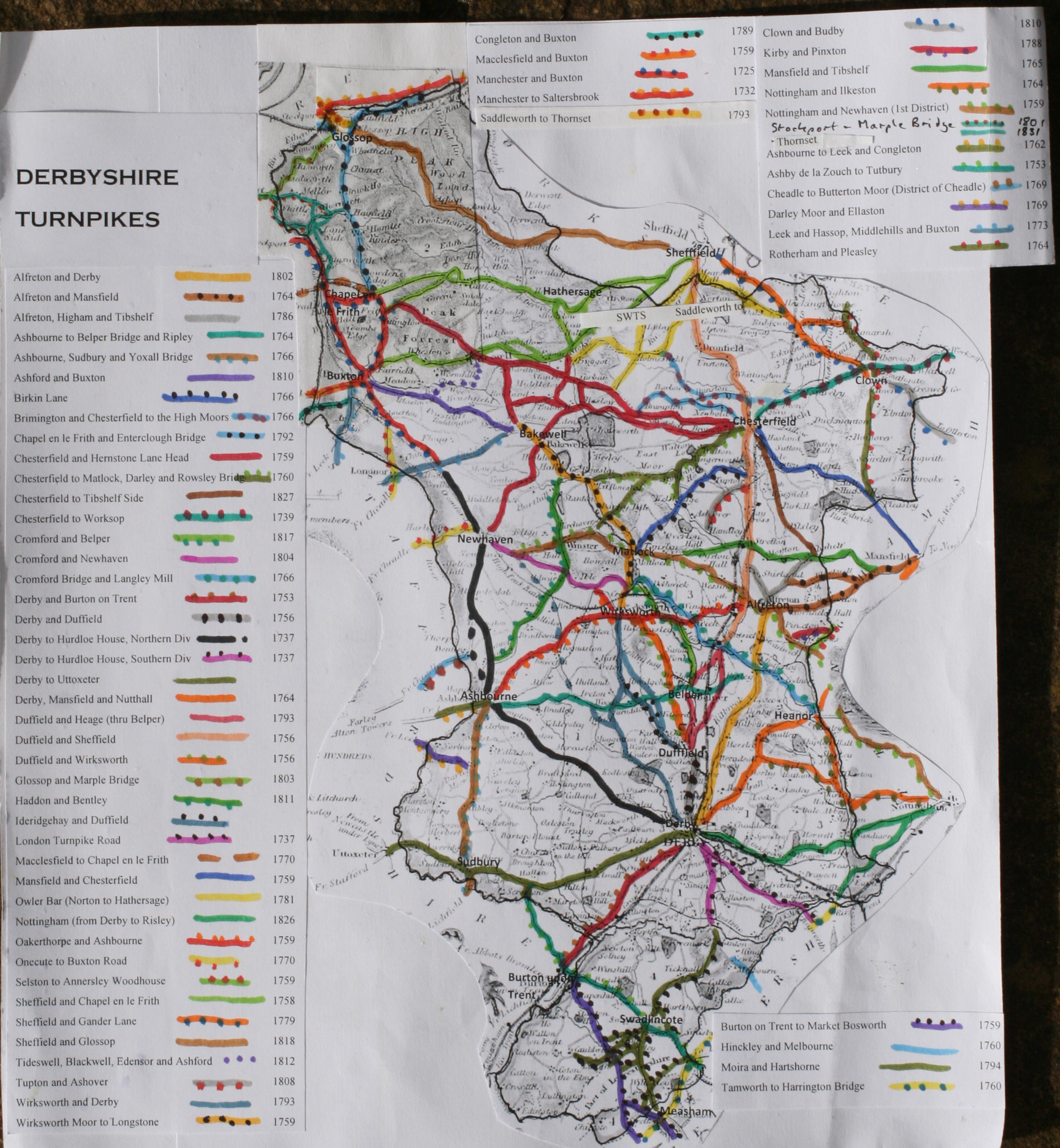
Explore the site for similar maps of the whole country and the history of these roads. There are also pages listing known tollbars and toll houses for each county.
 | ||||
| Fernilee Toll Cottage in 1939. |
 |
| Bugsworth Toll Bar. |
Friday, 20 May 2016
Furness Vale from the Air
Thanks to Jim Oliver for the loan of this aerial view of the village.
The date is believed to be in the mid 1970s. The brickyard is still
busy judging by the stacks of finished products. The framework can be
seen, partly erected for one of the new "Industrial Estate" buildings.
The last remaining "beehive" kiln is still to be seen. The Charlesworth
Crescent estate looks very new having been completed around this time.
Riddick's office and builders yard is still in Charlesworth Crescent so
the picture is perhaps just before they took over the former Co-op in
about 1974.
There are open fields on Station Road where houses have since been built.
The photograph appears to be one of a series of aerial views taken by Whaley Bridge photographer Frank Armstrong although it is one which we have not seen before

There are open fields on Station Road where houses have since been built.
The photograph appears to be one of a series of aerial views taken by Whaley Bridge photographer Frank Armstrong although it is one which we have not seen before

Friday, 15 April 2016
View of the Printworks
In the background of this photograph are the buildings of Furness Vale Printworks. This view is from the area of Lodge Farm which is just off of Station Road. Wew can see one of the mill lodges with asluice to control the flow of water. The man on the right appears to be operating a pump worked by a lever. In the foreground are a number of side tipper trucks and a section of narrow gauge contractors railway. These were often employed on construction sites and could be quickly laid or re-located. It is not clear what work is being carried out but it looks as if one of the ponds has been drained.
The photograph is undated.
Our thanks to New Mills Local History Society for allowing us to use this photograph.

The photograph is undated.
Our thanks to New Mills Local History Society for allowing us to use this photograph.

Monday, 15 February 2016
A Dangerous Road
William Wood
The murder of William Wood in July 1823 is well recorded. He was killed at a lonely spot on Buxton Old Road at Longside on Whaley Moor. This is the old roman road between Disley and Whaley Bridge and at that time was in Cheshire. The spot is marked by a commemorative "Murder Stone".

Wood, a cotton weaver from Eyam, was returning home from Manchester where he had sold his cloth and had received about £100 in payment. He travelled on foot and at Disley, called at a pub for refreshment. He got into conversation with three men and later continued on his way. After about ten minutes, the three left the pub and followed in Wood's direction catching up with him after a mile or two. Wood was beaten to death with stones and left at the roadside where his partly concealed body was later discovered. Wood's body was taken to the Cock Inn in Whaley Bridge where the coroners inquest was held a few days later.
The following day, three men appeared in Macclesfield where they bought new sets of clothes and gave away their old outfits. When news of the murder reached the town, suspicions were raised but the three had already left for Manchester by coach. When the old clothes were examined they were found to be stained with blood. The police followed to Manchester where one of the men was arrested in a public house. His companions had already left and there was no further trace of them. The arrested assailant was Charles Taylor, 17 years of age. He committed suicide at the New Bailey Prison in Salford. His companions, of a similar age were known to the authorities, having only recently been released from a term of imprisonment.

The New Bailey Prison
Taylor
had left prison just a day before the murder. On 12th August of 1823
it was reported that Joseph Dale had been arrested in Liverpool whilst
trying to enlist on a ship. On 24th April 1824, Dale was sentenced to
death and was hanged on the following Wednesday. The third man was named
as John Platt but it seems that he was never apprehended.James (or John) Ellis
Just three years later, at almost the same spot, history was almost repeated.
John Ellis of Parwich near Ashbourne was on his way to visit his brother in Gorton to whom he was carrying a bundle of clothes. He spent the night at the White Horse in Horwich End.

Another man, calling himself Michael Murray had also spent the night at the inn. Murray was described as being about 30 years of age with a thin face, dark hair and whiskers. Setting out the next day, Ellis saw that Murray was sitting on a wall at the roadside.. Murray changed the clogs that he wore for shoes and joined Ellis on the road towards Disley. On reaching a lonely part of the road Ellis was hit with a blackthorn stick that Murray carried and beaten until defenceless. This assault took place at Longside on Whaley Moor very close to the spot where William Wood had been murdered in similar circumstances just three years before. His pockets were rifled for a silver watch and a few shillings and a bundle containing a waistcoat, shirt and stockings, tied in a plaid handkerchief was taken.
A description of the robber and of the stolen items was sent by Mr Newton, the Whaley Bridge magistrate to police in Liverpool and a notice was given to several pawnbrokers in the City. A few days later, a man answering the description of the robber presented a silver watch to Mrs Fox, pawnbroker in St Thomas's buildings. Mr Miller, the Superintendant of Police was immediately informed and Murray taken into custody.
Ellis had been taken to Disley where he lay in a state of imminent danger. The prisoner was brought before him and unable to speak, he indicated by gestures that Murray was the perpetrator of the crime. Seeing no chance of escape, the prisoner said "Yes I am the man that did it and I am very sorry for it now" He offered to shake Ellis by the hand but the gesture was declined.
The prisoner was taken to Stockport and later committed for trial at Chester Castle. He gave his real name as Philip McGoveron, an Irishman
Subscribe to:
Posts (Atom)