Wednesday, 10 April 2019

229 Buxton Road and the Aspinall Family

  We were surprised to learn that there had been a hairdressing salon at 229 Buxton Road. Julie Walker (nee Aspinall) has described her childhood in Furness Vale.

  Renée and Peter Aspinall had moved there from Ashton, late in 1957 with their two young children,  Stephen then 1 year old and Julie 8 months old.  Peter Aspinall worked at Ferodo in Chapel, and Renée converted the large back room of their home into the salon. The family moved back to Ashton in 1965 when Renée bought a business there.
  The house at that time had a wall where a hedge now grows and large gates. The garage was painted black and white. In the back garden was an orchard of apple and pear trees and a gate led to the footpath at the rear.
  The children went to Furness Vale School and Julie remembers the teachers Miss Jeffries and Miss Banks. Stephen joined the cubs, and Julie, the Girl's Friendly Society at St.John's Church. Renée and the children were friendly with the Riddick family and often visited Yeardsley Hall for birthday parties and once for a seance.
  Renée employed Ann  to help her, the daughter of Herbert Fletcher of Bank End Farm. Ann had a sister Helen. Opposite the farm, were the railway cottages on the corner.The front doors were painted turquoise. The Taylor family lived there and the Aspinall children went to school with Michael and Ian.

  Julie now lives in Inverness and Stephen in Newquay.

This photograph from our archive shows 229 Buxton Road , the second dormer windowed house on the left.


The photographs below are from Julie Walker's collection

 
Renée Aspinall in the garden of 229 Buxton Road.

Renée with Julie and Stephen

Julie in the pram with Helen Fletcher at Bank End Farm

Julie Aspinall is among this group of girls dancing around the Maypole at St.John's Church.
Stephen in his cubs uniform
At school with Miss Banks
Many thanks to Julie Walker for telling us about her time in Furness Vale and for supplying these and many other fascinating photographs.

The Rose Queen

Furness Vale Rose Queen and her attendants aboard a Wade's lorry in the 1960s. Photograph courtesy of Julie Walker


The Rose Queen was Jean Ford, then aged 11 years. She was later to marry John Wheelan.

Monday, 8 April 2019

Celebrating the Coronation

  This photograph was taken in 1936 in the garden of Heatherby, Diglee Road, Furness Vale. This was the home of the Knowles-Bolton family, owners of Furness Clough Colliery and Furness Vale Brickyard. The coal mine was just behind Heatherby and could be reached through a gate in the garden.
  Leading the horse is William Cross who looked after the pit ponies at Furness Clough. Riding the pony Tommy, is young Edwin Knowles-Bolton. The motorcyclist is Harry Roberts who lived next door to Jackson's butchers shop on Buxton Road but his sidecar passenger is unknown..
  Everything is highly decorated, perhaps to celebrate the Coronation of King George VI. The whole village was bedecked with bunting for the occasion and most of the village will have turned out for the parade along Buxton Road.


Friday, 8 March 2019

The Life and Times of Furness Vale Printworks

The Life and Times of Furness Vale Printworks by Chris Bond is based upon  the scrapbooks of Mr W. A. Bradbury who was employed as a foreman for 53 years. "W. A. B." was also very much involved in public life; the District Council,  School, Chapel and the Co-op were just a few of his many duties.  He chronicled events in both the Printworks and the district around Furness Vale. This  is a unique record of  life in the village between 1794 and 1925.
This book was first published in 2012 and quickly sold out. We have only recently been able to arrange a re-print and copies are once again available from the History Society at £5. The book is on sale at Society meetings, the community shop and from 34 Yeardsley Lane. Copies may also be ordered from our online shop: https://etsy.me/343ItSQ


A Short History of the narrowboat "Badger"


George Boyle recently gave a talk on the history of his working narrowboat. His story also includes much background information about the former owners, their boats and canals in general.  The following is the text of George's talk, illustrated with a few photographs.

In order to cover the history of BADGER, it will be necessary to mention her owning company, Fellows, Morton and Clayton, or FMC for short.  Incidentally, photographs of BADGER working are extremely rare. 


FMC was probably the largest of the independent canal carrying companies.  By independent, I mean a company that owned boats but no canals.  Many canal companies also ran their own fleets of boats.  However, they kept boat and canal accounts separate which enabled independent companies like FMC to survive.


Before the mid to late 1800s canal boats did not have engines and were drawn by horses, or in the case of narrowboats, more correctly mules, as a full sized horse was more than a match for a single narrowboat and would be used to pull larger barges or a pair of narrowboats together.


In 1860 the first steam engines were fitted in narrowboats  Unfortunately, the steam engine, boiler and coal supplies were so heavy that the payload of the boat was reduced by up to 10 tons.
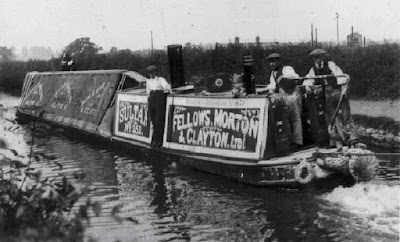


FM C Steamer "Sultan"

Thus a steamer had to tow at least one, or even two former horseboats, by now called butties, to make the operation profitable.  For that reason, steamers were confined to broad canals where the boat and butty could pass through the locks together.


By 1906 FMC had started experimenting with early diesel and gas engines but very quickly standardised on semi diesel engines manufactured in Sweden by a company called Bolinder, better known nowadays as Volvo.  They liked the engines so much that every FMC motor from 1913 until they sold out to the nationalised British Transport Commission in 1949 had a Bolinder engine of 9 or 18 horsepower.


Bolinder semi-diesel engine

FMC had its own workshops in Saltley, Birmingham, and Uxbridge, London where they built and repaired their boats.  These workshops fulfilled most of FMCs requirements but in1923 they were so busy that they placed an order for 12 boats with WJ Yarwood of Northwich.  One of those boats was BADGER, fleet No 288.


Badger when newly built


 Each boat cost £740 complete including the obligatory Bolinder engine. Eventually Yarwoods built a total of 30 boats for FMC.  When built, BADGER had rivetted wrought iron sides and an elm wooden bottom.  Iron is more rust resistant than steel and lasts longer at the price of being more brittle.  It has been known for an iron hull to crack between rivet holes when struck hard in exceptionally cold weather.  All boat bottoms were made from elm which has unusual properties.  Keep it saturated, as the bottom always is, and it will last for hundreds of years.  However let it dry and it will rapidly degrade to dust.  Incidentally, this is why wooden boats when out of use were sunk awaiting further work rather than being lifted onto the bank where they would have rapidly deteriorated.  Wooden boat bottoms normally only need replacing because of wear against the canal bed rather than rot.  All steel boats only arrived in the 1930s but, even so, the last wooden boat was built as late as 1958.


Although FMC operated throughout the canal network, and had their major presence on the London to Birmingham axis, BADGER was allocated to their northern fleet from new, working between Ellesmere Port and Manchester to the West and East Midlands.


The cabin on BADGER was also made from wood.  FMC were quite parsimonious in their treatment of boaters and they only fitted small bottle stoves in the cabins.


Boatmen with families would need more than this so they had to purchase and fit a range stove for themselves…………...


A narrowboat cabin fitted with stove


…...which they would have to transfer if they changed boats.


Cabins were snug, typically 6ft 6ins wide, narrowing to less than 6ft at the top, by around 8ft long.


It is as well to mention at this stage that when canal transport was new it had no effective competition.  Boatmen were well paid and could house their families on the bank.  Only when the railways arrived did margins become tight, forcing boatmen to bring their families onto the boats giving them cheap housing and extra free labour.


Inside the cabin the stove was near the door, a dinette with a drop flap front was next, and a cross double bed at the rear, although to call them double is stretching things.  BADGER is a comfortable 3ft 3ins wide, my old boat ALTON was a tighter 2ft 11ins wide.


The cabin side of any working boat displays several numbers so this would be a good time to explain their significance.


Firstly – the large number 288 is the fleet number allocated by the owning company for identification along with name.  Another little aside comes from this.  If you were a self employed boatman and owned your own boat, you inevitably put No. 1 on the cabinside.  Thus such boatmen became “Number Ones” and were always called that by employed boatmen.


The second number - “Registered at Birmingham No. 1454” refers to the boat’s health registration under the Canal Boats Act 1877.  This act was passed through parliament by social reformers keen to improve the lot of boating families when conditions were seen to be squalid to say the least.  At the first examination by a local authority inspector, amongst other things, the cabin would be measured and certified as suitable for x number of persons, inevitably with a narrowboat, 2 adults and 2 children.  Thereafter, the boat would be

occasionally examined and reported on, with penalties for the owners and boatmen for transgressions.  It was not uncommon for boatmen to have lots of children, indeed my previous boat ALTON at one time had  man, wife and eight children on board.  When word got out that inspectors were checking, boaters would hand younger children to boats going the other way to fool the inspectors, the children being collected, perhaps a fortnight later when the boats next passed.


The third number - in Badger’s case 804 -  is the one allocated by a canal company when they gauged the boat, that is, calculated the weight carried on any given draught.  They did this by loading weights into the boat and measuring the freeboard at intervals.  Thus they produced a chart for each boat which was copied to each toll office so that the load could be measured and the correct tolls charged. 


The number itself cannot be seen in the photo of the cabin side.  It was on two plates attached to the front face of the cabin.  However, I do have one of the original number plates issued to BADGER in 1923 which I found in the bilges when cleaning out.


The next number - 1396 - is unique to FMC boats. Because their boats went out onto the River Thames, the company registered itself in the Worshipful Company of Thames Watermen and 1396 was the number allocated to FMC.  It was a bit of unnecessary show by FMC and when the company livery changed post 1923 the use of this number was dropped.


There is one final number showing in the photo – 72505.  This is not historically significant in working boat terms, but was allocated by British Waterways in the 1970s when all boats were renumbered for their records.


The bows of working boats also had devices on them.  They were not just pretty designs but had distinct meanings.  Thus on the bows of  BADGER the double arrow device signified it was an FMC boat.  Other companies had different devices and all could be readily recognised by staff.  We have to remember that very few boatmen were literate, indeed several good friends of mine, retired boatmen and women, have never been able to read or write. The red diamond indicated it had already been gauged by the Birmingham Canals Navigation Company, the No 804 referred to earlier.  This was important as the toll clerk would know he had a copy of its gauging sheet available, and would allow a boat carrying the device straight into the toll lock.  A boat not showing the diamond would be pulled to one side for checking.


Returning to BADGER.  When built she was fitted with an 18hp engine.  This was a clear indication that she was meant to tow a butty most of the time.  FMC was so parsimonious in its use of engines that a boat intended to run “single motor” would only have a 9hp engine fitted.  A boat being taken away from butty towing to single motoring for any length of time, would have its 18hp engine removed and a 9hp put in its place.


Although early records for BADGER, or indeed any other FMC boat, are hard to come by, several things can be deduced.  In 1921,  the Shropshire Union Canal and Railway Company decided to give up carrying on their own boats.  FMC took over, but only bought the Shroppies 25 best boats.  Thus there was a need for new boats to fill the gap.  Additionally, because of the layout of the locks, the Shroppie is one of the few narrow canals where boat and butty operation is a realistic option.  Add the fact that she was fitted with an 18hp engine, and brought into use at just the right time, I believe I can reasonably deduce that BADGER was allocated initially to Ellesmere Port-West Midlands traffic via the Shroppie.


When working a boat and butty through narrow locks, the boatman has to operate each lock twice to pass the boats.  The Shroppie has a narrow flight at Audlem of 15 locks plus two other flights of 5 each.  In earlier busy times, horses were stationed at such locations to work the butty through separately, speeding up the operation.  In later years the boatman (and family) were on their own, and had to bow haul the butty themselves.  I have records of the boatman being paid an extra pound, later one guinea, to carry out this task.


 At Audlem part of the lock flight is closely spaced.  The ever resourceful boatmen discovered that by splicing a number of towing ropes together they could make a line long enough so that as the motor entered one lock it was able to draw the butty into the lock behind saving them work.  However, they still kept the extra pound bonus.


Records only really become available from 1940 onwards, although I am still doing research to find more. 


Health records from the follow up inspections of health inspectors have interesting snippets such as “cabin roof leaking” a not uncommon fault with wooden cabins, and sometimes name the cargo on board at the time but do not give its weight or destination.


The Boat Museum at Ellesmere Port holds many records relating to the canals.  Sadly, they are not always indexed as one would like, and educated guesses are needed to find the gems hidden in there.


Consignment notes are particularly valuable and with their attached paperwork they enable me to find out what was carried, its weight, origin and destination, name of captain and even the wages he was paid for the trip.


From these papers I can see that over the years the following types of cargo have been carried and I have produced a spreadsheet of these movements which, from time to time I add to as more information becomes available


Cocoa Beans, Tinned Vegetables, Flour,  Wheat, Sugar, Silicon Metal, Soda Crystals, Chocolate Crumb, Steel Tubes, Bentonite Clay,  Spelter, Aluminium and Copper.


An interesting omission from this list is coal.  I have never found any records of BADGER carrying coal.  Additionally, when a boat carries coal, the iron or steel hull is internally etched with acids leeching out of the coal.  BADGER’s hull has no such etching.  Thus I can conclude that BADGER never carried coal and was never a “dirty coal boat”, as people on the bank would call them.  Given that the vast majority of working boats that survive ended their days carrying coal, this in itself is unusual.


For many years BADGER was paired with the butty NORTHWICH….


….which is itself preserved at the Gloucester Boat Museum, although sadly not in the best of condition.


BADGER has also been paired in the past with the butty KILDARE, which is also preserved and is now the regular butty to the steamer PRESIDENT.


Nowadays, people have a leisurely view of canal travel.  The cry is always going up, “slow down” “what’s the hurry” but it wasn’t always like that.


Canals are naturally a slow means of moving.  Even in working days 4mph was a good speed on a narrow canal but to people earning a living, being paid by the trip, not the hour, time was money.  When travelling a working boat was never stationary.  It was always moving, horizontally along the canal, or vertically up and down locks.  In pursuit of this, boatman worked very hard.

My records show BADGER with its butty NORTHWICH loading at Ellesmere Port for Wolverhampton and 10 days later being back at Ellesmere Port loading again.  A round trip of 138 miles, with 132 locks, 100 of which were narrow meaning the butty had to be handled separately.


Even more remarkable was a trip in 1947 where BADGER left Ellesmere Port loaded with wheat for Autherley, a suburb of Wolverhampton.  FIVE days later she was back in Ellesmere Port loading again.  On this occasion she was single motor, that is, no butty, but that often meant the skipper was also on his own.  This trip involved 133 miles and 90 locks.


To complete such trips could mean a 6am start and 2am finish every day.


As I mentioned earlier, in 1948, the canals were nationalised and  seeing the writing on the wall, FMC sold out to the new British Transport Commission in 1949.


This was not the end of carrying and BADGER continued with her new owners.  Boatmen still lived on the boats with their families, often having no other home.

In the 1950s BADGER appears to have settled down with NORTHWICH to a steady life carrying various cargoes on the Shropshire Union Canal.  One interesting cargo was chocolate crumb for Cadburys from their factory at Knighton, Shropshire, to Bournville.  This is partially finished, but fully edible chocolate and boatmen would always have a supply handy to bribe local children into opening the odd lock gate for them.  In the case of BADGER, never having carried coal it was essential to obtain coal for the cabin from passing coal boats so something to trade would have been useful.


By the late 1950s, available cargoes, other than coal, were becoming harder to find as road haulage was expanding.   British Waterways, as they were now called, still had optimism for the future, and they built a small fleet of new narrowboats, some of which were allocated to the North West, mainly for coal and china clay in the Potteries.


In 1960, the skipper of BADGER and his family were given one, later a pair, of these new boats and they moved into coal carrying.  BADGER was taken out of the working fleet and transferred into the maintenance section.


Unlike today, where CRT have a fleet of modern purpose built maintenance boats, it was common for ex working boats to be pressed into service.  Rather fortunate for BADGER, because the alternative was a rather ignominious scuttling in one of the mining flashes around the system.


BADGER was allocated to Fradley, near Lichfield but one of the first jobs would have been removal of the Bolinder engine and the fitting of a much more user friendly air cooled, electric start one, more attuned to what maintenance men could handle as opposed to the livaboard boatmen. 


Sadly, at some time in the late 1960s, BADGER was attacked by vandals and set on fire.  She was deemed to be beyond repair and laid partially sunk at Fradley for at least a couple of years before the decision was made to sell her, normally for scrap.  BADGER was towed to Anderton for disposal.

 
However, BADGER was not quite ready to give up yet.  Fortunately, around that time, a man called Malcolm Braine was one of a few people who were buying scrap canal boats and restoring them for resale.


In fact, I believe I am correct in saying that Malcolm has saved every boat I have mentioned today, that is ALTON, SANDBACH, BADGER, PRESIDENT, NORTHWICH and KILDARE along with many others and deserves much credit for that.


Malcolm purchased BADGER, saving her from scrappage, and knowing that there was no market for a working boat, restored her to the condition you see today.

Badger moored at Furness Vale

Even though I was now retired, having only ever owned working boats, when I was looking for another boat I was naturally drawn to another unconverted boat with which to cruise round, visiting historic shows and the like.  My wife convinced me that dragging all that empty hold around was a waste of space and perhaps a partial conversion with more living accommodation than a back cabin would be a good idea.  I think the exact words were, “Get another unconverted boat and you will be on it on your own” so I was convinced.


BADGER as converted is a good compromise.  She still retains a reasonable length of open hold, which I call my garden shed.  All the junk goes in there.  The cabin extension contains a bathroom, galley, sitting accommodation with coal stove and two additional sleeping berths up front.


When Malcolm converted BADGER, he replaced the elm bottom with steel ending any damp problems or wearing of the wood.  He fitted a Lister JP2 engine, later replaced by a Gardner 2LW which she still has.


Because we now have living accommodation up front, I am able to dress the back cabin as working boatmen would have done, without the hassle of trying to cook and live in there, making up the bed every night for example.


We have a bungalow in the village so do not live on the boat full time but for more than half the year we cruise round the canal system, visiting various historic boat shows showing BADGER off to the public.


Badger with full complement of crew. 

George Boyle 2019


Monday, 11 February 2019

Bullock's Garage, Cheadle

This digitally colourised photograph shows Bullock's Garage  at 6 Manchester Road, Cheadle.  The building behind, is the Cheadle Institute.  The date is the early 1920s. Garage staff pose for the camera while an inidentified car is filled with petrol from the Pratt's pump. Parked by the kerb is a Renault taxi, a model that was popular in the UK at the time. The showroom on the right has a display of tyres and car lamps. Enamel signs advertise Pratt's Perfection Spirit and Austin Cars. Signage on the windows advertises Spencer Moulton Tyres, Lodge plugs, CAV Lamps and Daimler cars.
Today, there is still a used car dealer at this site.


The Anglo-American Oil Company, established in 1888 was an affiliate of Standard Oil of the USA. The company began supplying petrol in 1889 and in 1896 introduced the Pratt's brand, named after a founder of Standard Oil. By 1900 petrol was supplied on a nationwide scale, delivered in 2 gallon cans by horse drawn carts. They employed 1000 horses for this work. After World War I, Pratt's installed the UK's first petrol pump, at Hale in Cheshire.  Pratt's was re-branded as Esso in 1934 although lubricating oil was sold under its original name until the 1950s.

Wednesday, 6 February 2019

Hello Dolly Lane !


In this article we will follow a route from from Furness Vale to Bugsworth.  We will start at the bottom Station Road and as we cross the bridge  we pass over the River Goyt, the original boundary between Cheshire and Derbyshire. Look at the change in the masonry of the bridge parapet and you will see where the Toll Cottage once stood.  The bridge is known as Joule Bridge or sometimes Jolly Bridge and this was part of the Thronsett Turnpike . Turnpikes were abolished by Local Government Act of 1888 to much local rejoicing.


The name of this little hamlet of Gow Hole was recorded in 1587 as Jawhill, the earliest record. Various spellings are subsequently found, no doubt, as the name became corrupted: Joliehole; Jollyhole; Jowhole and finally Gow Hole and as we have seen Joule in reference to the bridge. 

The junction of Marsh Lane and Ladypit Road in the 1920s.  The coal wharf is behind the wall onthe right.

Sunday, 3 February 2019

Wartime Evacuees in Furness Vale

  On 2nd June 1940 a train arrived at Whaley Bridge from Southend on Sea in Essex. On board were 240 children evacuated due to the war.  They were accompanied by 12 teachers and 11 voluntary helpers.
   Met at Whaley Bridge, the children were first of all given tea, then medically examined and then allocated to their billets. The operation took a considerable time and caused a few tears.  Some billetors refused boys, others would not take girls. Some, confronted with brother and sister wanted to take one but not the other. Some children, boys in particular were hawked around several billets until kindly souls at last gave them shelter.
   Schoolrooms were established at the Mechanics Institute, at Whaley Bridge Church Hall and one classroom was made available at Furness Vale School.


  Wendy Brown is trying to find information about her mother's evacuation to Furness Vale.  Her name was Jean Hill (Rosenberg) and she was just six years old at the time.  She stayed with the Palmers who lived in Park Crescent.

  Val Stenson has added the following information:
"The Palmers were Percy Holmes Palmer (born in Bredbury but had lived in Chapel) & Lillian Gertrude Palmer nee Hodgkinson (from Lancashire) the couple married in Stockport in 1925 & lived at Woodlea off Yeardsley Lane which came under Whaley Bridge UDC in the 1939 National Registration. The couple had no children of their own, Percy worked as a Railway Signalman Heavy Works & Lillian stayed at home. Percy died in 1949 & by then the couple had moved to Melton Mowbury."

  The only "Woodlea" in Furness Vale is currently 236 Buxton Road and some distance from Park Crescent.

  If anybody remembers or knows of the Palmers, or Jean, then Wendy Brown would be delighted to hear from you.

Wendy Brown's niece chatted to here gran about her experiences for a school project and wrote down the conversation|:  


My Nana being Evacuated in World War II
During the War, my Nana was 6 ½ years old.  She had to be evacuated at the start of 1940.  She used to live on the South Coast at a place called Westcliff on Sea.
She was brought up on a steam train.  On this journey she remembers having no food or little and having some water, but the problem was the water tasted of soot because of the steam from the train.  The steam train dropped a lot of children off at Chinley.  When they got there, people either went to a home which made them clean or they went to homes where they were used as cheap labour, specially on farms or if they were lucky, they went to a nice family.  My Nana was lucky, she went to a Mr and Mrs Palmer.
My Nana was never short on food because they grew their own vegetables and kept hens.  The one food she disliked were runner beans because they salted them and kept them for winter.  She disliked them because they had them every day.
She can remember getting to their home in Furness Vale and them giving her a bath.  They kept scrubbing at her.  She remembers them saying “what have they sent us?”  They were saying this because she was very brown (because of a hot summer) and her accent.
When the war was over her mother came up to Furness Vale and Nana went to live with her.  Nana’s mum married a man called Sam Kitchen.  They lived together but my Nana never forgot Mr and Mrs Palmer.

 
  The photographs show the evacuee children  at Furness Vale School


Friday, 1 February 2019

Britannia Mill Buxworth

This is Google's satellite view of the Britannia Mill at Buxworth. Little remains of the four storey mill destroyed by fire in August 2005 and the site is described by many, as an eyesore.  


The mill was built in the late 18th or early 19th century for the manufacture of fustian, a coarse cotton fabric. It was originally powered by water drawn from the Black Brook. The water wheel was fed from two mill ponds. Landed at Liverpool, the raw cotton  was carried by canal to Buxworth and the finished goods were despatched by boat to Manchester. The mill had its own canal wharf next to teapot row. There was some rebuilding in 1851 and the site became part of the Bugsworth Hall Estate.

Fustian manufacture ceased in 1900 and the newly formed Britannia Wire Works Company moved into the now empty mill. Britannia manufactured a range of seating for the furniture, railway, aviation and motor trades as well as  matresses. The wire formed the sprung interiors. The company built up a considerable export business, the mill was extended and theponds filled in. Production ceased in May 1969 and the mill was occupied by PVC Group until the time of the fire.

There are now proposals to redevelop the site for housing. Rivertown Developments based in Buxworth hopes to build up to 110 homes in a mix of styles and size.

The websites of TPM Landscapes and Crowley Associates, planning consultants, not only detail the proposed developments but also provide considerable historical and site information with detailed maps showing how the mill developed. :
 http://www.tpmlandscape.co.uk/consultation/  

 http://crowleyassociates.co.uk/experience/britannia-mill/ 

Trevor Walmsley has recently contacted the History Society. He left New Mills in 1973 and now lives in New Zealand. His father in law, Lawrence Devine, was at Britannia all of his working life and was works manager until it closed in 1969. The photographs are of Mr Lawrence with his daughter Patricia; A calendar from the office and extracts from a patent deposited in 1945 for Ford car seats.


 The following photographs show the blaze being tackled by the fire brigade, the derelict building and the former Britannia road vehicles. 


Thursday, 31 January 2019

Industrial Archaeology of Greater Manchester

This book by Robina McNeil and Michael Nevell is an excellent guide to the many historical sites throughout Greater Manchester. Divided into the 10 local authority areas, almost 400 locations are listed, many accompanied by photographs and maps. This publication is well worth delving into especially when planning a day out in the region.
A pdf version is available for download by following this link: https://industrial-archaeology.org/…/2000-Industrial-Archae…


Friday, 25 January 2019

Gow Hole or Jow Hole ?


The derivation of the name Gow Hole is unknown. The earliest mention  of this hamlet,  so far traced is Jawhill in 1587. In probate documents from Lichfield Joint Records Office, various spellings are to be found: Joliehole in 1665; Jollyhole in 1674; Jowhole in 1694 and 1725 and Jow Hole in Beard in 1789. Burdett's Map of Derbyshire of 1763 shows Jow Hole as does the Tithe Map of 1841. The bridge over the Goyt at the bottom of Station Road is sometimes known as Joule Bridge or Jolly Bridge. The latter name has sometimes also been given to the canal bridge in Furness Vale alonside which was the Jolly Sailor beerhouse (or Traveller's Call).

Below are extracts from the Tithe Map.  Look closely at the bridge over the River Goyt and you will see the Toll House and Tollbar which once stood here.  Marsh Lane was managed by the Thornsett Turnpike Trust. 


Monday, 7 January 2019

DERBYSHIRE CATERPILLAR PLAGUE


SWARMS OF MARCHING INSECTS

The area affected by the Peak caterpillar plague is reported to be extending. From theKinder moorlands they are marching in the direction of Glossop and Hayfield, and near thelatter place they have invaded and spoiled the crops on some of the fields which farmers have setfireto prevent further ravages. A field of oats near Chinley has been completely ruined by the pests. They are swooping down the moors into the Goyt Valley in the direction of New Mills and Whaley Bridge and have already made their appearance on some of the farms there.
Mr H. P. Huss, the manager of Parr's Bank at Chapel-en-le-Frith, who first called attention to the plague, suggests that the gorse on the edges of the moors right along the roadsides in all directions from manchester to Sheffield, through all these places, be fired, and that tar be sprayed on each side of the affected roads two feet wide, on the Castleton road for three and a half miles long, and that the fields be heavily limed. He has also suggested that sanction be soughtfor the services, for, say, three weeks, of the local volunteers for this work.
He points out that tghe caterpillar will change in a few days into a moth, and each femal moth will in Autumn lay up to 100,000 eggs,so that the country is threatened with a far more serious plague unless serious and energetic action is taken.
Those best to judge consider that the alarming invasion is owing partly to the non-firing of the moors recently and partly to the orders for slaughtering birds that have heretofore fed on these pests and destroyed many of them, and they declare that until this ban is removed, crops wil be seriously diminished all ove the land at a time when every ounce of food is needed.
The Board of Agriculture has wired to Mr.Huss, to Mr.Boycott  (clerk to the Chapel-en-le-Frith District Council), and the superintendant of police at Chapel-en-le-Frith saying that they had instructed an inspector to visit the district and advis of the caterpillar attack. They asked to be supplied at once with particulars as to the area affected, whether pasture or arable lands, and any other details obtainable.
The police authorities replied that the first they heard of the matter was on the 11th inst. It was then reported that the caterpillars existed in swarmson the moorland between Chapel-en-le-Frith and Edale, and that they were moving along the main road in the direction of Peak Forest.Inquiries made since show that practically the whole of the division if affected, chielfly on the moors.
The general opinion is that the only effective means of stamping out what is undoubtably a rapidly spreading plague over the whole country from Sheffield to Manchester is to burn up all the moors, and so destroy the pests and their nests. In the meantime, precautionary measures should be taken to prevent these vast armies from getting into the water reservoirs at Derwent, from which Sheffield, Derby, Nottingham and Leicester derive their supply; those in Woodhead Valley that supply Manchester; and those in Kinder Valley from which Stockport derives its supply,as well as the supplies to the smaller towns and villages in the area.

Burton Daily Mail 20th June 1917


Tuesday, 25 December 2018

Furness From The Air

Here's a high quality aerial view of the village from 1974. The butcher's shop, at this time owned by James Lavin looks open for business as the shop blind is drawn. On the other corner of Station Road is Barbara Griffith's shop. The building that was to become the Imperial Palace restaurant was at that time, the offices of Riddick's Builders. There are a number of cars parked at the back of the office but note how quiet the roads are. The buildings of Riddick's yard may be seen on Charlesworth Road. This is the land, like a small wood, that became Charlesworth Close.
A train is approaching from Buxton, a three coach diesel unit. The fields beyond the station are still to be built on.There on the other side of Station Road is the Scout's hut.
In the brickyard is the old "bottle" kiln. Bricks and firebacks are still in production and stacks of them await despatch. The foundations can be seen for the first of the newindustrial sheds.
The Football Field looks in a very poor condition but the bowling green and tennis court are well maintained.

Take a close look at this photograph, there is so much to be seen


Thursday, 20 December 2018

Chinley Tales

Chinley 


Hidden away behind the high hills of North Derbyshire and served only along a by-road, Chinley feels remote.  The fact that one can be in Manchester in 30 minutes by a fast train has turned Chinley into something of a commuter village. It is the presence of the railway that caused this community to grow from a small hamlet, for this was once a major railway junction with a station of six platforms. London trains regularly called here as did services to Sheffield, Derby, Buxton, Manchester and beyond. The station once boasted a refreshment room and bookstall as well as the usual waiting rooms and booking offices. There was a large goods yard, a turntable and two signal boxes. The station now has a train every two hours and passengers wait in a glazed shelter on the single island platform.

Wednesday, 19 December 2018

The Australian Bungalows.


Furness Vale in Derbyshire takes pride in it's three "Australian" bungalows.  These were built, according to which version you hear, either by a retired sea captain or by a returning emigree. Whichever story is true, it seems that the builder was nostalgic for the architectural styles of New South Wales or Victoria.  


Originally these homes all had Australian names.  The nearest in the photo above was called  "Tarramia" and was probably built in 1898. The farthest, built at the same time still retains it's name "Yarrawonga". "Boominoomina" in the middle wasn't built until 1904. 

The three properties were offered for sale at auction in 1911. The owner then lived at "Yarrawonga" and Boominoomina was rented, furnished for £1 per week; probably quite a high price at that time.

The middle bungalow had at first been occupied by Mr Knowles, owner of the local coal mine and brickyard. This was at the time that his new house further up the road was being built. The mine was at the rear of these homes. Although it was worked for a period of more than two centuries, it would never have been much in evidence. At it's peak only 30 men worked underground. All that existed on the surface was a small brick building which also housed the adit and alongside, a small wooden pithead over a shaft.

 
"Yarrawonga"
"Tarramia", later re-named "Garswood"


1927  - The cast of the Methodist Sunday School play gather in the garden.

Sunday, 18 November 2018

A Walk Along The Towpath


We will start our walk along the towpath at Bank End Bridge. We're in New Mills here but it is an appropriate place to begin.


A track leads down from the A6, crosses the railway and then the canal bridge No 29.  This was an old pack horse route from Higher Disley to Goytside and Low Leighton. On the Newtown sidee of the Bridge, opposite the towpath was Bank End Wharf. This served the quarries which were on the other side of Buxton Road. If the footpath is followed downhill, it reaches the River Goyt and Goytside footbridge. This has long since been been a crossing point.  Just through the gate on the left is the outlet from a sough. This tunnel drained water from the Bank End Colliery workings which were mostly located around the area of the quarry. Until a few years ago, there was no protective grille and the tunnel was often used to access the mine.


Follow the towpath towards Furness Vale and after about 300 metres we reach the site of Bank End Colliery Engine House on the opposite bank. There was an 80ft deep shaft here a little distance from the canal. Tubs of coal would be raised from the workings and taken on a short track to a canal side tippler where narrowboats were loaded. The colliery closed in 1921.  Maps of the local colliery working show a lengthy tunnel from the field opposite Yeardsley Hall Barns to Bank End Engine house. This is marked on some maps as a roadway but is more likely to have been a drainage sough and probably continued down to the River Goyt.