This is a recording of our meeting on 7th February 2023 when Frank Pleszak presented the story of Frank Marriott, "The High Peak Dambuster".

Saturday, 11 February 2023


Sunday, 15 January 2023
A Tour Of The Archives
Our latest video is based upon our March 2022 meeting when members were taken on a virtual tour from New Mills to Furness Vale via Bridgemont and Buxworth.
Saturday, 24 December 2022
The Art and Mystery of Chimney Sweeping
Our first meeting of the New Year proved interesting and informative. Claire Moores' story was at times amusing, at times a harrowing account of a dangerous occupation.
If you missed this meeting, you can follow the presentation in this full length video recording.
An Evening With David Harrop
David Harrop of the Manchester Postal Museum was guest speaker at our meeting in December 2022. Here is a recording of his presentation:
Friday, 4 November 2022
Understanding Dale Mine
Here is a video recording of our meeting on 1st November 2022 when archaeologist Catherine Parker Heath presented a talk about the recent exploration of Dale Mine. The site is high above the picturesque Manifold Valley in North Staffordshire. Both lead and zinc were extracted during the 18th and 19th centuries.
Tuesday, 1 November 2022
Buxton Road in the early 20th Century
A view of Buxton Road c1920, courtesy of Carol Trafford.
The house at the corner of Station Road doesn't appear to be a shop although it was by 1923 and probably earlier- Frederick Booth, confectioner. Its believed originally to have been a blacksmiths.
Look at the garage - we've never seen a picture before the cars and petrol pumps arrived. It was advertised as a garage in 1924. It's thought originally to have been a stables for one of the collieries. One of the houses in the Garage Row seems to have a nameboard over the door. We have no record of any business/shop here so that's something new that we have learned.

Sunday, 30 October 2022
Furness Vale in 1960. A 3D Computer Model
We are creating a series of 3D computer models showing how parts of the village appeared c 1960. This short tour takes us past some of the houses and shops that many people still remember. We follow the cable hauled tramway from the brickyard as it emerges from beneath Buxton Road and heads towards the exchange sidings alongside the railway line. The video will be extended as we add more buildings and features.
Friday, 14 October 2022
Blackwell Mill
Blackwell Mill

The loneliest village in England is how Blackwell Mill was described in 1921.
The name comes from the corn mill which was powered by the waters of the River Wye and which had existed at the time of the Domesday Book. The mill fell into disuse many years ago and only the weir remains today.
The Midland Railway came to the Wye Valley in1863 forming a triangular junction at Blackwell Mill. In the middle of the triangle, a row of eight cottages was built to house railway workers. Blackwell Mill could only be reached by footpath so in November 1874 a small station, Blackwell Mill Halt was opened.

The station had two
very short platforms without any accommodation but a platelayers hut provided
shelter from the weather. Only two trains a week were scheduled to call
although passengers could request additional trains to stop. The station never
appeared in the public timetables.

The 1914 Ordnance Survey map shows a mission room alongside the cottages, the only other building at Blackwell Mill.
In 1921, the oldest resident was 73 year old Mr Cook, the signalman. The highlight of the week was being entertained by Mrs Drabble's gramophone.
The eight cottages still stand but have been joined by a cycle hire centre. They are no longer quite so isolated as they may now be reached by road.
This article first appeared in our April 2022 Newsletter
Sunday, 9 October 2022
The Lost Village of Ashopton
The Lost Village of Ashopton.

Ladybower Reservoir. Ashopton was sited in the centre of this picture
The remains of the village of Ashopton, lie today beneath the waters of Ladybower Reservoir, completed in 1945 to supply water to South Yorkshire and the East Midlands.
Ladybower was the third of the North Derbyshire reservoirs of the Derwent Valley. Howden was completed in 1912 and Derwent, just below,filled with water four years later. Only a small number of residents had been displaced, from lost farms and smallholdings, and these people were re-housed in the nearby villages of Ashopton and Derwent just a short way south.
Building the first dams had been a major undertaking. An eleven kilometre long railway was built north from Bamford to carry construction materials and a temporary village was built to house the 1000 workers. Birchinlee was built from corrugated iron huts and became known as "Tin Town". Although it existed only for a few years, it boasted a hospital, school, post office, canteen cum pub, a recreation hlaa and bath house; there was even a police station.
On completion of the works, both railway and town were dismantled.
It was soon realised that despite their huge capacity, these reservoirs were not going to meet the growing demand of the East Midland's cities. A third reservoir, Ladybower was now planned and this would engulf the small villages of Derwent and Ashopton. Properties were compulsorily purchased by the Derwent Valley Water Board betweem 1935 and 1943 and construction commenced.

These were only small communities, the larger, Ashopton had a population of fewer than 100 people. The village did however sit on the main Sheffield to Glossop Road and being at a crossroads was a busy stopping place. The Ashopton Inn was a large, former coaching house. There was also a post office and store and a motor garage and Methodist chapel of 1840. Nearby Derwent had a parish church and a manor house, Derwent Hall, once owned by the Duke of Norfolk.

The villagers were rehoused at Bamford, to the south and their homes demolished. the last service at Ashopton chapel was held on 25th September 1939. St.John and St.James in Derwent survived until March 1943. Ladybower Reservoir was filled in 1945
Occassionally, in dry summers, the water levels fall to reveal some of the remains of Derwent village; Ashopton has however completely disappeared beneath silt. Until 1947, the spire of Derwent Church would eerily reappear but it was then demolished being considered dangerous.
The postcards below were published in 1939 by Raphael Tuck & Co.


Friday, 7 October 2022
When Combs was in danger of flooding
The recent emergency at Toddbrook has tended to overshadow an earlier
incident at Combs Reservoir when the dam wall was damaged during a storm and threatened to cause flooding.

Combs Reservoir in 2015. The dam is on the left.
The dam at Combs Reservoir had been repaired on a number of previous occasions including the removal of trees in 1948 and the stemming of a leak in 1969 caused by decayed roots. It had been constructed in 1805 to the design of Benjamin Outram and raised by 2 metres in 1820.
A severe storm hit Britain on 3rd January 1976. Winds reached an average speed of 70 knots, gusting in places to 87 knots and causing widespread flooding and damage, especially in Eastern England. It was even stronger in Northern Europe where it reached hurricane force.
Another storm followed on 29th January bringing strong winds and very cold temperatures.
On the morning of 29th January, during the storm, a 10 metre wide slip occurred on the downstream slope of the dam. The damage was discovered at 7.15, reportedly by a postman on his rounds and the police and British Waterways alerted. At 9.0am the draw off valve was opened to lower the water level which was 11 cm above the spillway level and only 90cm below the level of the wave wall. Temperature was below freezing and spray was blowing over the crest. A deep cut was made in the overflow weir and pumps used to lower the water level to eighteen feet below the weir level and a month later by a further two feet and eventually twenty four feet.
Investigations followed and these involved digging a number of trial pits and drilling many bore holes to take soil samples. Eighteen months later, little progress had been made and it was questioned whether there was an economic case for repairs to the dam. It was 1978 before British Waterways were able to assign an engineer to the project and his proposals included strengthening the downstream face of the dam and installing a wave wall along the top. The road at the foot of the dam would be rebuilt at a higher level and the space infilled. . Although design work progressed it was not until 1982 that a capital grant was received to finance the project. Work commenced in June. It was December 1983 when the work was completed and the water level restored.
It was concluded that cavities had been created at the base of the wave wall by wave action leading to saturation by spray of the downstream face. An investigation found that the dam had been marginally stable for a long time and that the height of the wave wall was inadequate.

Several people can
recall events of the day. The team working on the dam
had to crawl along the ice covered surface to assemble piping to
syphon water using pumps. These operated for many months before the
new splash wall was installed. A worker had to climb down to open
the sluice at the far end of the dam and returned with the back of
his donkey jacket iced up and his hair appearing as icicles. A small
card box was found at the bottom of the drained reservoir. It was
full of live .38 pistol bullets.
Although the dam was not breached a massive amount of water was released during the emergency. There are many reports of flooding and some people were evacuated especially between Combs Reservoir and Horwich End.
At Cadster Farm three fields of hay were ready for bailing and were lost to flooding; a hay rake was never seen again. A bailer jammed under Cadster Bridge and the river was 3 feet deep and the width of the field.
An area at the bottom of Elnor Lane where houses have since been built was flooded.
We are grateful to Wendy Alsop for allowing us to reproduce photographs taken by her late husband, Derek.
Many of the details of the slip and its repair are reproduced with permission from the history of Combs Sailing Club. The Club maintained their activities throughout this period despite greatly reduced water levels. They received much assistance from Toddbrook Sailing Club.
 Damage
to the banking - January 1976
Damage
to the banking - January 1976
Reducing the water levels January and February 1976

Installing a new wave wall on the dam – July and November 1983

Building the new roadway 1983

Wednesday, 5 October 2022
Fish, Chips andPeas
 Wood's Supper Bar.
 Alfred Wood opened his Fish and Chip shop at some time between the two World Wars. The business was located at the corner of Buxton Road and Old Road. Earlier photos show that this had at one time been a draper's shop. By 1941 this had been sold to Mrs Amy Johnson.
The photograph above comes from Kathleen Bennett and shows the shop dressed for either the 1935 Jubilee or the 1937 Coronation. In the window is a poster for UCP Tripe and in each corner is a selection of bottles, presumably containing soft drinks.

"Elder" in the above advertisement refers to a dish of cooked cow's udder.

This postcard, also from Kath Bennet, shows Buxton Road in the 1930s. The sign at the end of Wood's shop, advertises Barrett's Soda Water. We don't know when the fish and chip shop closed but it was re-opened as a newsagent's in 1957 by Brian Smedley.
In this picture we can also see Valentines confectioners (later Hill's grocers) and the Post Office. In the distance are Ernie Davies's "cafe" and the bank.
Wednesday, 24 August 2022
Raising The Nap
Prior to mechanisation, the teasel was used in the preparation of woollen cloth.
Once woven, the cloth was "fulled" to remove impurities; this originally involved trampling the cloth under water. Fuller's Earth, a clay found in the West Country was used to absorb oils and other impurities.
Next, the "nap" of the cloth had to be raised and then cut with shears. The Romans used the skin of a hedgehog for the purpose but in medieval England teasel heads were set into a frame which was pulled across dampened cloth. The process drew out loose fibres, roughened the surface and raised the nap which could then be cut to ensure a smooth finish.
The process was mechanised by the industrial revolution but it wasn't until the 20th century that the teasel was replaced by artificial materials. The Teasel gig was a machine holding 3000 of the prickly heads in an iron frame. It was electrically powered and replacement of the teasels was a skilled task.
The loose fibres pulled out by the teasels were later used to produce flock wallpaper. Teasels can sometimes still be used, for processing the very finest cloth. The naturally formed hooks of the plant are gentler than steel barbs.
Below:- A fine crop of teasels growing at Furness Vale Football Field.


In the Autumn, the seed heads dry out and goldfinches, having thin beaks can reach the seeds and can often be seen feeding on them.

Friday, 12 August 2022
On The Road in 1907
The "Travelling Castle" was built in 1907 for Lorna Barran of Kingham in Oxfordshire. She was described in a newspaper feature as "not without experience of the nomadic life and its requirements"
The caravan was built by Thomas Fallows, a carriage builder of Manchester Road, Cheadle. It had a "pointing of bright yellow and a superior finish" and externally resembled a gypsy caravan. It was 12ft long and 6ft 6in wide. Bamboo canes were attached to the left hand side and when covered with a canvas, provided privacy and shelter for bathing.
Internally it was fitted with a corner cupboard for china and crockery, a wardrobe in another corner, and drawers, tables and shelves etc., which converted into bedroom at nightime. Paraphernalia for almost every requirement that a settled home demands was compressed into this limited space.
And the cost? Exclusive of internal fittings, was just £50..

Sunday, 7 August 2022
A Gruesome Tale

Lantern Pike Murder.....
A scream rang out as the Derbyshire ‘Lonely Inn’ murderer took his last few breaths at
Nottingham Jail, where Derbyshire murderer George Hayward met his grisly end.
April 10th 1928, dawned warm and bright, a beautiful spring day – but for callous killer George Hayward, it would be the last morning of his life.
Hayward, a 32-year-old married man from Derbyshire, had an 8am appointment with hangman Thomas Pierrepoint.
In anticipation of the grim proceedings, a large crowd, estimated to number around 200 people, had gathered at the gates of Nottingham Prison.
Silently, they waited until the prison bell rang out, confirming that the sentence had been carried out and the murderer was dead.
At that point, one girl, overcome by the atmosphere, gave out a shrill shriek.
But otherwise, there was nothing to worry the small contingent of city policemen on duty outside the prison gates that morning.
Among the crowd was a reporter from the local Nottingham Post newspaper who wrote: “The birds sang sweetly, the only sound to be heard in an atmosphere of strained tenseness.
“Some minutes before 8 o’clock, a bell tolled ... and the spectators stirred as they realised that the doomed man was already on his way to the scaffold to expiate the crime of which he had been found guilty.
“Two minutes later, the prison bell again tolled deeply and, yet again, at a further interval of two minutes – at 8am – and a hush descended on the waiting crowds in recognition of the passing of a soul.
“Men doffed their hats, women hung their heads and the cry of an overwrought girl broke the stillness.”
No one realised it at the time, but George Walter Frederick Hayward would be the last person to be executed behind the grim walls of Nottingham Prison.
There was little doubt that Hayward was guilty of the murder of Mrs Amy Collinson, wife of the landlord of the New Inn (now called the Lantern Pike) at Little Hayfield in the Peak District.
The crime was discovered by Mrs Collinson’s husband when he returned home from working in Glossop on an October night in 1927 to find his isolated pub locked and in darkness.
When he got inside, he found his wife dead in a pool of blood on the kitchen floor, her throat cut from ear to ear.
Evidence suggested she had been battered from behind as she cleared the fire grate, then dragged across the floor – out of sight of a window – where the killer had used a carving knife to finish her off.
About £40 – money used for the till float – was missing. At today’s values, Mrs Collinson was killed for around £2,000.
Jobless traveller George Hayward, a friend of the couple but a man saddled with debt, quickly fell under suspicion and, when police searched his house, they found money stuffed up the chimney.
They also found blood on his clothing, but the most crucial evidence was discovered thanks to a spider’s web.
A sharp-eyed constable, searching around a cistern in Hayward’s house, noticed a broken web.
He checked inside the cistern and there he found a piece of lead pipe. Hayward had used it to batter Mrs Collinson.
The case became known as “the lonely inn murder”.
Hayward’s trial was held in February 1928 at Derby Assizes in front of Mr Justice Hawke.
It was noted by the local reporters that, each morning, the judge had a vase of fresh flowers on his bench. On opening day it was white lilac and daffodils.
Onlookers had queued for hours to get a seat in the public gallery as Hayward, described as “a small, wiry figure with keen piercing eyes” pleaded not guilty to the crime.
The first witness to take the stand was Dr Lynch and, as he described in detail the knife wound suffered by the victim, a juror fainted.
It meant the trial had to be halted and a new jury sworn in.
This merely delayed the inevitable verdict of guilty and the sentence of death by hanging carried out by a member of a famous family of hangmen.
Born in Sutton Bonington, on the Nottinghamshire/Leicestershire border, Thomas Pierrepoint was an executioner for nearly 40 years, sending more than 290 killers and rapists to their deaths.
He was still active into his seventies and never officially retired, his name simply being removed from the official list of hangmen.
In most cases, he was assisted by his nephew, Albert Pierrepoint, who would go on to become the leading executioner up to the time of the death penalty’s abolition in 1965.
The last executions in England took place on August 13, 1964, when Peter Anthony Allen, was hanged at Walton Prison in Liverpool, and Gwynne Owen Evans, at Strangeways Prison in Manchester.
They had been found guilty of the murder of John Alan West on April 7 that year.
West was a 53-year-old van driver working for a laundry when he was killed by Allen and Evans.
The pair had gone to rob him at his home in Seaton, Cumberland.
Both murderers were unemployed and had a history of petty crime; they were arrested and charged within two days of the crime.
At the subsequent trial, each blamed the other, but the jury found both responsible.
Use of the death penalty had been declining up to this time and the decision not to reprieve the two came as a surprise.
Our thanks to Vivian Dubé for sending this report.
Saturday, 16 July 2022
High Up On The Moors
At 463metres (1518 feet), Flash is the highest village in Great Britain. It is also home to the highest village pub, The New Inn. Just outside the village, The Flash Bar Stores is the highest shop in England and alongside is the former "Traveller's Rest" once the third highest pub in the country but now converted to holiday accommodation. The Post Office was also highest in the land as was the village post box.

Flash is in the parish of Quarnford which has a population of 242; much reduced from the 700 residents of the early 1800s. The parish name was first recorded in 1227 and perhaps refers to the Old English name for a millstone : a ‘cweorn’.
Agriculture was of course an important source of employment but so too was mining. Coal was first produced in 1401 and there were a number of pits in the area, mostly to the north of the village. The mines continued to be worked through the 18th and 19th centuries with the last mine closing in the 1930s.
A number of people were employed in the silk trade and in 1850 there were 34 people employed making buttons by hand. This trade continued into the 20th century.
St.Paul's Church dates from 1901 and replaced an earlier building from 1744. Naturally it is the highest in the land. Only ocassional services are now held.
This was an early centre of Methodism and a chapel was built in 1784. Although no longer a place of worship, it does of course hold yet another altitude record.
Flash once had its own school and at one time taught 50 children. It closed however in 2012 when its number fell to just four. There was no prospect of it surviving as only one child had been born in the village in a 10 year period.

The Post Office was just behind the New Inn and closed c1990. There is still a Post Office in the village but only on one day each week at the village Hall.
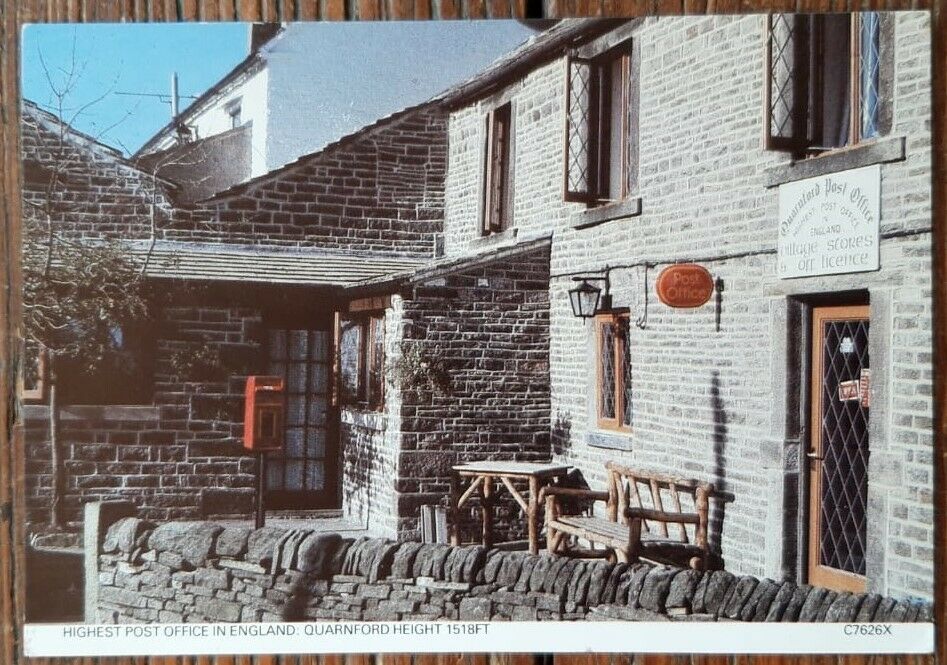

The Post Office and the sign from the gable end rescued by David Harrop
Despite its remote location, the village has its own brewery. Its products, usually only in bottles, can be found at the Flash Bar stores.

The Tea Pot Club was a mutual society set up in 1846 to provide sickness relief. The money was collected in a tea pot! It was wound up in the 1990s but every May, a marching band leads a parade whe a teapot is carried through the village.
The district had a reputation for criminal activity including cockfighting and prizefighting. Money is said to have been couterfeited giving rise to the term "Flash Money".

Cutting from the Ashton Reporter of 1938
Wednesday, 13 July 2022
A Derbyshire Miscellany
We are grateful to Vivian Dubé for the following articles about Derbyshire history:
This Wife for Sale
Between 100 and 200 years ago, husbands all over the country were selling their wives at bargain prices. The going rate was anything from half a pint of beer to 25 guineas (£26.25).
On 5 December 1771 a Derbyshire farmer, Thomas Bott, sold his wife for 1s.6d (7.5p), delivering her up in Derby market place with a halter round her neck. This was an average price at the time.
It was probably a farmer who swapped his wife for a sheepdog and a bale of hay at Chesterfield market.
By comparison, William Bradley of Matlock got gold and silver for his wife of 18 years. In 1773 he sold her at Wirksworth market for two guineas (£2.20p) and a silver watch.
Fifteen years later, again at Wirksworth, a breeches-maker sold his wife to a shoemaker for 5s 3d (26p). About 500 people witnessed the sale, making a great deal of noise as they congratulated the newly-joined couple.

Courtesy of Vivian Dubé; first posted on Facebook 11th July 2022
A New Mills Accident
Accident - The workpeople employed by Messrs, Hibbert and Alcock, Torr Mills, were thrown into a state of alarm on Wednesday morning last, by the sudden stoppage of the machinery, upon inquiring it was discovered that the boiler was fast emptying itself of its contents through the sludge pipe. To avoid a serious accident, it was found necessary to let off the steam and rake out the fire. In the consternation, the stoker who was endeavouring to do his utmost to prevent any damage, accidentally fell off a plank into the boiling water, and was seriously scalded on the back; one of the overlookers hearing his cries for help, went and in attempting to rescue him, accidentally fell in and scalded his legs and feet.
From an undated newspaper cutting
Torr Mill, built in the 1790s stood alongside the River Goyt and just below the Union Road Bridge. The mill was destroyed in a fire in 1912

How Hayfield Bridge Was Built
The handsome bridge over the river in the centre of Hayfield was built in the year 1837, of course, on the site of a more ancient and primitive structure. Cut in the central stone was the inscription:-
"Erected Anno Domini, M.M.C.C.C.X.X.X.V.I.I.
Samuel Worth, Architect.
George Bamford, Builder"
Samuel Worth, Architect.
George Bamford, Builder"
It was a big day when this central stone was laid, in which there is a cavity containing several articles, one of which, it is said, is a bottle of wine. The ancient bridge consisted of three arches, and a former bridge was washed away by a flood 110 years ago. On the 16th June 1858, a great flood occurred caused by an unusual downpour of rain on the top of Kinder Scout, where the water rose to the keystone of the arch, and suddenly the weir, which had stood time out of memory, was torn up, and the back parts of four houses swept away. It was at this flood that Mr Boardman, an old pensioner, who retired to bed early, had to be aroused, and was only got safely away from his bed chamber when the flood swept it away. The bridge is one that the inhabitants may be justly proud of, for the more pressure there is put upon it the firmer it stands. On the south side the arch rests upon solid rock, but great difficulty was experienced in getting a good foundation on the north side, owing to the quicksand which exists on that side of Hayfield. After sinking as deep as possible, bags of wool were pressed down for the foundation. A temporary bridge was made during its erection opposite the George Inn. The new bridge is considerably higher than the old structure, and consequently the road through the village was made much higher, which accounts for some of the houses being so much below the present road level. After the bridge was erected, Mr. George Rowbottom, of Marple, built the Bridge End Buildings (in 1838). Many can well remember the great festivities on the jubilee of the bridge, in 1887.
From an undated newspaper cutting

Hayfield Bridge c1900
The Needhams of Thornsett
Thornsett came to the Needham family by the marriage of Maud, daughter of Roger Mellor, to Thomas de Nedeham, elder son of Thomas, sometime around 1350. She brought with her part of the manor, which at that time was about 1300 acres. Thornsett is a hamlet near Glossop, Derbyshire and is currently in the parish of New Mills, although at the time the Needham's were resident there it was in Glossop parish. Thomas made Thornsett Hall his family residence and subsequently it was the family home of the Needham's for nearly 300 years and 9 generations of the family
Parts of the hall are still visible at Thornsett Hey Farm, notably a stone buttress, visible from the road, just west of the 'Printer's Arms'. A second buttress was demolished some time after the '30s since it was a hazard to traffic. The Thornsett Needham's were Foresters in the Royal Forest of the High Peak , officials acting for the King, and this is reflected in the bucks' heads on the various Needham coats of arms. Needham's of Thornsett are listed among the gentry of Derbyshire from 1360. During the early sixteenth-century, they also acquired the manors of Snitterton and Cowley, and descendants married well into county families. By the time that armorial claims were verified during the Herald's Visitation to Derbyshire in 1611, the family was recognised as Needham of Needham, Thornsett, Snitterton and Cowley.
However, like many good things it didn't last. George Needham (born before 1557), who inherited Thornsett and Cowley from his father William after WIlliams brother Ottiwell died, made some unwise investments in local mines together with his son Henry (born before 1577). This resulted in them selling the family estates ( including Thornsett) in 1613 to Sir Francis Needham of Melbourne Derbyshire, who immediately sold the estates on. Many works indicate that the Seniors of nearby Bridgetown acquired the properties; as a consequence Thornsett left the Needham family. George died in around 1615 and Henry moved to Wales , so by the time of the next Visitation in 1662/3, Needham's were no longer recorded in Derbyshire.
Sources
1. Source : Alastair Lack http://www.lackfamily.net/genealogy/index_genealogy.html
Parts of the hall are still visible at Thornsett Hey Farm, notably a stone buttress, visible from the road, just west of the 'Printer's Arms'. A second buttress was demolished some time after the '30s since it was a hazard to traffic. The Thornsett Needham's were Foresters in the Royal Forest of the High Peak , officials acting for the King, and this is reflected in the bucks' heads on the various Needham coats of arms. Needham's of Thornsett are listed among the gentry of Derbyshire from 1360. During the early sixteenth-century, they also acquired the manors of Snitterton and Cowley, and descendants married well into county families. By the time that armorial claims were verified during the Herald's Visitation to Derbyshire in 1611, the family was recognised as Needham of Needham, Thornsett, Snitterton and Cowley.
However, like many good things it didn't last. George Needham (born before 1557), who inherited Thornsett and Cowley from his father William after WIlliams brother Ottiwell died, made some unwise investments in local mines together with his son Henry (born before 1577). This resulted in them selling the family estates ( including Thornsett) in 1613 to Sir Francis Needham of Melbourne Derbyshire, who immediately sold the estates on. Many works indicate that the Seniors of nearby Bridgetown acquired the properties; as a consequence Thornsett left the Needham family. George died in around 1615 and Henry moved to Wales , so by the time of the next Visitation in 1662/3, Needham's were no longer recorded in Derbyshire.
Sources
1. Source : Alastair Lack http://www.lackfamily.net/genealogy/index_genealogy.html

THORNSETT OLD HALL DEMOLISHED - In the interests of public safety this old building known as "Barn End" has been demolished and the road at Thornsett widened. Few people seem to be aware that this old building was once part of one of the historic homes of the old officials of the Ancient Forest of the Peak. Yet this building was the homestead of the Needhams of Thornsett at a time when kings and nobles, knights and ladies, riding across unfenced country, over moorland and waste, through fen and ford, with hooded falcon and stooping hawks enjoyed what was for nearly a thousand years the national sport of England.
Cutting from the Ashton Reporter of 1938
Building the Midland Railway through Derbyshire
In the early years of the 1860s, the Midland Railway commissioned a series of photographs recording the construction of its new line between Rowsley and New Mills in Derbyshire. Later in the decade, building of the extension to London was photographed including St.Pancras Station.
The Science Museum has now released around 100 photographs under a creative commons licence and these may be viewed or downloaded from its website: https://bit.ly/3RrXqBN
Below is a selection of pictures from locations in Derbyshire.


Building Bugsworth Viaduct in about 1862

Building the tunnel at Chapel en le Frith, about 1862


Peep O' Day Bridge, Peak Forest Station, about 1862

Monsal Dale Viaduct, about 1864

Construction of a railway bridge, about 1862. Location unknown.

The River Wye, Derbyshire, about 1862
Tuesday, 5 July 2022
Brickbarn Pit - Shallcross Hall Colliery
Shallcross Hall Colliery, known locally as Brickbarn Pit was opened by the Buxton Lime Firms company in 1909. Coal was mined until February 1925 by which time the reserves had been exhausted. There was an additional mine entrance through an adit to the west of Buxton Road and this was known as Walker's Pit. Much of the output was taken out of the Walker's Pit adit and over a narrow bridge crossing the River Goyt nd straight into Botany Bleach Works. Coal was also raised from the Brickbarn shaft and taken down an inclined plane which led to Shallcross Sidings and also to the nearby Mevril Bleach Works . This shaft gave access to the Yard Seam which here was six feet thick. The workings extended over a large area although the coal beneath Shallcross Manor was not mined. A steam engine with a Galloway boiler provided power for the pithead and Worthington pumps kept the workings dry, releasing the water into the Goyt at the Walker adit and into the Blackbrook near Wheel Farm.
Mining in this area has a long history. The Shallcross Mines were among the oldest in North Derbyshire and had been worked by the Shallcross family since the mid seventeenth century providing much wealth. By the early nineteenth century, Thomas Boothman was mining at Shallcross and in the latter years of that century, local coal owners, Levi and Elijah Hall were working the Shallcross New Pit which was located to the south of The Manor.
The photographs below are courtesy of Arthur Philips.


Subscribe to:
Posts (Atom)